Texas allows permitless carry for non-prohibited adults 21+. A LTC is still available and is what other states recognize.
Permitless carry is legal in Texas
A non-prohibited adult aged 21 or older may
carry a concealed handgun without a permit
(since 2021).
Confirmed on DPS's own Firearm Carry Act page (re-fetched 15 September 2026, page still live, update notation 09/01/2021): HB 1927 "allows individuals who are 21 years of age or older and who can legally possess a firearm to carry a handgun without first obtaining a license," and "The Firearm Carry Act takes effect September 1, 2021." Verbatim current statute (Penal Code § 46.02(a), read 15 September 2026) makes it an offense to carry a handgun if the person "(1) intentionally, knowingly, or recklessly carries on or about his or her person a handgun; (2) at the time of the offense: (A) is younger than 21 years of age; or (B) has been convicted of an offense under Section 22.01(a)(1), 22.05, 22.07, or 42.01(a)(7) or (8) committed in the five-year period preceding the date the instant offense was committed; and (3) is not: (A) on the person's own premises or premises under the person's control; or (B) inside of or directly en route to a motor vehicle or watercraft that is owned by the person or under the person's control." So under-21s and persons with one of those five-year convictions must stay on their own premises/vehicle or hold an LTC. Limits applying to permitless and licensed carriers alike: § 46.02(a-1) bars carrying a handgun in plain view in one's own vehicle or watercraft unless the person is 21 or older or LTC-licensed AND the handgun is in a holster; § 46.02(a-5) bars intentionally displaying a handgun in plain view in a public place unless carried in a holster; § 46.02(a-6) bars carrying while intoxicated off one's own property/vehicle; § 46.02(a-7) makes carry by a person prohibited under § 46.04 an offense. Place restrictions in §§ 46.03 and 46.035 still apply. HB 1927 did NOT repeal the LTC program. Section 46.02 was not amended in 2025 or 2026.
Getting the permit anyway is still worth it for most people: other states recognize
the permit, not your residency, so without one you generally cannot carry
across state lines.
There are 11 details on this page we
could not confirm from a primary source.
Read what they are
before relying on this.
Requirements at a glance
Permit name
License to Carry a Handgun
Issuing authority
Texas Department of Public Safety (DPS), Regulatory Services Division – Handgun Licensing Program
System
shall-issue
Minimum age
18 — Statutorily the LTC minimum age is 21 — Tex. Gov't Code § 411.172(a)(2), read verbatim 15 September 2026, still says a person is eligible if the person "(2) is at least 21 years of age," and it has not been amended. However, DPS's live Eligibility FAQ (re-fetched 15 September 2026, statement still present) states: "A federal district court has ruled the Department can no longer apply the License to Carry statutory eligibility criteria that prohibit otherwise eligible 18-to-20 year-olds from obtaining the license. Firearms Policy Coalition, Inc. et al. v. Steven McCraw, No. 4:21-cv-1245-P. The Department will therefore no longer deny applications solely on the basis that the applicants are 18-to-20 years old." So in practice an 18-year-old can obtain a Texas LTC today. Two express statutory 18-to-20 pathways also exist independent of that injunction, both read verbatim today: § 411.172(g) — "Notwithstanding Subsection (a)(2), a person who is at least 18 years of age but not yet 21 years of age is eligible for a license to carry a handgun if the person: (1) is a member or veteran of the United States armed forces, including a member or veteran of the reserves or national guard; (2) was discharged under honorable conditions, if discharged..." — and § 411.172(i), the same "notwithstanding" language for a person protected under an active protective order under Title 4, Family Code, or Subchapter A, Chapter 7B, Code of Criminal Procedure, or an active magistrate's order for emergency protection under Art. 17.292, C.C.P. A license issued on the § 411.172(i) basis bears a "protective order designation" and expires at the earlier of the order's end or the holder's 22nd birthday (§ 411.1735(c)). CRITICAL AGE ASYMMETRY: permitless carry still requires 21 (Penal Code § 46.02(a)(2)(A)); an 18-20 year old must hold an LTC to carry lawfully in public. Federal law separately bars handgun purchases from FFLs under 21, and § 411.172(h) confirms the license "does not affect the person's ability to purchase a handgun or ammunition under federal law."
Training required
Yes — 4-6 hours, live fire required
State fee
$40 initial / $40 renewal — the state's own charge, not the total
Valid for
4 years
Processing time
DPS states it "will make every effort to issue your license within 60 days of receiving the completed application packet" (Application FAQ, re-fetched 15 September 2026). This tracks Tex. Gov't Code § 411.176(b) (record check and investigation completed not later than the 60th day) and § 411.177(b). If DPS must conduct a further record check because a question exists about the application's accuracy or the applicant's eligibility, § 411.176(d) gives it until the 180th day after receipt. Note the current platform migration: applications filed before the 12 September 2026 cutoff continue processing, but no new applications can be filed until RSD Connect launches 1 October 2026.
Fingerprints
Required
Non-resident permit
Available
What it actually costs
The state fee is rarely the whole bill. Fingerprinting is usually charged by a private
vendor, training is bought from an instructor, and several states add photographs,
notarisation or other requirements on top.
State fee
$40
Fingerprinting
$10–$45 — our estimate; no vendor publishes a rate
Training course
$75–$250 (private instructor)
Realistic total
$125–$335 — includes an estimated component
Forty dollars for four years is among the cheapest permits in the country, and Texas discounts it further across more categories than any other state — $25 for honorably discharged veterans, $0 for active military, serving peace officers, county jailers, correctional officers, clerks and prosecutors. The state also declines to influence the largest component, in terms: 'DPS does not regulate the cost charged by certified LTC instructors.' The course runs four to six classroom hours by statute, plus range instruction and a proficiency demonstration. On fingerprints Texas publishes a floor but not the rate: DPS says a law enforcement agency may charge up to $10 for ink-rolled prints under Human Resource Code 80.001, which is the low end above, while the IdentoGO electronic fee it directs most applicants to appears on no schedule DPS publishes. One caveat on timing rather than price: as of mid-September 2026 no new application can be filed at all until the RSD Connect platform launches on 1 October 2026.
Standard fee is $40 original and $40 renewal, confirmed 15 September 2026 against both the official DPS LTC Fee Table PDF and the DPS Application FAQ ("The standard fee for an original LTC is $40. The standard fee for a renewal of a LTC is $40."), and against Tex. Gov't Code § 411.174(a)(6), which requires "a nonrefundable application and license fee of $40 paid to the department." Statutory discounts/exemptions from the current fee table: senior citizen $40/$35 (§ 411.195); indigent $40/$35 (§ 411.194); honorably discharged veteran $25/$25 (§ 411.1951); active military and active Texas military member $0/$0 (§ 411.1951); juvenile probation or supervision officer $25/$25 (§ 411.1953); active Texas peace officer, active railroad peace officer, TSCRA active special ranger $0/$0 (§ 411.1991); TDCJ correctional officer $0/$0 (§ 411.1994); county jailer $0/$0 (§ 411.1993); honorably retired Texas peace officer, retired railroad peace officer, retired TSCRA special ranger $0/$0 (§ 411.199); retired federal officer $0/$0 (§ 411.199(g)); former reserve law enforcement officer $0/$0 (§ 411.1992); active judge $25/$25 and retired judge $25/$25 (§ 411.201); felony prosecuting attorney $0/$0 (§ 411.201(h)); county clerk and district clerk $0/$0 (§ 411.201); protective-order designation $40/$40 (§ 411.1735); at-risk designation $40/$40 (§ 411.184). Instructor certification and Online Course Provider certification are $100/$100 (§ 411.190), and School Safety Certification for qualified handgun instructors is $100 original with no renewal fee (§ 411.1901). The FAST/IdentoGO fingerprint vendor fee is extra and is not on the DPS table. Fees are non-refundable and non-transferable. Training class prices are set by private instructors — "DPS does not regulate the cost charged by certified LTC instructors." A voluntary Texas Veterans' Assistance Fund contribution may be added to the application (§ 411.1741). The fee table PDF carries no printed effective date.
How to apply
Confirm eligibility and lawful-presence requirements under Tex. Gov't Code ch. 411, subch. H, and check whether you qualify for a fee discount under a "Special Condition" status.
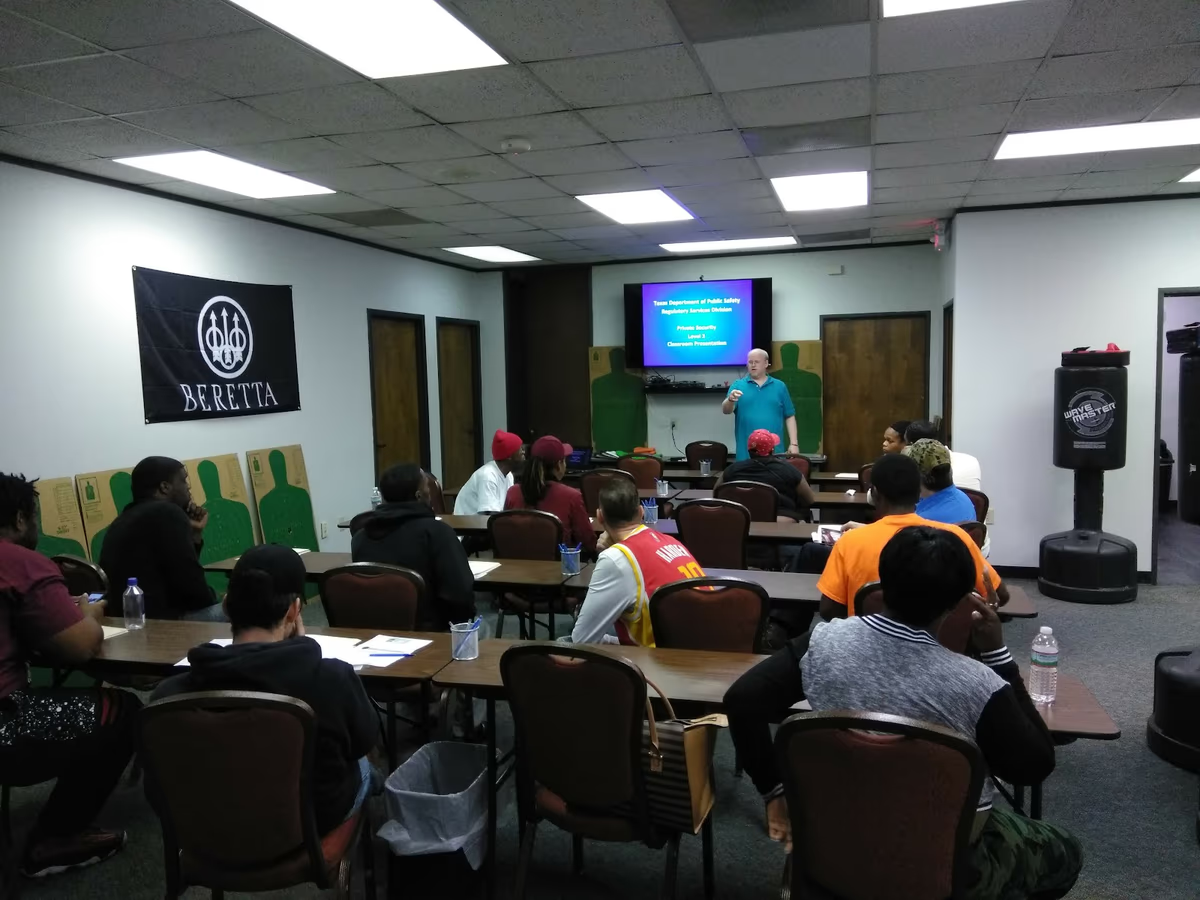
Complete the required training: 4-6 hours of classroom instruction (in person with a DPS-qualified LTC instructor, or online through a DPS-approved Online Course Provider), plus 1-2 hours of range instruction and a live-fire handgun proficiency demonstration with a Texas Qualified LTC Instructor, and pass the written exam. The range/proficiency portion may be completed before or after the online classroom portion.
Obtain your Certificate of Training: form LTC-100 (all in-person) or form LTC-101 (online classroom plus in-person range with a qualified instructor).
Submit the application through DPS's online licensing system and pay the fee ($40 standard). NOTE AS OF 15 SEPTEMBER 2026: online LTC applications are closed during a platform migration. DPS's last day to submit an application on the old system was 12 September 2026, and the last day to submit supporting documents for an existing application was 14 September 2026. The replacement platform, RSD Connect, goes live 1 October 2026 — "Beginning October 1, 2026, users can visit the DPS website to log in to the new licensing platform, and LTC applications will resume" — and "Applications submitted prior to the scheduled downtime will resume processing in the new system." Start from the DPS Handgun Licensing section page rather than a saved portal link: the old txapps.texas.gov LTC portal returns HTTP 404 (re-confirmed 15 September 2026) even though the DPS Licensing & Registration page still displays it as the "Submit an application online" link and carries no migration notice.
Be prepared to document your eligibility under the Personal Responsibility and Work Opportunity Reconciliation Act of 1996 for state or local public benefits, including a professional or commercial license. DPS adopted 37 Tex. Admin. Code §§ 6.11 and 6.16 (and § 6.46 for instructor renewals) effective 2 July 2026 to require every original and renewal applicant to "submit proof to the department of the applicant's eligibility" under that Act. In practice this means proof of U.S. citizenship or qualified-alien status.
Schedule and complete fingerprinting through Fingerprint Application Services of Texas (FAST) using the Service Code issued after you apply — book online or call (888) 467-2080. A separate vendor fee applies. Renewals normally reuse fingerprints already on file. Tex. Gov't Code § 411.174(a)(5) requires two complete sets of legible and classifiable fingerprints, and § 411.175 provides an alternative submission procedure for applicants in counties of 46,000 or fewer people who live more than 25 miles from a digital fingerprinting facility.
Upload supporting documents via the DPS RSD "Contact Us" portal: the LTC-100 or LTC-101, documents for any special-condition discount, lawful-presence and PRWORA documentation, and arrest dispositions if applicable. Non-residents must also submit form LTC-6, two passport-style photos, and a copy of their out-of-state driver license or state ID.
Wait for the background check. DPS aims to issue within 60 days of a complete packet, plus up to 180 days from receipt if it must conduct a further record check under § 411.176(d).
Currently charged by information or indictment with a Class A or Class B misdemeanor (or equivalent), an offense under Penal Code § 42.01 (disorderly conduct), or a felony (§ 411.172(a)(4))
Fugitive from justice for a felony or a Class A/B misdemeanor (§ 411.172(a)(5))
Chemically dependent person (§ 411.172(a)(6))
Incapable of exercising sound judgment with respect to the proper use and storage of a handgun (§ 411.172(a)(7)) — may be referred to the DSHS Medical Advisory Board; new § 411.1765 (added by H.B. 1234, 89th Leg., R.S., eff. 1 Sept. 2025) now bars DPS from denying on this ground without first giving the applicant written notice of the specific reason and at least 30 days to submit supplemental materials, which must then go back to the full medical advisory board panel
Conviction of a Class A or Class B misdemeanor, or of disorderly conduct under Penal Code § 42.01, in the five years preceding application (§ 411.172(a)(8)) — this includes DWI, which is at least a Class B misdemeanor
Deferred adjudication counts as a conviction for LTC purposes (§ 411.171(4), § 411.1711); a dismissal without prosecution does not
Not fully qualified under federal and state law to purchase a handgun, i.e. any 18 U.S.C. § 922(g) disqualifier (§ 411.172(a)(9))
Final determination of delinquency in child support administered or collected by the Attorney General (§ 411.172(a)(10))
Final determination of delinquency in taxes or other money owed to the state or a political subdivision (§ 411.172(a)(11))
Currently restricted under a court protective order, or subject to a restraining order affecting the spousal relationship other than one solely affecting property interests (§ 411.172(a)(12))
Adjudicated in the 10 years preceding application as having engaged in delinquent conduct violating a felony-grade penal law (§ 411.172(a)(13))
Material misrepresentation or failure to disclose a material fact on the application (§ 411.172(a)(14))
Not a legal resident of Texas for the six-month period preceding application and not otherwise eligible as a non-resident (§ 411.172(a)(1), § 411.173(a))
Inability to document eligibility under the Personal Responsibility and Work Opportunity Reconciliation Act of 1996 for state or local public benefits, including a professional or commercial license — newly required of original and renewal LTC applicants by 37 Tex. Admin. Code §§ 6.11 and 6.16 as adopted effective 2 July 2026
Where to get the required training
Texas publishes an official list of certified instructors. That list is
authoritative — a certificate from an instructor who is not on it may not be accepted.
View the official instructor list
Training providers in Texas
Businesses in our directory that offer firearms training. These are
not state-verified as certified permit instructors —
check against the official list above, or ask the provider directly.
Texas recognizes permits from 49 other jurisdictions.
Alaska, Alabama, Arkansas, Arizona, California, Colorado, Connecticut, District of Columbia, Delaware, Florida, Georgia, Hawaii, Iowa, Idaho, Illinois, Indiana, Kansas, Kentucky, Louisiana, Massachusetts, Maryland, Maine, Michigan, Minnesota, Missouri, Mississippi, Montana, North Carolina, North Dakota, Nebraska, New Hampshire, New Jersey, New Mexico, Nevada, New York, Ohio, Oklahoma, Oregon, Pennsylvania, Rhode Island, South Carolina, South Dakota, Tennessee, Utah, Virginia, Washington, Wisconsin, West Virginia, Wyoming
34 jurisdictions honor a Texas permit
Derived from what each of those states officially publishes.
Alaska, Alabama, Arkansas, Arizona, Colorado, Delaware, Florida, Georgia, Iowa, Idaho, Indiana, Kansas, Kentucky, Louisiana, Michigan, Minnesota, Missouri, Mississippi, Montana, North Carolina, North Dakota, Nebraska, New Mexico, Nevada, Ohio, Oklahoma, Pennsylvania, South Dakota, Tennessee, Utah, Virginia, Wisconsin, West Virginia, Wyoming
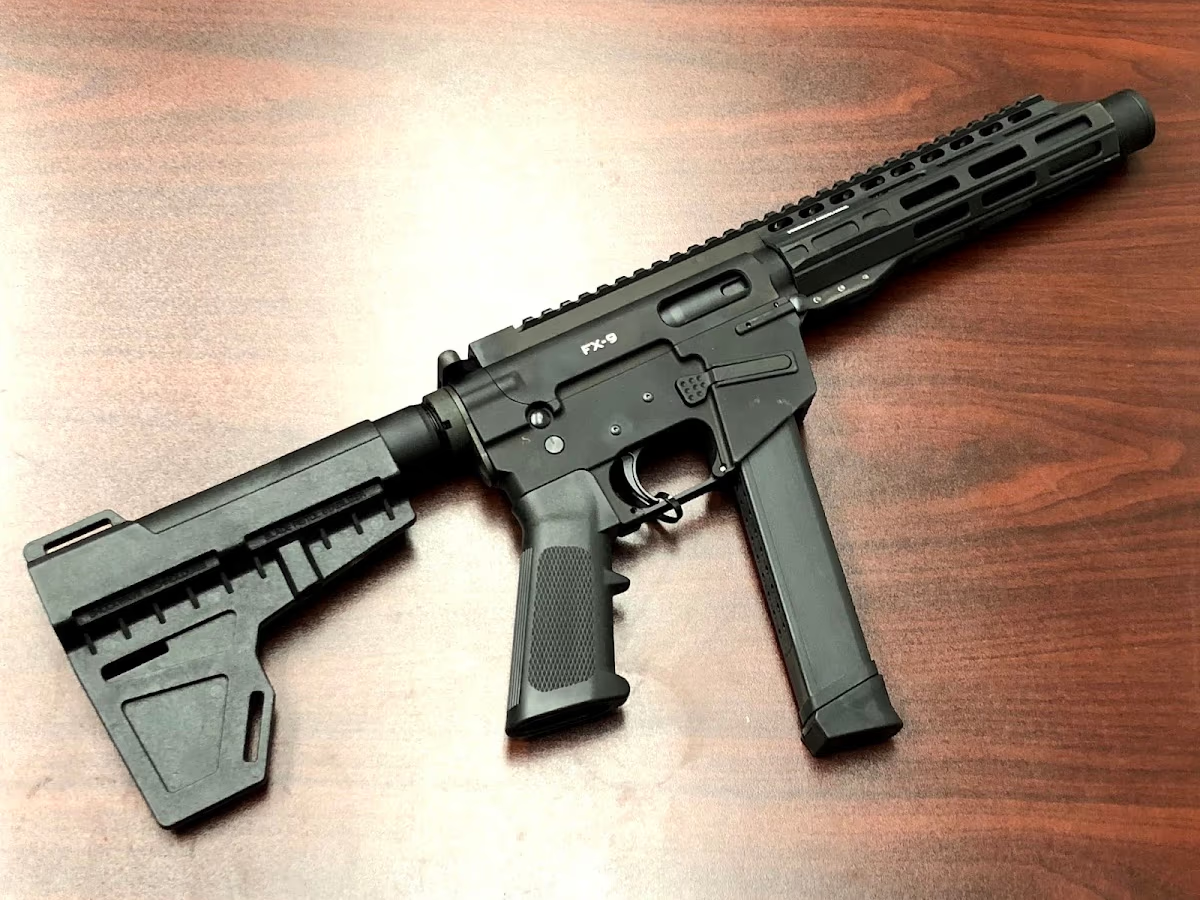
Texas has no statute prohibiting an eligible person from building or assembling a firearm for personal use, and no state serial-number, marking, or registration requirement for a self-made firearm. A full-text search of the current Texas Penal Code ch. 46 (Weapons), performed 15 September 2026 on the official chapter text, returns ZERO occurrences of the string "serial," and the chapter contains no unfinished-frame/receiver provision and no state firearms registry provision. The only manufacturing prohibition is § 46.05, which makes it an offense to intentionally or knowingly possess, MANUFACTURE, transport, repair, or sell an explosive weapon, machine gun, short-barrel firearm, armor-piercing ammunition, a chemical dispensing device, a zip gun, a tire deflation device, or an improvised explosive device — unless the item is registered in the federal National Firearms Registration and Transfer Record or is otherwise not subject to that requirement. (H.B. 957, 87th Leg., 2021, repealed the firearm-silencer entry from § 46.05, so suppressors are no longer a Texas prohibited weapon.) Building a machine gun or short-barrel firearm at home therefore remains a Texas felony absent NFA registration. FEDERAL law applies independently regardless of Texas law: the National Firearms Act, 18 U.S.C. § 922(o) (machine guns), § 922(p) (undetectable firearms), § 922(r), the prohibition on manufacturing for sale without an FFL, and ATF's frame/receiver rule. Texas also broadly preempts local firearm regulation (Tex. Local Gov't Code § 229.001), so cities and counties may not impose their own serialization or registration rules.
Tex. Penal Code ch. 46 (esp. § 46.05, Prohibited Weapons); no Texas serialization or registration statute
RECIPROCITY CONFLICT (most important caveat, re-checked 15 September 2026 and STILL UNRESOLVED BY DPS): Texas's controlling statute and its own agency chart disagree. The codified text of Tex. Gov't Code § 411.173(b), which I read verbatim today, says flatly that "A valid license to carry a handgun issued by any other state is recognized in this state," and the section history shows subsections (c) and (d) — the old proclamation/agreement machinery — "Repealed by Acts 2025, 89th Leg., R.S., Ch. 483 (S.B. 706), Sec. 2, eff. September 1, 2025." But the DPS "State Reciprocity Information" page is still headed September 11, 2020, still displays the pre-2025 chart, and nowhere mentions S.B. 706 or universal recognition; it still shows Maine, New Hampshire, Oregon, Vermont, D.C. and the territories as "No Agreement" and still states that Wisconsin license holders "will not be allowed to carry in Texas" and treats Minnesota the same way. The DPS Reciprocity FAQ likewise still frames recognition as depending on "a state that has reciprocity with Texas." I searched for and did not find ANY DPS page, news release, or updated chart acknowledging S.B. 706. I resolved the conflict in favor of the statute, because a statute controls over a stale agency web page and the amended subsection is unconditional — but this remains an unresolved contradiction between the law and the issuing agency's live publications, and it is the weakest point in this record. Anyone relying on an out-of-state license in Texas — especially an 18-20 year old, for whom permitless carry is unavailable — should confirm with DPS directly and should not assume a Texas officer is working from the amended statute rather than the published chart.
APPLICATION CHANNEL IN TRANSITION (re-verified 15 September 2026): no new LTC application can be filed online right now. DPS is replacing the LTC and CAP licensing platform with RSD Connect, live 1 October 2026; the last day to apply on the old system was 12 September 2026 and the last day to submit supporting documents for a pending application was 14 September 2026. DPS says applications filed before the downtime resume processing in the new system. The old portal, https://txapps.texas.gov/txapp/txdps/ltc/, returns HTTP 404 (confirmed by direct request today). A NEW PROBLEM found today: the DPS "Licensing & Registration" page — the URL this record uses as officialApplicationUrl — carries no migration notice at all and still presents that dead txapps link as the "Submit an application online" step, so an applicant following the official page will hit a 404 with no explanation. Only the DPS news release documents the outage. I found no DPS page giving a post-1-October application URL, so officialApplicationUrl remains the section page; it will need re-checking after 1 October 2026.
minAge is reported as 18 based on DPS's currently published Eligibility FAQ describing the Firearms Policy Coalition, Inc. v. McCraw injunction (N.D. Tex., No. 4:21-cv-1245-P), which I confirmed is still live on the DPS site today. The statutory text of § 411.172(a)(2) still reads "at least 21 years of age" and has not been amended. I could not independently confirm the injunction's appellate posture from a court source today: the CourtListener docket returned HTTP 403 and the govinfo case page returned no content. Non-primary sources indicate Texas noticed an appeal (5th Cir. No. 22-10898) and withdrew it in December 2022, which would make the August 2022 judgment final and unappealed, and nothing I found suggests the judgment has been stayed or vacated — but I did not read a docket entry saying so. The operative basis for reporting 18 is therefore the issuing agency's own live non-enforcement statement, not a verified court record. If the injunction were lifted, the answer would revert to 21 except for the § 411.172(g) military and § 411.172(i) protective-order pathways. Permitless carry unambiguously requires 21 either way.
Whether recognition under § 411.173(b) extends to licenses issued by U.S. territories (PR, GU, VI, MP, AS) is my inference from the Code Construction Act definition of "State" (§ 311.005(7)), not from any Texas source naming those jurisdictions. Territories are therefore excluded from the honors array. I did not re-read § 311.005 today; that definition is carried forward from the 2026-08-10 research pass, though the live URL still resolves.
Vermont is excluded from the honors array because Vermont issues no concealed-carry license at all, not because Texas declines to recognize one. That is my characterization, not a Texas statement.
The live statutes.capitol.texas.gov site is a JavaScript single-page application that serves no statute text to non-browser clients — verified again today, when both the Government Code ch. 411 and Penal Code ch. 46 URLs returned byte-identical 28 KB shells with no statutory text. Verbatim statutory text was therefore read from Internet Archive captures of the official pages: Gov't Code ch. 411 captured 2025-12-05 and Penal Code ch. 46 captured 2025-12-02. (These supersede the capture dates cited in the previous version of this record; the Archive's monthly captures from January 2026 onward contain only the empty shell, so December 2025 is the most recent readable text.) Both captures post-date the 89th Legislature's September 1, 2025 effective dates, and the next Texas regular session is not until 2027, so no intervening statutory amendment is expected — but I could not read live 2026 statutory text directly to confirm, and a 2026 special session, if one occurred, would not be reflected.
A 2026 administrative change was found that the previous research pass missed: DPS adopted amendments to 37 Tex. Admin. Code §§ 6.11, 6.16 and 6.46 effective 2 July 2026, requiring original and renewal LTC applicants (and instructor-certification renewal applicants) to submit proof of eligibility under the Personal Responsibility and Work Opportunity Reconciliation Act of 1996 for state or local public benefits including a professional or commercial license. I read this in the official Texas Register adopted-rules issue of 26 June 2026. I did NOT find a DPS page or form explaining what documents satisfy this requirement in practice, so the applicationSteps entry describes the requirement but not the accepted proof. Applicants should expect to document citizenship or qualified-alien status.
Several DPS pages (the reciprocity chart, the Firearm Carry Act page, and multiple FAQs) display stale header dates — September 2020, July 2021 — while containing newer content, so page dates are not a reliable currency signal for any DPS page. Conversely the reciprocity chart's stale date does appear to reflect genuinely stale content.
validityYears is given as 4 because that is the initial term, but § 411.183 is more precise: an initial license expires on the earlier of the holder's first birthday occurring after the fourth anniversary of issuance or the expiration of the holder's lawful presence in the United States (so 4-5 years in practice for a citizen), or the first anniversary of issuance if there is no definite lawful-presence expiration date; a renewed license expires on the holder's birthdate five years after the previous license expired. Protective-order-designated licenses expire at the holder's 22nd birthday or when the order ends (§ 411.1735(c)).
Fingerprints are required for original applications (§ 411.174(a)(5) requires two complete sets); renewals normally reuse prints on file, so a renewal applicant may not need new prints. The FAST/IdentoGO fingerprint vendor fee is not published on the DPS fee table and is not included in the fee figures.
For home manufacture I verified the absence of a Texas serialization or registration requirement by full-text search of Penal Code ch. 46 only (zero occurrences of "serial," re-confirmed today). I did not exhaustively search every other Texas code for a self-manufactured-firearm provision, though Texas's strong preemption posture and the absence of any such provision in the weapons chapter make one very unlikely. Federal requirements (NFA, 18 U.S.C. § 922(o)/(p)/(r), manufacturing-for-sale licensing, ATF's frame/receiver rule) are unaffected by Texas law and were not researched here.