Oregon requires a Concealed Handgun License to carry. It is shall-issue, the minimum age is 21, and training is required.
Requirements at a glance
Permit name
Concealed Handgun License
Issuing authority
County sheriff of the applicant's county of residence (no statewide issuing agency)
System
shall-issue
Minimum age
21 — ORS 166.291(1)(b), read verbatim: the sheriff shall issue the license if the person 'Is at least 21 years of age.' No lower age tier and no military exception for the CHL. Separately, ORS 166.250(2)(b) permits a US citizen over 18 residing in or temporarily sojourning in Oregon to possess a handgun at their own residence or place of business without any license.
Training required
Yes
State fee
$115 initial / $75 renewal — the state's own charge, not the total
Valid for
4 years
Processing time
Up to 45 days by statute. ORS 166.292(1), read verbatim: if the application is approved the sheriff shall issue and deliver the license 'within 45 days of the application'; ORS 166.293(1) requires a written denial within 45 days and allows court review if no decision issues in 45 days. Lane County Sheriff: 'ORS 166.292 allows the Sheriff 45 days to review and issue the permit on a CHL application. Due to current workload issues, it is safe to assume that it will take 45 days.' The real-world bottleneck is the appointment, not the statutory clock: most counties require an in-person appointment for fingerprinting and photo, and Lane County advises that appointments 'should be booked a minimum of six months in advance.' Washington County takes new applications by appointment and renewals as walk-ins Monday-Friday 9am-3pm. An expired license stays valid up to 45 extra days after a timely renewal application under ORS 166.295(1)(b).
Fingerprints
Required
Non-resident permit
Available
What it actually costs
The state fee is rarely the whole bill. Fingerprinting is usually charged by a private
vendor, training is bought from an instructor, and several states add photographs,
notarisation or other requirements on top.
State fee
$115
Fingerprinting
$0 — our estimate; no vendor publishes a rate
Training course
$75–$250 (private instructor)
Realistic total
$190–$365 — includes an estimated component
Now fully reconciled against the statute. ORS 166.291(5)(a) sets a single all-in figure for a new license: $100 to the sheriff plus $15 to the Department of State Police for the fingerprint check = $115, which is exactly what the Lane County and Washington County fee schedules publish. Fingerprinting is therefore NOT an extra line item -- the prior pass's $15-$45 fingerprint estimate double-counted the statutory $15 that is already inside the $115, so it is now zero. Renewals are $75 and require no fingerprints at all under ORS 166.295(1)(a). The only genuinely variable cost is the competency course, and even that can be $0 for an applicant who already holds an approved hunter-education card or can document handgun training through military service or organized shooting competition under ORS 166.291(1)(f); the $75-$250 range reflects a commercially purchased CHL class. Lane County adds a 3% charge on debit or credit card payment. A transfer between Oregon counties is $30 and a duplicate for loss or address change is $15.
STATUTE-VERIFIED on 2026-09-15. ORS 166.291(5)(a), read verbatim: 'Fees for concealed handgun licenses are: (A) $15 to the Department of State Police for conducting the fingerprint check of the applicant. (B) $100 to the sheriff for the initial issuance of a concealed handgun license. (C) $75 to the sheriff for the renewal of a concealed handgun license. (D) $15 to the sheriff for the duplication of a license because of loss or change of address.' A new license therefore costs $100 + $15 = $115 all-in, and the $15 fingerprint check is INSIDE that $115, not on top of it. A renewal is $75 and requires no fingerprints at all (ORS 166.295(1)(a)), so no $15 State Police component applies. These amounts were set by SB 554 (2021), Or. Laws ch. 146 sec. 12. Two county sheriff fee schedules match the statute exactly: Lane County -- new $115, renewal within Lane County $75, transfer within Oregon but new to Lane County $30, address change or replacement $15; Washington County -- new $115, renewal $75, transfer $30, transfer-and-renew $90. Statutory transfer and duplicate amounts beyond the four listed in ORS 166.291(5)(a) are set elsewhere or by the sheriff. Caution: some county pages remain stale and understate the statutory fee -- the Josephine County Sheriff's page still advertises 'Total Cost for Renewal Application: $50,' which is $25 below the amount ORS 166.291(5)(a)(C) requires. Lane County adds a 3% charge for debit or credit card payment and does not accept American Express. Confirm with your own county sheriff before applying.
How to apply
Confirm eligibility under ORS 166.291(1): at least 21, US citizen or qualifying legal resident noncitizen, resident of the county (or a contiguous-state resident granted the ORS 166.291(8) waiver), no disqualifying criminal, restraining-order, mental-health or juvenile history.
Complete a qualifying handgun competency showing under ORS 166.291(1)(f) -- hunter education with a handgun component, an NRA course, a law-enforcement or community-college course, a course by an NRA- or law-enforcement-certified instructor, or documented equivalent experience through organized shooting competition or military service. Obtain the certificate; check with your sheriff first, as some counties reject specific vendors (Josephine County: 'We do not accept certificates obtained through American Firearms Training').
Locate your county sheriff's CHL page. There is no statewide application -- Oregon State Police confirms 'Applications for Concealed Handgun Licenses are processed by the Sheriff's office in the applicant's county of residence.' Several counties (e.g. Benton, which moved to a third-party vendor on 12 August 2024) route applications through an online portal; others require paper.
Book an in-person appointment. Most counties require one for new applications, and some for renewals and transfers. Lane County advises booking 'a minimum of six months in advance'; Washington County takes new applications by appointment and renewals as walk-ins 9am-3pm weekdays.
Attend the appointment with two pieces of current identification (one bearing a photograph), proof of county residency, your training certificate, and two character references -- ORS 166.291(3)(a) and (4) require the application to list your residence addresses for the previous three years and to be signed; making false statements on it is a misdemeanor.
Submit to fingerprinting and photographing by the sheriff. ORS 166.291(3)(b) requires it and directs the sheriff to request a nationwide Department of State Police / FBI fingerprint-based records check where necessary; the FBI must return the fingerprint cards and keep no record of the prints. Oregon State Police notes the license 'requires the applicant to submit a fingerprint card for a nationwide criminal records search.'
Pay the statutory fee -- $115 for a new license ($100 to the sheriff plus $15 to the Department of State Police for the fingerprint check) or $75 for a renewal, under ORS 166.291(5)(a). Many sheriffs take payment in person only; Lane County accepts cash, check or card, adds a 3% charge for debit or credit card use, and does not accept American Express.
Wait for the sheriff's investigation and criminal history check. ORS 166.292(1) gives the sheriff 45 days to issue; ORS 166.293(1) requires a written denial by certified mail within 45 days, and if no decision issues within 45 days you may seek circuit court review.
Receive the license, valid four years from the date of issue under ORS 166.292(4). The sheriff must also give you a list of places where carrying a concealed handgun is prohibited or restricted (ORS 166.292(6)). Renew before expiration -- a timely renewal application keeps an expired license valid up to 45 more days (ORS 166.295(1)(b)) -- and note renewing early does not extend the term. Moving to a new Oregon county requires a $30 transfer; report any address change so the sheriff can issue a duplicate ($15).
Not a US citizen, or a legal resident noncitizen who cannot document continuous residency in the county for at least six months plus a written declaration to United States Citizenship and Immigration Services of intent to acquire citizenship, with proof presented to the sheriff at application (ORS 166.291(1)(a))
Not a resident of the county where applying (ORS 166.291(1)(c)) -- county residency is proved by Oregon driver license, voter notification card, property lease/ownership documentation, or an Oregon tax return showing a county address (ORS 166.291(9)); the sheriff MAY waive this for a contiguous-state resident with a compelling business interest or other legitimate demonstrated need (ORS 166.291(8))
Outstanding warrants for arrest (ORS 166.291(1)(d))
Free on any form of pretrial release (ORS 166.291(1)(e))
Ever convicted of a felony, or found guilty except for insanity under ORS 161.295 of a felony (ORS 166.291(1)(g))
Convicted of a misdemeanor, or found guilty except for insanity under ORS 161.295 of a misdemeanor, within the four years prior to the application (ORS 166.291(1)(h))
Committed to the Oregon Health Authority under ORS 426.130 (ORS 166.291(1)(i))
Found to be a person with mental illness and subject to an ORS 426.130 order prohibiting purchase or possession of a firearm (ORS 166.291(1)(j))
Discharged from the jurisdiction of the juvenile court within the last four years, where the juvenile adjudication was for an act that if committed by an adult would be a felony or a misdemeanor involving violence as defined in ORS 166.470 (ORS 166.291(1)(k))
Convicted of an offense involving controlled substances, or participation in a court-supervised drug diversion program, subject to a narrow single-marijuana-offense exception (ORS 166.291(1)(L))
Subject to a citation issued under ORS 163.735 (stalking) or an order issued under ORS 30.866, 107.700 to 107.735 (Family Abuse Prevention Act restraining orders) or 163.738 (ORS 166.291(1)(m))
Received a dishonorable discharge from the Armed Forces of the United States (ORS 166.291(1)(n))
Required to register as a sex offender in any state (ORS 166.291(1)(o))
Presently subject to an order under ORS 426.133 -- assisted outpatient treatment -- prohibiting the person from purchasing or possessing a firearm (ORS 166.291(1)(p))
Sheriff's limited discretion: under ORS 166.293(2) a sheriff may, notwithstanding ORS 166.291(1) and subject to court review under ORS 166.293(5), deny or revoke a license on reasonable grounds that the applicant has been or is reasonably likely to be a danger to self or others, or to the community at large
Relief note: a person granted relief under ORS 166.273, 166.274 or 166.293 or 18 U.S.C. 925(c), or whose record has been expunged, is not subject to the disabilities in ORS 166.291(1)(g) to (L) (ORS 166.291(2))
Where to get the required training
Oregon does not publish a central list of certified instructors. Confirm directly
with County sheriff of the applicant's county of residence (no statewide issuing agency) that a course will be accepted before you pay for it.
Training providers in Oregon
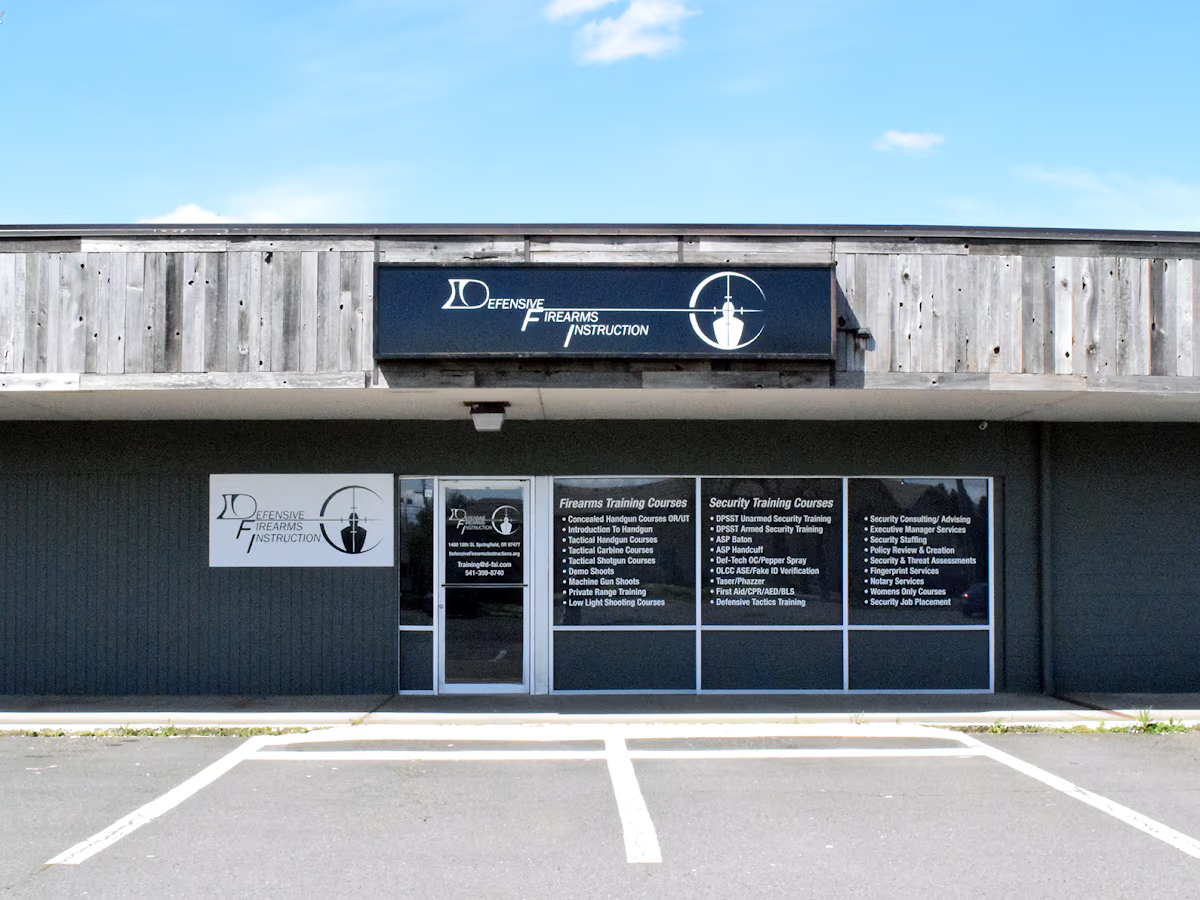
Businesses in our directory that offer firearms training. These are
not state-verified as certified permit instructors —
check against the official list above, or ask the provider directly.
Oregon recognizes no out-of-state carry permits. A permit from another state does not authorize you to carry here. Oregon does, however, issue its own license to non-residents — see the application details above.
23 jurisdictions honor a Oregon permit
Derived from what each of those states officially publishes.
Alaska, Alabama, Arkansas, Arizona, Florida, Iowa, Idaho, Indiana, Kansas, Kentucky, Michigan, Missouri, Mississippi, Montana, North Carolina, Nebraska, Ohio, Oklahoma, South Dakota, Tennessee, Texas, Utah, Virginia
Oregon has no statute that criminalizes the act of building a firearm for personal use as such, but HB 2005 (2023), Or. Laws 2023 ch. 229, made it effectively impossible to build and keep an unserialized one. Text read verbatim on 2026-09-15. ORS 166.266(1): 'A person may not knowingly possess, offer for sale, sell or transfer a firearm unless the firearm has been imprinted with a serial number by a federally licensed firearm manufacturer, importer or dealer, or a gunsmith with a federal firearms license, in accordance with federal law.' Critically, a private builder may NOT self-apply a serial number -- the imprinting must be done by an FFL. Exceptions in ORS 166.266(2): antique firearms; firearms manufactured prior to October 22, 1968; firearms rendered permanently inoperable; sale, offer or transfer to, or possession by, a person licensed as a manufacturer, importer or dealer under 18 U.S.C. 923; and a gunsmith taking possession solely to imprint the serial number. Penalties escalate under ORS 166.266(3): Class B violation for a first offense, Class A misdemeanor with one prior conviction under ORS 166.265, 166.266 or 166.267, and Class B felony with two or more such priors; the firearm is forfeited under ORS 166.266(4). ORS 166.267(1) separately bars importing, offering for sale, selling or transferring an unfinished frame or receiver unless the person is an FFL dealer under 18 U.S.C. 923, the manufacturer's name and an individual serial number are conspicuously placed on it per 18 U.S.C. 923(i) and 27 C.F.R. 478.92, and 18 U.S.C. 923(g) records are kept; penalties are Class B violation, then Class A misdemeanor with one prior, then Class B felony with two or more. ORS 166.267(2) bars knowing POSSESSION of an unserialized unfinished frame or receiver unless the person is a federally licensed gun manufacturer and the part is an unfinished part within a manufacturing process that includes serialization; penalties are Class B violation, Class A misdemeanor with one prior, and Class C felony with two or more -- so the 80% receiver supply chain is closed. ORS 166.265 makes manufacturing, importing, offering for sale, selling or transferring an undetectable firearm a Class B felony and knowing possession a Class A misdemeanor (Class B felony with one or more priors), with forfeiture. Bottom line: you may assemble a firearm for personal use, but to possess it lawfully it must bear a serial number imprinted by an FFL manufacturer, importer, dealer or FFL gunsmith. There is no state firearm registration and no requirement to register a self-made firearm with any Oregon agency -- the requirement is serialization, not registration.
MEASURE 114 IS NOT IN EFFECT TODAY, AND CANNOT OPERATE BEFORE 1 JANUARY 2028. This resolves the prior pass's open question. Two independent reasons, both from primary sources. (a) By statute: Oregon Laws 2026, chapter 120 (HB 4145), sections 1 and 2, effective on passage and approved by the Governor on 7 April 2026, amended sections 10 and 13 of chapter 1, Oregon Laws 2023 to strike 'March 15, 2026' and substitute 'January 1, 2028' -- so the permit-to-purchase provisions (ORS 166.503, 166.505 and 166.508 and the amendments to ORS 166.412, 166.435, 166.436 and 166.438) apply only to firearm transfers conducted on or after 1 January 2028, and the large-capacity magazine provisions of ORS 166.355 apply only to conduct on or after 1 January 2028. (b) By court order: the Harney County Circuit Court permanently enjoined the measure in Arnold v. Kotek (Case No. 22CV41008); the Oregon Court of Appeals reversed on 12 March 2025 (Appellate Case No. A183242); the Oregon Supreme Court heard oral argument on 6 November 2025 and, as of this verification on 15 September 2026, has NOT issued an opinion -- the Oregon Judicial Department's published Supreme Court opinion list runs through 3 September 2026 and contains no Arnold v. Kotek decision, and Or. Laws 2026 ch. 120 sec. 3 (7 April 2026) still speaks of 'proceedings pending before the Oregon Supreme Court concerning the constitutionality of Ballot Measure 114 (2022).' None of this touches any carry field in this record: Measure 114 governs ACQUIRING a firearm and magazine capacity, not carrying, and the CHL is a separate license with its own statutes. A Supreme Court ruling could arrive at any time; if it upholds the measure, the 1 January 2028 operative date still applies, and if it strikes the measure down the dates become moot.
The official ORS chapter 166 web page is the 2025 Edition and still PRINTS the superseded date 'March 15, 2026' in the notes following ORS 166.355 and ORS 166.438. Its banner warns that 'Uncodified sections printed in this chapter were amended or repealed by the Legislative Assembly during its 2026 regular session' and links to Oregon Laws 2026 chapter 120, which is the controlling text. A reader who consults only the ORS page will see a stale Measure 114 date.
Anyone reading press coverage of HB 4145 should use the enacted chapter, not the reporting. The House-passed version described in February 2026 news coverage would also have raised the Measure 114 permit-to-purchase fee from $65 to $150 and the renewal from $50 to $110, extended the decision window from 30 to 60 days, and set a separate 2027 magazine date. None of that survived into Oregon Laws 2026 chapter 120 as enacted, which contains only four sections: the two date changes to 1 January 2028, the non-mootness declaration, and the emergency clause. Those figures also have nothing to do with CHL fees, which are set separately by ORS 166.291(5)(a).
No statewide application URL exists. Oregon has 36 county sheriffs, each with its own page, portal, appointment process and payment rules; several use third-party online vendors (Benton County moved to one on 12 August 2024). The officialApplicationUrl field points to the Oregon State Police page that directs applicants to their county sheriff, because there is no better statewide target.
instructorRegistryUrl is null because Oregon publishes no state-certified CHL instructor list. ORS 166.291(1)(f) defers to NRA certification or law-enforcement-agency certification rather than a state credential, so there is no central registry and acceptance is county-by-county. Josephine County rejects American Firearms Training certificates; Lane County points applicants to the Oregon State Shooting Association's CHL certificate course at oregonchl.org, which is a private shooting-sports organization rather than a government registry.
ORS 166.377(1) and (3), as amended by SB 243 (2025), let university, community college and school district boards switch off the CHL affirmative defense on school grounds, and let cities, counties and ORS 198.010 districts switch it off for buildings they use for official meetings -- making possession there a Class A misdemeanor under ORS 166.370(1)(b) instead of a defense. Each adopting body must post signs at normal points of entry and publish a list on its website, but I could not enumerate which local governments have actually adopted such policies. CHL holders must check each jurisdiction's own website.
Nonresident CHLs are discretionary and county-dependent, so nonResidentPermitAvailable: true overstates how easy this is. ORS 166.291(8) says only that 'The county sheriff MAY waive the residency requirement in subsection (1)(c) of this section for a resident of a contiguous state who has a compelling business interest or other legitimate demonstrated need' -- there is no entitlement. Note this is subsection (8); the prior pass cited ORS 166.291(2), which is actually the relief-from-disabilities provision. Practice varies sharply: Washington County will consider applicants from WA, ID, NV or CA who explain in writing a compelling need correlating specifically to Washington County and how often they visit, and requires that explanation again at each renewal; Lane County 'does not border any other States and consequently does not issue to Out of State Residents'; Josephine County states 'Until further notice, we will no longer be able to accept out-of-state applications,' renewing existing out-of-state licenses only. I did not survey all 36 counties.
Open carry is governed by a patchwork of local ordinances. ORS 166.250(3) establishes that firearms carried openly in belt holsters are not 'concealed' for purposes of the state offense, but Portland, Multnomah County, Salem, Beaverton, Tigard, Oregon City and Independence are commonly cited as restricting loaded firearms in public, with CHL holders exempt. I did not verify each of those ordinances against the municipality's own code in this pass.
On home manufacture, no Oregon statute expressly says 'you may build a firearm for personal use.' selfManufactureAllowed is true because no provision criminalizes the act of building itself -- the prohibition in ORS 166.266(1) attaches to POSSESSION, sale or transfer of a firearm lacking an FFL-imprinted serial number. This is an inference from the absence of a prohibition, not from affirmative statutory permission, and the practical effect is that a home-built firearm must be taken to an FFL gunsmith for serialization before it can lawfully be possessed.
The federal challenge to Measure 114, Oregon Firearms Federation v. Kotek (D. Or., appealed to the Ninth Circuit after Judge Immergut upheld the measure), was not checked against the Ninth Circuit docket in this pass. It is not load-bearing for this record: the 1 January 2028 operative date in Oregon Laws 2026 chapter 120 controls regardless of how the federal appeal comes out, and neither case concerns the CHL or carry.
County fee pages can lag the statute in either direction, so the $115 / $75 figures are what ORS 166.291(5)(a) REQUIRES, not a guarantee of what a given counter will charge. Josephine County currently advertises a $50 renewal. Confirm the amount and the accepted payment methods with your own county sheriff before your appointment.