GUNMAPUSA Search

North Carolina Concealed Carry Permit

North Carolina requires a Concealed Handgun Permit to carry. It is shall-issue, the minimum age is 21, and 8 hours of training is required.

Requirements at a glance

Permit name Concealed Handgun Permit
Issuing authority Sheriff of the county in which the applicant resides (N.C. county sheriffs). The N.C. Department of Justice / Criminal Justice Education and Training Standards Commission sets the training-course and instructor standards and runs the annual reciprocity inquiry, but does not issue permits.
System shall-issue
Minimum age 21 — G.S. 14-415.12(a)(2), read today, requires the applicant to be '21 years of age or older.' There is no lower-age tier and no 18-20 military exception in the NC concealed handgun permit statute. The section's most recent enacted amendment is S.L. 2025-51, s. 3(a), which did not change the age criterion. 2025 SB 50 would set an 18+ permitless standard but is not law (see permitlessCarry notes).
Training required Yes — 8 hours, live fire required
State fee $80 initial / $75 renewal — the state's own charge, not the total
Valid for 5 years
Processing time Up to 45 days. G.S. 14-415.15(a) provides that within 45 days after receipt of the items listed in G.S. 14-415.13 and the required mental-health/capacity records, the sheriff 'shall either issue or deny the permit'; the sheriff must request those mental-health records within 10 days of receiving the G.S. 14-415.13 items. The 45-day clock does not start until the complete application, fingerprints and records release are received. Under G.S. 14-415.15(b) the sheriff MAY issue a temporary permit of up to 45 days, on presentment of only the application, fee and fingerprints, to a person the sheriff reasonably believes faces an emergency risk to personal safety, family or property (a 50B-3 protective order is evidence of such an emergency); that temporary permit cannot be renewed and can be revoked without a hearing. A denial must be given in writing with grounds within 45 days, and is appealable to a district court judge in the district where the application was filed (G.S. 14-415.15(c)). If a renewal is filed within the 90-day window before expiration, the existing permit stays valid past its expiration date until the sheriff grants or denies the renewal (G.S. 14-415.16(c)).
Fingerprints Required
Non-resident permit Not available

What it actually costs

The state fee is rarely the whole bill. Fingerprinting is usually charged by a private vendor, training is bought from an instructor, and several states add photographs, notarisation or other requirements on top.

State fee $80
Fingerprinting $10
Training course $75–$250 (private instructor)
Realistic total $165–$340

G.S. 14-415.19 sets $80 for a new application, and the sheriff's fingerprint-processing fee is capped at $10, so the government side cannot exceed $90; G.S. 14-415.15(a) additionally forbids any person, company, mental health provider or governmental entity from charging the applicant extra for the background checks. The 8-hour course required by 12 NCAC 09F .0102 - two hours of legal instruction, a written examination and live fire - is bought privately and is the larger half of the bill; no statute or rule caps its price, and the low/high range here is indicative only. Retired sworn law enforcement officers (G.S. 14-415.19(a1)) and honorably or general-honorably discharged veterans (G.S. 14-415.19(a2)) pay $45 rather than $80, and $40 rather than $75 on renewal.

G.S. 14-415.19, read today: application fee $80.00; renewal fee $75.00; duplicate permit $15.00. These amounts are unchanged - the section's most recent enacted amendment, S.L. 2025-72, s. 1(a), added the reduced-fee subsection for honorably discharged veterans rather than changing the headline fees. An additional fingerprint-processing fee 'not to exceed ten dollars ($10.00)' is collected and retained by the sheriff under subsec. (b) if fingerprints were required, so realistic initial government out-of-pocket is about $90, plus the separate private cost of the 8-hour training course (not set by statute). Reduced fees of $45.00 application / $40.00 renewal apply to retired sworn law enforcement officers who supply a retirement letter and an agency statement (subsec. (a1)) and, under subsec. (a2), to 'a person who was discharged honorably or under general honorable conditions from military service in the Armed Forces of the United States' who supplies a DD-214, a VA Veterans Identification Card, or other documentation satisfactory to the sheriff. Fees are paid to the sheriff and transmitted to the county finance officer; $45 of each application fee and $40 of each renewal fee is remitted to the N.C. Department of Public Safety for the State and federal record checks, and the remaining $35 is retained by the sheriff for administering Article 54B and other law enforcement purposes. Separately, G.S. 14-415.15(a) provides that 'No person, company, mental health provider, or governmental entity may charge additional fees to the applicant for background checks conducted under this subsection.'

How to apply

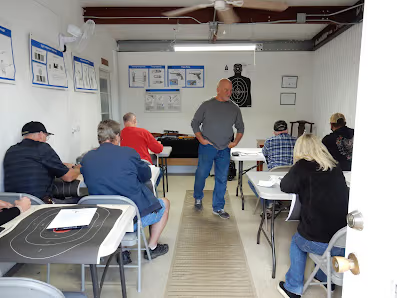
  1. Complete an approved 8-hour 'Concealed Carry Handgun Training' course, including live fire / range exercises and the written legal-issues examination, and obtain the original certificate of completion adopted and distributed by the N.C. Criminal Justice Education and Training Standards Commission and signed by the certified instructor (G.S. 14-415.12(a)(4), 14-415.13(a)(4); 12 NCAC 09F .0102). Approved sponsors include the Commission, the NRA, the USCCA, certified-instructor-taught agencies/schools, and the N.C. Private Protective Services Board under G.S. 74C-13.
  2. Apply to the sheriff of the county in which you reside - not any other county and not a state agency (G.S. 14-415.13(a)).
  3. Complete the application under oath. The form content is standardized statewide: G.S. 14-415.14(a) requires the application to be 'in triplicate, in a form to be prescribed by the State Bureau of Investigation,' and the sheriff must make applications readily available and must provide the form electronically (G.S. 14-415.13(a)(1)). The same subdivision bars the sheriff from requesting employment information, character affidavits, additional background checks, photographs or other information unless Article 54B specifically permits it. Submission is still handled county-by-county, and many NC sheriffs run their own online scheduling/intake portal.
  4. Pay the nonrefundable $80 application fee (or $45 if a retired sworn LEO under G.S. 14-415.19(a1) or an honorably/general-honorably discharged veteran under (a2)), plus a fingerprint-processing fee of up to $10.
  5. Submit a full set of fingerprints administered by the sheriff (G.S. 14-415.13(a)(3)). The sheriff submits them to the SBI for a State and national records check and also runs a NICS check (G.S. 14-415.13(b)).
  6. Sign the release, on a form prescribed by the Administrative Office of the Courts, authorizing disclosure to the sheriff of any record concerning mental health or capacity (G.S. 14-415.13(a)(5)).
  7. Optionally consent on the application to receive permit-related communications electronically at a designated email address; a current permit holder can give or revoke that consent later on a separate paper SBI form (G.S. 14-415.14(a1)).
  8. Wait up to 45 days for issuance or denial (G.S. 14-415.15(a)). If you face a documented emergency risk to your safety, ask the sheriff about a temporary permit of up to 45 days under G.S. 14-415.15(b). A denial must be in writing with grounds and may be appealed to a district court judge (G.S. 14-415.15(c)). The permit is valid throughout the State for five years from issuance (G.S. 14-415.11(b)).
  9. Once permitted: carry the permit together with valid identification whenever carrying concealed, disclose to any law enforcement officer who approaches or addresses you that you hold a valid permit and are carrying a concealed handgun, display both on request, and notify the issuing sheriff of any change of permanent address within 30 days (G.S. 14-415.11(a), (d)). Never carry concealed while consuming alcohol or with any alcohol remaining in your body (G.S. 14-415.11(c2)).
  10. Renew by applying to the sheriff of the county where you reside within the 90-day period before expiration, filing the sheriff's renewal form, an affidavit that you remain qualified, fingerprints and the renewal fee; the sheriff may waive retaking the training course, and no new fingerprints are required if your prints were submitted to the SBI after June 30, 2001 on AFIS (G.S. 14-415.16(b), (c), (d)). The sheriff must mail or (with your consent) email a renewal notice at least 45 days before expiration. If you miss the deadline you may still apply within 60 days after expiration and the sheriff may waive the course, but that does not extend the expiration date (G.S. 14-415.16(a), (e)).

Apply on the official North Carolina site

What disqualifies you

Where to get the required training

North Carolina does not publish a central list of certified instructors. Confirm directly with Sheriff of the county in which the applicant resides (N.C. county sheriffs). The N.C. Department of Justice / Criminal Justice Education and Training Standards Commission sets the training-course and instructor standards and runs the annual reciprocity inquiry, but does not issue permits. that a course will be accepted before you pay for it.

Training providers in North Carolina

Businesses in our directory that offer firearms training. These are not state-verified as certified permit instructors — check against the official list above, or ask the provider directly.

All firearms training in North Carolina →

Reciprocity

Carrying into North Carolina

North Carolina recognizes permits from 48 other jurisdictions.

Alaska, Alabama, Arkansas, Arizona, California, Colorado, Connecticut, Delaware, Florida, Georgia, Hawaii, Iowa, Idaho, Illinois, Indiana, Kansas, Kentucky, Louisiana, Massachusetts, Maryland, Maine, Michigan, Minnesota, Missouri, Mississippi, Montana, North Dakota, Nebraska, New Hampshire, New Jersey, New Mexico, Nevada, New York, Ohio, Oklahoma, Oregon, Pennsylvania, Rhode Island, South Carolina, South Dakota, Tennessee, Texas, Utah, Virginia, Washington, Wisconsin, West Virginia, Wyoming

37 jurisdictions honor a North Carolina permit

Derived from what each of those states officially publishes.

Alaska, Alabama, Arkansas, Arizona, Colorado, Delaware, Florida, Georgia, Iowa, Idaho, Indiana, Kansas, Kentucky, Louisiana, Maine, Michigan, Minnesota, Missouri, Mississippi, Montana, North Dakota, Nebraska, New Mexico, Nevada, Ohio, Oklahoma, Pennsylvania, South Carolina, South Dakota, Tennessee, Texas, Utah, Virginia, Washington, Wisconsin, West Virginia, Wyoming

Official North Carolina reciprocity page Full reciprocity matrix →

Building your own in North Carolina

Build for personal use
Allowed
Serial number required
No

North Carolina has NO state statute prohibiting an otherwise non-prohibited adult from building a firearm for personal use, and NO state statute requiring a serial number, state registration, or marking on a self-made firearm. NC has not enacted a 'ghost gun' / unserialized-firearm law. The two nearby statutes do not change this: (1) G.S. 14-409 makes it unlawful to 'manufacture, sell, give away, dispose of, use or possess machine guns, submachine guns' and similar automatic weapons, subject to exceptions for lawful possession under 26 U.S.C. Chapter 53 with a sheriff permit, for scientific/experimental purposes, and for pre-existing historical relics - so building a machine gun is barred, but ordinary semiautomatic and manually operated firearms are untouched. (2) G.S. 14-160.2 only prohibits altering, defacing, destroying or removing a permanent serial number or other identification mark with intent to conceal identity, and possessing a firearm whose mark has been so altered; it presupposes a mark already exists and does not mandate that one be applied in the first instance. Article 53 of Chapter 14 (G.S. 14-409.1 through 14-409.9) was repealed in its entirety by S.L. 1995, c. 487, s. 4 and contains nothing on the subject. FEDERAL LAW STILL CONTROLS AND IS THE BINDING CONSTRAINT: a person may build a firearm for personal use without a license, but may not manufacture for sale or distribution without an FFL, may not build an NFA item without prior ATF approval, may not build an undetectable firearm (18 U.S.C. 922(p)), and may not build one at all if prohibited under 18 U.S.C. 922(g). ATF's 2022 frame-or-receiver rule (2021R-05F) governs commercially sold kits. Verify current federal requirements independently; this field describes NORTH CAROLINA law only.

N.C. Gen. Stat. § 14-409 (machine guns); § 14-160.2 (alteration of identification marks); no NC statute addresses self-manufacture or serialization of ordinary firearms

Federal law, gunsmithing schools, and tools →

Statutes

What we could not confirm

  • PENDING LEGAL CHANGE - RECHECK BEFORE RELYING: 2025 SB 50 ('Freedom to Carry NC') is one House vote away from making NC a permitless-carry state at 18+. The Senate overrode the veto 7/29/2025 (30-19); the House has calendared and withdrawn the override at least eleven times and has never voted. On the official NCGA bill page, read 2026-09-15, the newest recorded action of any kind is still 4/6/2026 and no session-law number has been assigned, so it is NOT law. The bill stays alive: adjournment resolution S1091 expressly allows each reconvened 2026 session to take up a vetoed bill 'solely for the purpose of considering overriding of the veto', and the remaining dates are 9/28-9/30, 10/26-10/28, 11/16-11/19 and 11/30-12/18/2026, with sine die on December 18, 2026. Anyone relying on this record after those dates must recheck the bill page; if the House overrides, permitlessCarry.allowed flips to true and the minimum age becomes 18.
  • G.S. 14-415.24(a) says a permit 'issued by another STATE' is valid in NC. Neither the statute nor the NC DOJ page addresses the District of Columbia, Puerto Rico, Guam, the U.S. Virgin Islands or other territories, so DC and territorial permits are of uncertain status in NC. I did not list them in reciprocity.honors and found no official NC statement resolving the question.
  • The NC DOJ reciprocity page carries no visible last-updated date. Its list of 17 states is the OUTBOUND direction (states that told NC DOJ they will honor an NC permit) and I deliberately excluded it from reciprocity.honors, but I could not confirm how recently that outbound list was refreshed. This does not affect the inbound direction, which rests on the statute rather than on the page.
  • 12 NCAC 09F .0103 (Approval of Courses), .0104 (Instructor Qualifications) and .0105 (Instructor Responsibilities) currently show NO operative text on the official NCAC site - only history notes ending 'RRC Objection February 22, 2024 and rule returned to the agency on May 29, 2024'. So the rules governing how a course gets approved and who may teach it are in limbo, and in particular the widely repeated claim that virtual delivery is barred by .0103(e) has no currently published rule text behind it. The eight-hour requirement in .0102 is unaffected. I could not determine when or whether replacement rules will be adopted, and a reader should confirm with the Commission or the course sponsor that a specific course is currently approved.
  • Processing of NEW N.C. concealed-handgun instructor applications is still on hold. The NC DOJ instructor page, read 2026-09-15, says 'Due to recent changes in the administrative code governing regulation of instructors and courses for concealed handgun training, processing of new CCH instructor applications is on hold' and gives no end date; renewals continue through the Acadis Portal. I could not determine when the hold will lift or whether it has measurably reduced course availability in any county.
  • instructorRegistryUrl remains null: there is no official NC-published, publicly browsable list of certified Concealed Carry Handgun instructors. I re-checked the NC DOJ instructor page today and it links to no registry; NC DOJ offers only a general 'Officer Search: Certification Status' tool at https://ncdoj.gov/officer-search/ (live, HTTP 200), which is not confirmed to cover CCH instructors. Find an instructor through the approved sponsors named in G.S. 14-415.12(a)(4).
  • The application form's CONTENT is standardized - G.S. 14-415.14(a) requires it to be 'in triplicate, in a form to be prescribed by the State Bureau of Investigation' - but there is no single statewide submission portal: G.S. 14-415.13(a) requires application to the sheriff of the county of residence, on a form the sheriff provides (and must provide electronically). officialApplicationUrl therefore still points at the governing statute rather than at a form. A state-level PDF of the SBI form appears to exist at https://files.nc.gov/ncdps/div/SBI/Forms/SBIConcealedHandgunPermit.pdf, but it returned HTTP 403 to every automated request I made, so I could not verify its current revision and deliberately did not cite it; the NCSBI forms index at https://www.ncsbi.gov/SBI-Forms.aspx (live, HTTP 200) does not list a concealed handgun permit form. Applicants should obtain the form from their own county sheriff.
  • nonResidentPermitAvailable is false, based on G.S. 14-415.12(a)(1) (resident of the State 30 days or longer immediately preceding the application) and G.S. 14-415.13(a) (apply to the sheriff of the county 'in which the person resides'), both re-read today. I did not separately verify how active-duty military personnel stationed in North Carolina but domiciled elsewhere are treated for residency purposes, and no provision of Article 54B resolves it on its face.
  • permitSystem is recorded as shall-issue on the strength of G.S. 14-415.12(a) ('The sheriff shall issue a permit to an applicant if the applicant qualifies') and G.S. 14-415.15(c) ('A person's application for a permit shall be denied only if the applicant fails to qualify under the criteria listed in this Article'), with an appeal to a district court judge. I did not research how the 100 county sheriffs apply this in practice, and county-level processing times and intake procedures vary even though the legal standard does not.
  • The disqualifier list is a condensed rendering of G.S. 14-415.12(b), which is long and cross-references numerous specific Chapter 14 offenses and federal prohibitors. Read the full statute, and get legal advice, before relying on it in any individual case.
  • homeManufacture reflects the ABSENCE of any NC statute on point - a negative finding. I re-confirmed today that Article 53 is repealed in its entirety, that G.S. 14-409 reaches only machine guns/submachine guns and like weapons, and that G.S. 14-160.2 (newest amendment S.L. 2009-204) punishes only the removal of an EXISTING mark. I did not exhaustively search every article of Chapter 14 or any local ordinances, and federal law (including ATF rule 2021R-05F) imposes requirements this field does not describe.

Sources