New York requires a License to Carry a Pistol or Revolver Concealed (Pistol/Revolver License, carry-concealed class) to carry. It is shall-issue, the minimum age is 21, and 18 (16 classroom + 2 live fire) hours of training is required.
Requirements at a glance
Permit name
License to Carry a Pistol or Revolver Concealed (Pistol/Revolver License, carry-concealed class)
Issuing authority
County/city licensing officer (a county judge or justice of a court of record in most counties; the sheriff in Nassau and Suffolk; the Police Commissioner in New York City; the Commissioner of Public Safety in Westchester). The NY State Police administer statewide recertification and the license database.
System
shall-issue
Minimum age
21 — Penal Law § 400.00(1)(a), verified verbatim on 2026-09-15 against the version effective 11 July 2025: no license shall be issued or renewed except for an applicant "twenty-one years of age or older, provided, however, that where such applicant has been honorably discharged from the United States army, navy, marine corps, air force or coast guard, or the national guard of the state of New York, no such age restriction shall apply." So honorably discharged veterans/NY National Guard members are exempt from the 21-year minimum. Federal handgun-purchase age rules apply independently.
Training required
Yes — 18 (16 classroom + 2 live fire) hours, live fire required
State fee
Not published
Valid for
3 years
Processing time
Statutory maximum six months. Penal Law § 400.00(4-b): "the licensing officer shall act upon any application for a license pursuant to this section within six months of the date of presentment of such an application to the appropriate authority." Actual county-by-county times vary widely and frequently approach or exceed the statutory limit.
Fingerprints
Required
Non-resident permit
Available
What it actually costs
The state fee is rarely the whole bill. Fingerprinting is usually charged by a private
vendor, training is bought from an instructor, and several states add photographs,
notarisation or other requirements on top.
Training course
$150–$350 (private instructor)
County license fee
varies — $3 to $10 outside New York City and Nassau, set by the county legislature (Penal Law § 400.00(14))
New York City application fee
varies — $340.00, non-refundable, per the NYPD firearms-licensing page
New York City fingerprint fee
varies — $89.75, non-refundable, per the NYPD firearms-licensing page
Nassau County
varies — sets its own fee by local law, well above the upstate statutory cap; no figure published on a reachable primary source
Fingerprint processing outside New York City
varies — state and FBI charge under § 400.00(4); amount not published on a reachable state page — counties quote figures around $87 to $107 including local processing
License amendment (adding a handgun)
varies — $3, or $5 in Suffolk County (Penal Law § 400.00(14))
State Police recertification
varies — free
New York has no statewide fee to publish. Penal Law § 400.00(14) caps the county license fee between three and ten dollars upstate, while New York City sets its own by local law at $340 plus $89.75 for fingerprints — two orders of magnitude higher, so the same license costs a few dollars in one county and several hundred in another. The 2022 Concealed Carry Improvement Act then added the largest training requirement in the country under § 400.00(19): sixteen hours of in-person curriculum plus two of live fire, required at renewal as well as issue. Recertification itself is free.
There is no single statewide fee, so fees.initial and fees.renewal are null rather than a guess. Penal Law § 400.00(14), verified verbatim on 2026-09-15, directs the licensing officer to collect and pay into the county treasury 'for each license to carry or possess a pistol or revolver or to purchase or take possession of a semiautomatic rifle, not less than three dollars nor more than ten dollars as may be determined by the legislative body of the county; for each amendment thereto, three dollars, and five dollars in the county of Suffolk'. The same subdivision sets a $5 duplicate-license fee and a $5 fee for processing a license transfer between counties, and provides a reduced/waived fee for qualified retired police officers, sheriffs, deputies, Triborough Bridge and Tunnel officers and retired uniformed court officers and court clerks. New York City and Nassau County set their own fees by local law, far above the upstate statutory cap: the NYPD firearms-licensing page states 'The application fee is $340.00' and 'The fee for fingerprints is $89.75' for handgun license applicants, both non-refundable, payable by credit card or by two separate money orders (verified in the raw page on 2026-09-15; the HTTP 403 recorded in the previous sweep was transient edge filtering, not a missing page). Outside New York City, applicants pay a separate state/FBI fingerprint processing fee under Penal Law § 400.00(4) whose amount is set administratively and is not published on a currently reachable state page. State Police recertification is free: 'there are no fees associated with recertification; however, existing county fees associated with new applications and amendments still apply.'
How to apply
Confirm you are 21 or older (or an honorably discharged veteran/NY National Guard member) and not disqualified under Penal Law § 400.00(1).
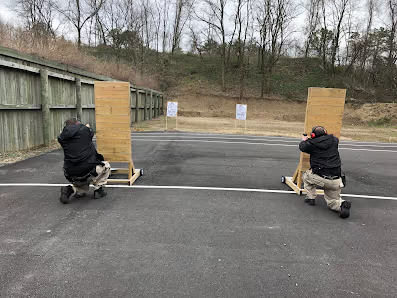
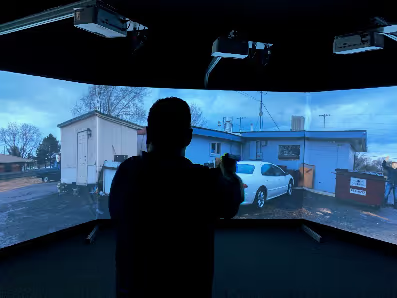
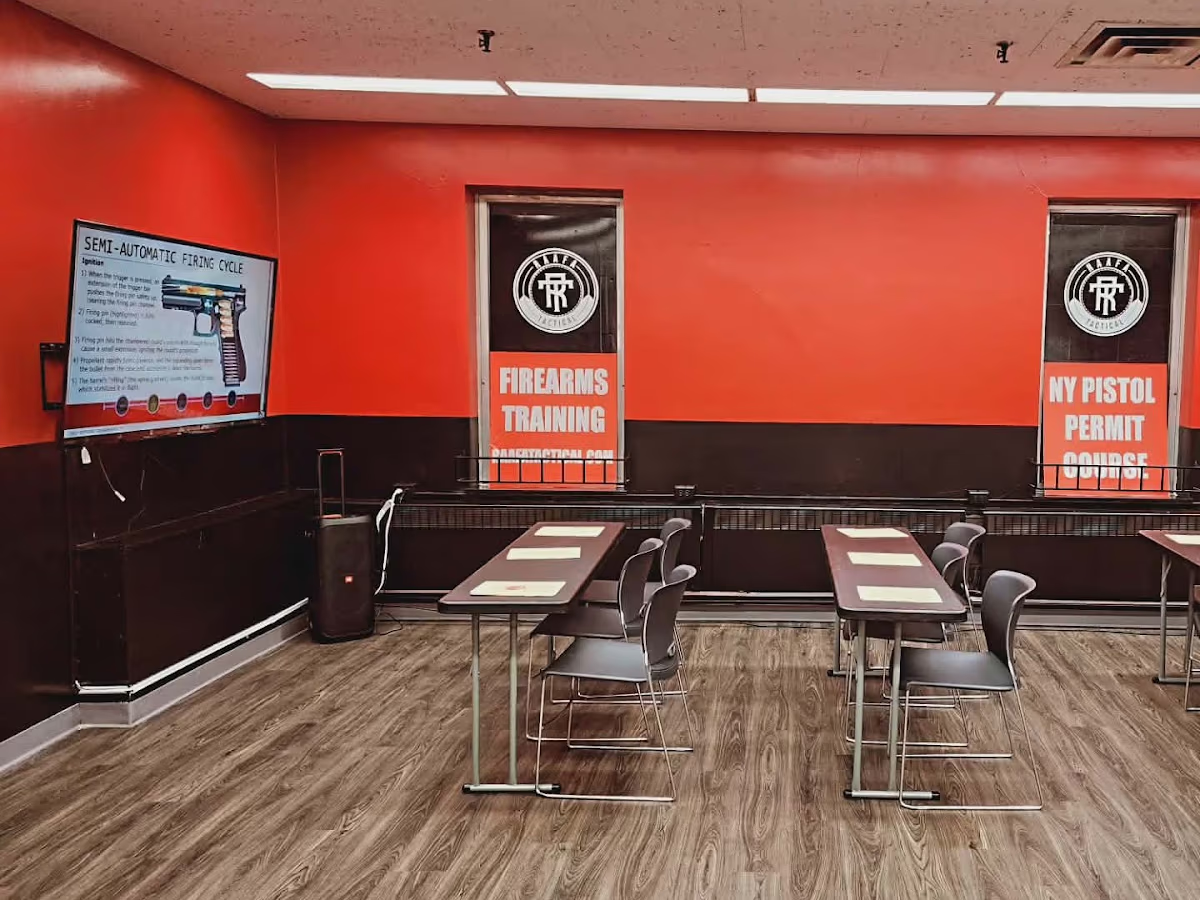
Complete the mandatory 16-hour in-person classroom course plus 2-hour live-fire range course from a Duly Authorized Instructor (Penal Law § 265.00(19)), scoring at least 80% on the written test and demonstrating live-fire proficiency (Penal Law § 400.00(19)). Instructors and course materials meeting the joint DCJS/State Police Minimum Standards are 'deemed approved' — there is no state list of individually approved instructors, so ask your county licensing officer. Keep the certificate of completion.
Obtain form PPB-3 (Pistol/Revolver License Application / Semi-Automatic Rifle License Application), currently revision 12/24, plus the PPB-3A continuation sheet and PPB-3B fingerprint form, from your county licensing officer or the State Police forms page. Many counties add a local supplement and require in-person pickup.
Assemble the required disclosures: names, addresses and signatures for no fewer than four character references who attest to your good moral character (Penal Law § 400.00(1)(o)(ii)), and disclosure of your spouse or domestic partner and any other adults residing in your home, including adult children. NOTE: Penal Law § 400.00(1)(o)(iv) also text-requires 'a list of former and current social media accounts of the applicant from the past three years', but that provision is ENJOINED and is not being enforced — the Second Circuit upheld the injunction against it, the Supreme Court denied certiorari on 7 April 2025, and the current PPB-3 (Rev 12/24) form contains no social-media question.
Be fingerprinted (Penal Law § 400.00(4)) and pay the fingerprint processing fee for the state and FBI criminal history check ($89.75 in New York City; the amount charged elsewhere is set administratively and varies by county).
Submit the completed application with the county license fee to the licensing officer for the city or county where you reside, are principally employed, or have your principal place of business (Penal Law § 400.00(3)).
Attend the mandatory in-person interview with the licensing officer or their designee (Penal Law § 400.00(1)(o)).
Wait for the investigation and determination; the licensing officer must act within six months (Penal Law § 400.00(4-b)). If denied, you may request a hearing before the DCJS firearm license appeals board within ninety days.
After issuance, amend the license to add each individual handgun you acquire (form PPB-5) — in New York each pistol is listed on the license; the amendment fee is $3 ($5 in Suffolk County).
Recertify with the State Police every three years for a concealed-carry license (Penal Law § 400.00(10)(d); electronically only, paper forms no longer accepted). Licensees in New York City, Nassau, Suffolk and Westchester do not recertify with the State Police and instead renew through their local licensing authority.
Under 21 years of age (unless honorably discharged from the U.S. armed forces or the NY National Guard)
Lack of 'good moral character,' defined in Penal Law § 400.00(1)(b) as not possessing 'the essential character, temperament and judgement necessary to be entrusted with a weapon and to use it only in a manner that does not endanger oneself or others' — this standard survived Second Circuit review and is enforceable
Conviction of a felony or a 'serious offense' as defined in Penal Law § 265.00(17)
Being a fugitive from justice
Being an unlawful user of or addicted to a controlled substance
Not being a U.S. citizen or lawfully admitted alien; unlawful or nonimmigrant status
Dishonorable discharge from the armed forces
Having renounced U.S. citizenship
Having been involuntarily committed to a mental institution, or adjudicated mentally incompetent / a mental defective
Having had a firearms license revoked, or being under a suspension or ineligibility order
Being the subject of a qualifying order of protection or an extreme risk protection order (red flag order)
Recent conviction of assault in the third degree, misdemeanor driving while intoxicated, or menacing
Failure to complete the required 16+2 hour firearm safety training
Refusal or failure to appear for the mandatory in-person interview, or failure to supply the four character references or the household-member disclosure (the statute's three-year social-media-account disclosure under § 400.00(1)(o)(iv) is enjoined and cannot lawfully be a basis for denial)
Any other good cause found by the licensing officer for the denial of the license
Where to get the required training
New York does not publish a central list of certified instructors. Confirm directly
with County/city licensing officer (a county judge or justice of a court of record in most counties; the sheriff in Nassau and Suffolk; the Police Commissioner in New York City; the Commissioner of Public Safety in Westchester). The NY State Police administer statewide recertification and the license database. that a course will be accepted before you pay for it.
Training providers in New York
Businesses in our directory that offer firearms training. These are
not state-verified as certified permit instructors —
check against the official list above, or ask the provider directly.
New York recognizes no out-of-state carry permits. A permit from another state does not authorize you to carry here. New York does, however, issue its own license to non-residents — see the application details above.
24 jurisdictions honor a New York permit
Derived from what each of those states officially publishes.
New York effectively prohibits building a firearm for personal use. The amended § 265.10 that took effect 25 August 2026 is now the operative version and was read directly on 2026-09-15; the prohibition is unchanged and the amendment added rapid-fire modification devices as a separate class E felony. Penal Law § 265.10(1) now reads: 'Any person who manufactures or causes to be manufactured any machine-gun, ghost gun, unfinished frame or receiver, firearm silencer, major component of a firearm, assault weapon, large capacity ammunition feeding device or disguised gun is guilty of a class D felony. Any person who manufactures or causes to be manufactured any rapid-fire modification device is guilty of a class E felony.' The subdivision contains no exemption for personal or non-commercial manufacture; Article 265's exemptions run to licensed gunsmiths and dealers. A 'ghost gun' is defined in § 265.00 as 'a firearm, rifle or shotgun that does not comply with the provisions of section 265.07 of this article and is not serialized,' and an 'unfinished frame or receiver' is 'any unserialized material that does not constitute the frame or receiver of a firearm ... but that has been shaped or formed in any way for the purpose of becoming the frame or receiver ... and which may readily be made into a functional frame or receiver through milling, drilling or other means.' Mere POSSESSION is also criminal: § 265.01(9-B) (possession of a ghost gun) and § 265.01(10) (possession of an unserialized frame or receiver) are class A misdemeanors for anyone who is not a licensed gunsmith or dealer. Selling escalates sharply — §§ 265.60/265.61 (ghost guns) and §§ 265.63/265.64 (frames/receivers) are class E and class D felonies. Serialization is mandatory and CANNOT be done by the builder: § 265.07 requires a unique serial number be engraved, cast or stamped on the item, and authorizes only 'any person licensed as a gunsmith, or required to be, or a dealer in firearms pursuant to section 400.00' to do it; violation is a class E felony. Separately, any handgun a New Yorker lawfully possesses must be listed on their § 400.00 pistol license via amendment, so even a hypothetically serialized self-built handgun could not be lawfully possessed without adding it to the license. Bottom line: home-building a firearm in New York is a felony, not a regulated-but-legal activity — do not rely on federal 'personal use' manufacture allowances here.
N.Y. Penal Law §§ 265.10(1), 265.07, 265.01(9-B) and (10), 265.00 (definitions of 'ghost gun' and 'unfinished frame or receiver'); § 400.00
There is no single statewide dollar fee to report, so fees.initial and fees.renewal are null rather than a guess. Penal Law § 400.00(14) sets only a $3–$10 range for the county license fee outside New York City and Nassau, delegated to each county legislature. New York City's own figures are now confirmed from the NYPD ($340.00 application plus $89.75 fingerprints) but they apply only within New York City. Ask your county licensing officer for the local figure.
The NYPD publishes its $340.00 application fee as a single figure for 'handgun license' applicants and does not break it down by license class, so whether a New York City carry-business license costs more than a premises-residence license could not be confirmed from the official page.
The fingerprint processing fee charged OUTSIDE New York City (Penal Law § 400.00(4)) could not be confirmed from a state source: the DCJS fingerprint-services page that formerly listed it (criminaljustice.ny.gov/pio/fp_services.htm) now returns HTTP 404, and individual county pages quote differing totals (Madison County, for example, quotes an $87.00 DCJS fingerprint fee plus $20.00 county processing). Confirm the amount with your county licensing officer before applying.
nonResidentPermitAvailable is true based on the state's official FAQ, which states that 'residency is not among the eligibility criteria for being issued a firearm license' and that non-residents are evaluated under the same standards as all others. This sits in tension with Penal Law § 400.00(3), which requires application to the licensing officer where the applicant 'resides, is principally employed or has his or her principal place of business' — a person with no New York nexus may have no licensing officer with jurisdiction. Treat non-resident licensing as legally available but practically dependent on a NY residence, employment or business nexus; confirm with the specific county licensing officer.
permitSystem is recorded as shall-issue because the 2022 Concealed Carry Improvement Act removed the 'proper cause' discretionary standard struck down in NYSRPA v. Bruen. However, § 400.00(1)(b) retains a 'good moral character' standard vesting substantial discretion in the licensing officer, and that standard is now enforceable — the Second Circuit vacated the preliminary injunction against it and the Supreme Court denied certiorari on 7 April 2025. New York is therefore shall-issue in form but meaningfully discretionary in practice, and county-to-county variation is large.
validityYears is set to 3, reflecting the concealed-carry recertification/renewal cycle confirmed in Penal Law § 400.00(10)(d), but the structure genuinely differs by region: outside NYC/Nassau/Suffolk/Westchester the license itself does not expire but must be recertified with the State Police every 3 years for concealed carry (5 years under § 400.00(10)(b) for other classes); in NYC (3 years) and Nassau/Suffolk/Westchester (up to 5 years) the license itself expires and is renewed locally. One number cannot capture this.
The Antonyuk/Hardaway CCIA litigation is still only at the preliminary-injunction stage. The Second Circuit expressly cautioned that its 'affirmance or vacatur of the district courts' injunctions does not determine the ultimate constitutionality of the challenged CCIA provisions, which await further briefing, discovery, and historical analysis,' and merits proceedings continue on remand. The enjoined/enforceable split recorded here (social-media disclosure enjoined; § 265.01-d enjoined as to private property held open to the public; sensitive locations and good moral character enforceable) is current as of 2026-09-15 but could change.
The place-of-worship sensitive-location subdivision, § 265.01-e(2)(c), is NOT generally struck down — a point commonly reported incorrectly. The Second Circuit upheld the injunction against it only 'as applied to Pastor Spencer, the Tabernacle Family Church, its members, or their agents and licensees,' and a May 2023 amendment separately exempted persons responsible for security at places of worship. Anyone outside those narrow categories should treat places of worship as sensitive locations where carry is a class E felony.
Both ny.gov and nysenate.gov sit behind Cloudflare bot protection that intermittently returns HTTP 403 with 'Cf-Mitigated: challenge' to automated requests, including to gunsafety.ny.gov, troopers.ny.gov and criminaljustice.ny.gov. Every URL in this record was nonetheless fetched successfully at least once on 2026-09-15 and its content read. An automated link checker reporting 403 on these hosts is seeing edge filtering, not dead links, and those reports should not be acted on by deleting the links.