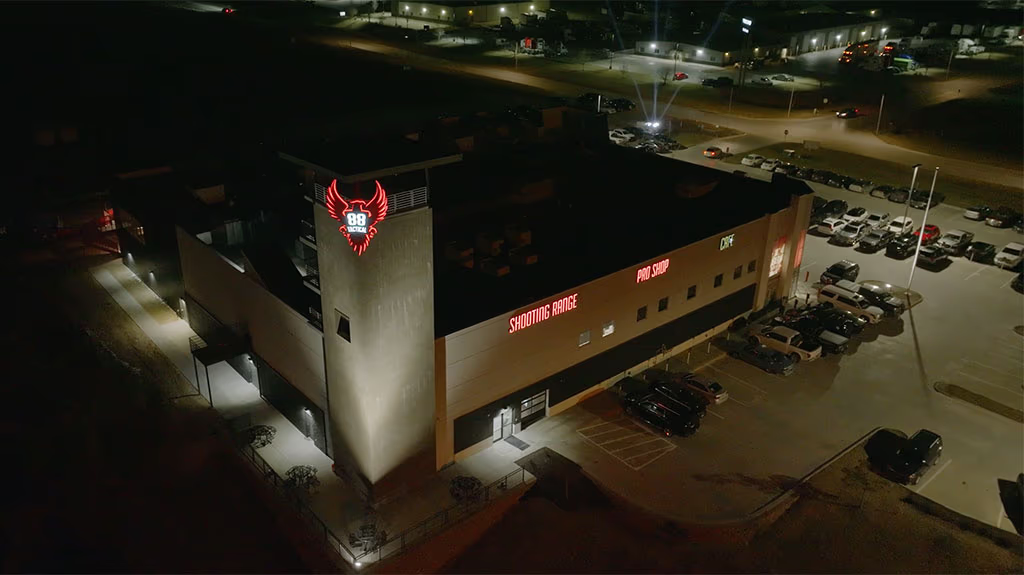
88 Tactical
15350 Shepard St
Omaha, NE
Firearms Training
Nebraska allows permitless carry for non-prohibited adults 21+. A CHP is still available and is what other states recognize.
A non-prohibited adult aged 21 or older may carry a concealed handgun without a permit (since 2023). YES — permitless (constitutional) carry took effect September 2, 2023 under LB 77. The affirmative grant is in Neb. Rev. Stat. 28-1202.01(1): "Except as otherwise provided in this section and section 28-1204.04, a person, other than a minor or a prohibited person, may carry a concealed handgun anywhere in Nebraska, with or without a permit under the Concealed Handgun Permit Act." Section 28-1202 supplies the matching prohibition: "A minor or a prohibited person shall not carry a weapon or weapons concealed on or about his or her person" (Class I misdemeanor first offense, Class IV felony second or subsequent). Section 28-1201(11) defines "minor" as a person under 21, EXCEPT that a person 18 or older who is active-duty or reserve armed forces, National Guard of this state, or Reserve Officers' Training Corps, or a peace officer or other duly authorized law enforcement officer, is not a minor for this purpose. Section 28-1201(12) defines "prohibited person" as a person barred from possessing a firearm or ammunition by state law (including but not limited to 28-1206) or by 18 U.S.C. 922(d) or (g) as that section existed January 1, 2023. NOTE the date mismatch: permitless carry keys to federal law as of January 1, 2023, while permit eligibility under 69-2433 keys to 18 U.S.C. 922 as it existed January 1, 2005. Permitless carriers remain bound by the location bans in 28-1202.01(3), the zero-tolerance alcohol/controlled-substance bar in 28-1202.02, the duty to carry an identification document in 28-1202.03, and the peace-officer-contact / handgun-securing procedure in 28-1202.04. PERMIT-ONLY PRIVILEGE (new for 2026): LB 1237, which became law April 17, 2026 without the Governor's approval and is in effect (the Legislature's 2026 general effective date was July 18, 2026), makes it an offense to knowingly enter or attempt to enter the State Capitol while in possession of a weapon, and the concealed-handgun exception runs ONLY to "an individual holding a current and valid permit to carry a concealed handgun issued pursuant to the Concealed Handgun Permit Act" (plus persons with prior Nebraska State Patrol approval, on-duty law enforcement, and qualified/retired officers under 18 U.S.C. 926B/926C). The parallel carve-out was added as 28-1202.01(11). A permitless carrier therefore may NOT carry into the State Capitol; a Nebraska permit holder may. The State Patrol must implement weapons and prohibited-substance screening at the Capitol no later than January 1, 2027 (Neb. Rev. Stat. 81-1108.15(6)(b)). Separately, possessing a firearm in a school, on school grounds, in a school-owned vehicle, or at a school-sponsored activity or athletic event is the Class IV felony of unlawful possession of a firearm at a school under 28-1204.04, which binds permit holders and permitless carriers alike; LB 1329 (2024) BROADENED the school-parking-lot exception in 28-1204.04(2)(j) from a "valid holder of a permit issued under the Concealed Handgun Permit Act" to "a person other than a minor or prohibited person," so a permitless carrier now also may leave a handgun locked in a vehicle compartment in a school parking area open to the public. LB 1329 also added a "home school" definition to 28-1201 and excluded home schools from the definition of "school." A permit remains useful for out-of-state reciprocity and is now required for State Capitol carry. LOCAL PREEMPTION (Neb. Rev. Stat. 13-330 (as amended by LB 77, 2023, § 1; formerly § 18-1703)): LB 77 did far more than authorize permitless carry — its section 1 rewrote the preemption statute now codified at Neb. Rev. Stat. 13-330. It declares "that the regulation of the ownership, possession, storage, transportation, sale, and transfer of firearms and other weapons is a matter of statewide concern," and provides that "Notwithstanding the provisions of any home rule charter, counties, cities, and villages shall not have the power to: (a) Regulate the ownership, possession, storage, transportation, sale, or transfer of firearms or other weapons, except as expressly provided by state law; or (b) Require registration of firearms or other weapons," with any conflicting ordinance, permit or regulation "declared to be null and void." The "notwithstanding any home rule charter" language is what reaches Omaha (metropolitan class) and Lincoln (primary class). Before LB 77 the same section preempted only the regulation of concealed handguns "as such ownership, possession, or transportation is authorized under the Concealed Handgun Permit Act," and only "as against any permitholder" — so the 2023 rewrite is a large expansion. LB 77 also struck the concealed-weapons power out of each city-class enabling statute: 14-102 (Omaha), 15-255 (Lincoln), 16-227 (first class) and 17-556 (second class and villages) no longer authorize a city to "punish and prevent the carrying of concealed weapons." WHAT SURVIVED, precisely: (1) discharge. Section 13-330(2)(a) enumerates ownership, possession, storage, transportation, sale and transfer — not discharge — and the city-class statutes still expressly grant discharge authority, so local discharge ordinances stand. Omaha retains 14-102(6), "To punish and prevent the discharge of firearms, fireworks, or explosives of any description within the city, other than the discharge of firearms at a shooting range pursuant to the Nebraska Shooting Range Protection Act"; Lincoln retains 15-255(2), "prevent the discharge of firearms, rockets, powder, fireworks, or other dangerous and combustible material." (2) Gunpowder and explosives handling: 14-102(19) still allows Omaha "To regulate or prohibit the transportation and keeping of gunpowder, oils, and other combustible and explosive articles," and 15-255(3) is the Lincoln analogue. (3) The property-owner power that every place in Nebraska has: 28-1202.01(2) and (5) let "the person, persons, entity, or entities in control of the place or premises" — a city included, acting as a property owner rather than a regulator — prohibit concealed carry on that place by posting conspicuous notice or by asking the carrier to remove the handgun. WHAT DID NOT SURVIVE: Omaha repealed 22 gun ordinances and amended 8 more after LB 77, including its handgun purchase permit requirement, its ban on possession by people under 21, and its restrictions on carrying concealed without a state permit. STILL CONTESTED — do not tell a reader these cities are simply gun-ordinance-free: Omaha subsequently enacted ordinances banning bump stocks and "ghost gun" parts, and in February 2026 a Douglas County District Court judge upheld them, holding that neither bump stocks nor ghost guns fall within what LB 77 preempted; the separate challenge to Omaha's executive order barring firearms on city property was held moot because the order had been rescinded in 2025. Lincoln's ordinances (firearms on city property, firearms in parks, firearm sales reporting, prohibited devices, switchblades, and vehicle firearm storage) remain on the books and are still being litigated: the Nebraska Supreme Court decided the standing question in Nebraska Firearms Owners Assn. v. City of Lincoln, No. S-24-0503 (Aug. 29, 2025) — the association lacked associational standing but the individual plaintiffs had standing on a credible threat of prosecution — and the merits returned to the District Court for Lancaster County (Judge Andrew R. Jacobsen), where cross-motions for summary judgment were argued in July 2026. A reader in Omaha or Lincoln should assume these specific local rules may be enforced until a court says otherwise.
Getting the permit anyway is still worth it for most people: other states recognize the permit, not your residency, so without one you generally cannot carry across state lines.
Neb. Rev. Stat. §§ 28-1202.01(1), 28-1202, 28-1201 (as amended by LB 77, 2023; LB 1329, 2024; LB 1237, 2026)
There are 13 details on this page we could not confirm from a primary source. Read what they are before relying on this.
| Permit name | Concealed Handgun Permit |
|---|---|
| Issuing authority | Nebraska State Patrol |
| System | shall-issue |
| Minimum age | 21 — Neb. Rev. Stat. 69-2433(1) requires a permit applicant to "Be at least twenty-one years of age." There is no lower-age or provisional permit. For permitless carry the effective floor is also 21, except that 18+ active or reserve armed forces, National Guard, and Reserve Officers' Training Corps members, and peace officers or other duly authorized law enforcement officers, are excluded from the definition of "minor" in Neb. Rev. Stat. 28-1201(11)(b) and may carry concealed at 18. |
| Training required | Yes, live fire required |
| State fee | $100 initial / $50 renewal — the state's own charge, not the total |
| Valid for | 5 years |
| Processing time | Neb. Rev. Stat. 69-2430 requires NSP to issue within forty-five days after the date of application if the applicant has complied with that section and met all requirements of 69-2433. The NSP FAQ states: "If all requirements are met, an initial permit will be issued within 45 days after application. Renewal, data change, and lost/stolen applications will be processed in the order they are received." A federal record check is requested before state and local records. NSP advises calling the office before arriving, because days and hours vary and "Some offices do not always have staff available for fingerprinting and notarizing applications." An applicant denied a permit may appeal to the district court for the county of residence or of application under the Administrative Procedure Act (69-2430). |
| Fingerprints | Required |
| Non-resident permit | Not available |
The state fee is rarely the whole bill. Fingerprinting is usually charged by a private vendor, training is bought from an instructor, and several states add photographs, notarisation or other requirements on top.
| State fee | $100 |
|---|---|
| Fingerprinting | $15–$45 — our estimate; no vendor publishes a rate |
| Training course | $75–$250 (private instructor) |
| Online portal charge | $4.50 — only if paying online, so excluded from the total |
| Realistic total | $190–$395 — includes an estimated component |
Neb. Rev. Stat. 69-2436 sets $100 for five years and $50 to renew, and Nebraska is tidy about the small things — name changes, address updates and replacing a lost permit are all free. 69-2432 prescribes the syllabus without an hour count, and the State Patrol's own FAQ declines to supply one: 'Courses will normally last from 8 to 16 hours, there is no required length.' That two-fold spread in the largest component, sitting on top of an unpriced fingerprint charge, is why the total is left open. Note that all of these costs describe the PERMIT. Carrying concealed without a permit in Nebraska costs nothing: there is no fee, no course and no application, only the duty to carry an identification document under 28-1202.03.
Set by Neb. Rev. Stat. 69-2436: "The fee for issuing a permit is one hundred dollars" and the renewal fee is "fifty dollars," each covering a five-year term. The NSP FAQ confirms "Initial = $100 Renewal = $50" and that paying by credit card, debit card or e-check online adds a $4.50 charge. Name/address updates and lost-or-stolen replacements are free. Training course costs are separate and paid directly to the instructor. Renewal may be applied for no earlier than four months before expiration and no later than thirty business days after the date of expiration (69-2436).
Apply on the official Nebraska site
Nebraska publishes an official list of certified instructors. That list is authoritative — a certificate from an instructor who is not on it may not be accepted. View the official instructor list
Businesses in our directory that offer firearms training. These are not state-verified as certified permit instructors — check against the official list above, or ask the provider directly.
15350 Shepard St
Omaha, NE
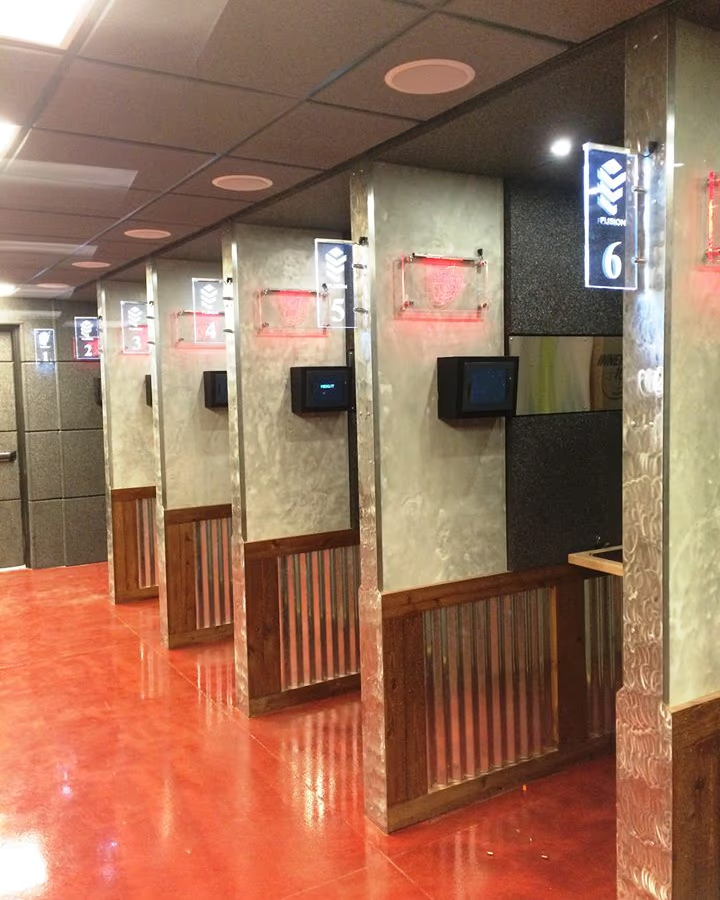
8910 Military Rd
Omaha, NE
3109 N 120th St
Omaha, NE
2626 Harney St D
Omaha, NE
Gage County, NE
6100 N 16th St
Omaha, NE
9000 Sandhills Ct
Lincoln, NE
10915 Harrison St
Omaha, NE
6901 Monterey Dr
Lincoln, NE
3606 N 156th St Ste 101-198
Omaha, NE
All firearms training in Nebraska →
Nebraska recognizes permits from 36 other jurisdictions.
Alaska, Arkansas, Arizona, California, Colorado, Connecticut, District of Columbia, Florida, Hawaii, Iowa, Idaho, Illinois, Kansas, Kentucky, Louisiana, Maine, Michigan, Minnesota, Missouri, Montana, North Carolina, North Dakota, New Mexico, Nevada, Ohio, Oklahoma, Oregon, South Carolina, South Dakota, Tennessee, Texas, Utah, Virginia, Wisconsin, West Virginia, Wyoming
Derived from what each of those states officially publishes.
Alaska, Alabama, Arkansas, Arizona, Colorado, Florida, Iowa, Idaho, Indiana, Kansas, Kentucky, Louisiana, Maine, Michigan, Minnesota, Missouri, Mississippi, Montana, North Carolina, North Dakota, New Mexico, Nevada, Ohio, Oklahoma, South Dakota, Tennessee, Texas, Utah, Virginia, Wisconsin, West Virginia, Wyoming
Official Nebraska reciprocity page Full reciprocity matrix →
Nebraska has NO STATE statute prohibiting or regulating the manufacture of a firearm for personal use, no state 'ghost gun' or unfinished-frame/receiver law, no state serialization mandate, and no firearm registry. A section-by-section review of Chapter 28, Article 12 (Firearms and Weapons), sections 28-1201 through 28-1225, found no provision addressing self-manufacture, undetectable firearms, unfinished frames or receivers, or registration. This is lawful by ABSENCE of prohibition rather than by an affirmative statutory grant — a weaker basis than a citation. LOCAL EXCEPTION, IMPORTANT: the City of Omaha enacted an ordinance banning 'ghost gun' parts used to assemble firearms (and one banning bump stocks) after LB 77, and in February 2026 a Douglas County District Court judge upheld both, finding neither was preempted by LB 77's statewide preemption in Neb. Rev. Stat. 13-330. So the statement 'Nebraska has no ghost gun law' is true of state law but NOT of Omaha city law as currently enforced. What Nebraska DOES criminalize statewide: knowingly possessing, receiving, selling or leasing, other than by delivery to law enforcement officials, any firearm from which the manufacturer's identification mark or serial number has been removed, defaced, altered or destroyed — possession of a defaced firearm, Neb. Rev. Stat. 28-1207, a Class III felony; and intentionally removing, defacing, covering, altering or destroying the manufacturer's identification mark or serial number or other distinguishing numbers on any firearm — defacing a firearm, Neb. Rev. Stat. 28-1208, also a Class III felony. (The baseline had these two section numbers possibly transposed; they are now confirmed from the statute catchlines: 28-1207 is possession, 28-1208 is the act of defacing.) By their terms both reach a firearm that HAD a serial number which was removed, not one that never bore a number; that reading is textual and was not confirmed against Nebraska case law. Federal law applies independently: a prohibited person may not manufacture or possess any firearm; NFA items require ATF approval; a self-made firearm may not be manufactured for sale without a license; and ATF Final Rule 2021R-05F governs commercially sold frames, receivers and kits.
No Nebraska statute on point; cf. Neb. Rev. Stat. 28-1207 (possession of a defaced firearm) and 28-1208 (defacing a firearm), and 28-1203 (machine guns, short rifles, short shotguns)