Maryland requires a Wear and Carry Permit (Handgun Permit) to carry. It is shall-issue, the minimum age is 21, and 16 hours of training is required.
Requirements at a glance
Permit name
Wear and Carry Permit (Handgun Permit)
Issuing authority
Maryland Department of State Police, Licensing Division (Handgun Permit Unit)
System
shall-issue
Minimum age
21 — Md. Public Safety § 5-306(a)(1) requires that the applicant "(i) is at least 21 years old; or (ii) is a person who is a member of the uniformed services or the National Guard." The statutory text of subparagraph (ii) was amended by 2025 Md. Laws ch. 261 (S.B. 280) / ch. 262 (H.B. 1060), effective 1 October 2025, and now reads simply "a member," without the word "active"; MDSP's Wear & Carry Permit page still paraphrases the pathway as "an active member of the U.S. Armed Forces, the National Guard or uniformed services," so read the statute rather than the agency summary. Section 5-306(c) adds that an applicant under 30 qualifies only if the applicant has not been committed to a juvenile institution for more than 1 year and has not been adjudicated delinquent for an act that would be a crime of violence, a felony, or a misdemeanor carrying more than 2 years if committed by an adult. Neither § 5-306 nor MDSP states a floor age for the uniformed-services pathway. The separate HQL under § 5-117.1(d)(1) has a firm 21 minimum with no services exception.
Training required
Yes — 16 hours, live fire required
State fee
$125 initial / $75 renewal — the state's own charge, not the total
Valid for
2 years
Processing time
MDSP renders a final disposition within 90 days of receiving a completed initial or renewal application and the fee; applications are screened for completeness in 1-5 business days and incomplete applicants are emailed within 5 business days; replacement applications are processed within 30 days. The separate HQL is decided within 30 days under Md. Public Safety § 5-117.1(h)(1).
Fingerprints
Required
Non-resident permit
Available
What it actually costs
The state fee is rarely the whole bill. Fingerprinting is usually charged by a private
vendor, training is bought from an instructor, and several states add photographs,
notarisation or other requirements on top.
State fee
$125
Fingerprinting
$15–$45 — our estimate; no vendor publishes a rate
Training course
$150–$350 (private instructor)
Realistic total
$290–$520 — includes an estimated component
Md. Public Safety § 5-304. The $125 covers only the wear-and-carry application; it excludes LiveScan and the mandatory 16-hour course, and it excludes the Handgun Qualification License entirely. THE HQL IS A SEPARATE BUDGET LINE: $50 initial and $20 to renew under § 5-117.1(g)(2) and (j)(1)(ii), plus its own 4-hour course and its own LiveScan submission, and it is required to purchase, rent or receive a handgun rather than to carry one. A Maryland resident starting from nothing therefore faces two applications, two courses, two fee schedules and two different portals, and should add roughly $50 plus 4-hour course tuition to the totals here. With a 2-year initial term, the wear-and-carry permit alone is among the most expensive in the country per year.
Md. Public Safety § 5-304(b)(2) caps the wear-and-carry fee at $125 for an initial application, $75 for a renewal or subsequent application, and $20 for a duplicate or modified permit, and MDSP's published fee table charges exactly those amounts ($125 initial / $75 renewal / $20 replacement / $20 modification), collected by Visa or MasterCard in the Licensing Portal and nonrefundable. Under § 5-304(d) no fee may be charged to a State, county or municipal public safety employee required to carry, wear or transport a handgun as a condition of governmental employment, or to a retired law enforcement officer of the State or of a Maryland county or municipality. These figures EXCLUDE the third-party LiveScan fingerprint fee and the tuition for the 16-hour course, neither of which the State sets. THEY ALSO EXCLUDE THE HQL. The Handgun Qualification License under § 5-117.1 is a separate document with its own money: § 5-117.1(g)(2) and MDSP set $50 for the initial HQL, § 5-117.1(j)(1)(ii) and MDSP set $20 to renew, and § 5-117.1(m)(2) sets up to $20 for a replacement, paid in the separate eMDSP system, plus its own 4-hour course and its own LiveScan submission. An HQL is NOT a prerequisite to applying for or holding a wear-and-carry permit - it appears neither among the § 5-306 qualifications nor on MDSP's Wear & Carry application checklist - but a Maryland resident who does not already own a handgun needs the HQL to buy one, so that person in practice pays both. Section 5-306(e) permits (but does not require) the Secretary to issue an HQL "without an additional application or fee" to a person who meets the permit qualifications, and MDSP offers an "HQL Permit Exempt" application type for valid permit holders that waives the LiveScan submission.
How to apply
Confirm which document you need, because Maryland has two: a wear-and-carry permit is required to carry, wear or transport a handgun (Md. Public Safety § 5-303), while the Handgun Qualification License under § 5-117.1 is a separate $50, 10-year document required only to purchase, rent or receive a handgun. An HQL is not a prerequisite to applying for the wear-and-carry permit, but if you do not already own a handgun you will need the HQL as well, with its own 4-hour course, its own LiveScan submission and its own application filed in the eMDSP system rather than the Licensing Portal.
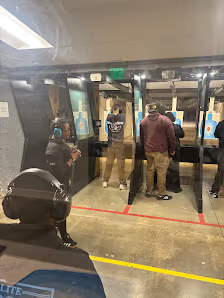
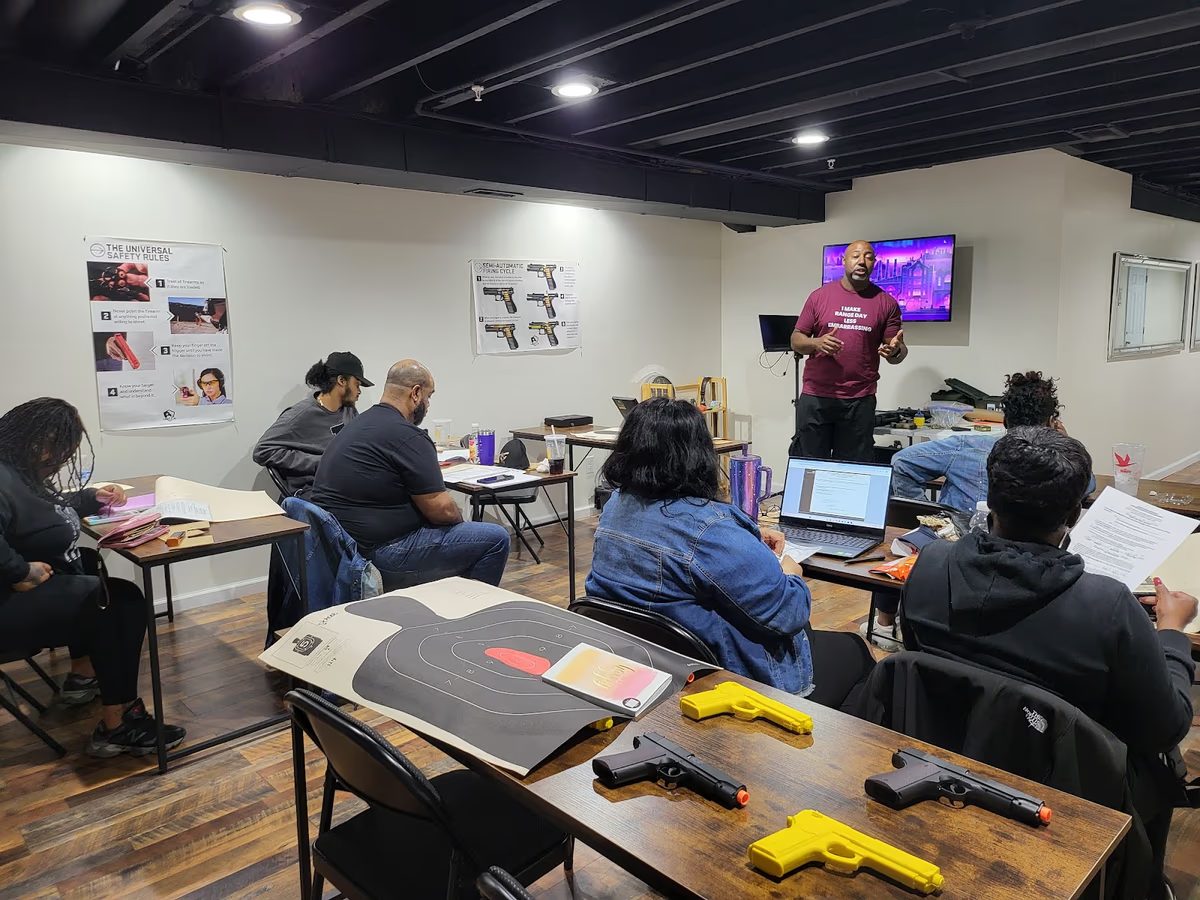
Complete a Maryland State Police-approved 16-hour Firearms Safety Training Course taught in person by a Qualified Handgun Instructor (8 hours for a renewal), covering the classroom curriculum in Md. Public Safety § 5-306(a-1)(2), and pass the live-fire qualification: at least 25 rounds at no more than 15 yards with a score of at least 70 percent, or for designated security personnel a 50-round Practical Police Course at up to 25 yards, per COMAR 29.03.02.05C(4).
Have the instructor complete and sign MSP Form 29-14, Certified Qualification Score Sheet, and keep it. The course must have been completed within the previous 2 years when you submit the application (COMAR 29.03.02.04B(2)). If you are exempt from training under § 5-306(b) - law enforcement, retired law enforcement in good standing, a member, retired member or honorably discharged member of the armed forces or National Guard, or a Qualified Handgun Instructor - gather your exemption documentation instead.
Verify your instructor is registered with the Maryland State Police using the official Qualified Handgun Instructor search at https://emdsp.mdsp.org/verification/. MDSP states a course taught by an instructor who is not on that registry will not be accepted.
Submit LiveScan fingerprints to Maryland CJIS and the FBI at a LiveScan vendor approved by the Department of Public Safety and Correctional Services, giving the technician Agency Authorization Number 9400082484, ORI MDMSP6000, and reason "MD Public Safety Article, Section 5-305", and sign and date the FBI Privacy Act Statement before being printed. Keep the fingerprint receipt. Out-of-state LiveScan providers are NOT accepted, so a non-resident applicant must be fingerprinted in Maryland. Fingerprints are not required for a renewal (§ 5-309(c)).
Have a color passport-style photograph ready in electronic form.
Create or log into an account on the MDSP Licensing Portal at https://licensingportal.mdsp.maryland.gov/MspBridgeClient/ and select "START HGP". The application cannot be handwritten or mailed; online filing is the only route.
Complete every required section of the wear-and-carry (handgun permit) application and upload the LiveScan fingerprint receipt, the signed MSP 29-14 score sheet (or your exemption documentation), and the photograph.
Pay the nonrefundable fee electronically by Visa or MasterCard - $125 initial, $75 renewal, $20 replacement or modification (Md. Public Safety § 5-304) - and submit the application. Maryland State, county and municipal public safety employees required to carry as a condition of employment, and retired Maryland State, county and municipal law enforcement officers, pay no fee.
Wait for the MDSP Licensing Division background investigation. Completeness is checked in 1-5 business days and a final disposition is emailed within 90 days, with the approval letter and permit card mailed to the application address. Do not carry until the card is in hand - MDSP warns that a submitted application confers no authority. A denial may be met with a request for informal review or an appeal to the Office of Administrative Hearings within 10 days.
To renew, start the application 90 days before expiry: complete the 8-hour course, upload a new signed MSP 29-14, and file in the Licensing Portal with the $75 fee. If you file at least 14 days before expiry you may keep carrying on the expired permit until the renewal is decided. If the permit has already expired you must reapply as a new applicant, with the full 16-hour course and a new LiveScan submission.
Before carrying, read MDSP's "Prohibited Places to Carry a Firearm" page. A valid permit does not authorise carry in the locations barred by Md. Criminal Law §§ 4-102, 4-111 and related regulations, and which of those restrictions are enforceable today turns on the Fourth Circuit's 20 January 2026 decision in Kipke v. Moore and its stay of that decision.
Conviction of a felony, or of a misdemeanor for which a sentence of imprisonment for more than 1 year was imposed, unless pardoned or granted relief under 18 U.S.C. § 925(c) (Md. Pub. Safety § 5-306(a)(2)).
Conviction of a crime involving the possession, use, or distribution of a controlled dangerous substance (§ 5-306(a)(3)).
Being presently an alcoholic, an addict, or a habitual user of a controlled dangerous substance other than under legitimate medical direction (§ 5-306(a)(5)).
Being on supervised probation for conviction of a crime punishable by imprisonment for 1 year or more, for drunk or drugged driving under Md. Transportation § 21-902(b) or (c), or for violating a protective order under Md. Family Law § 4-509 (§ 5-306(a)(4)).
Being the respondent of a current non-ex-parte civil protective order, a current extreme risk protective order, or any other current court order prohibiting the purchase or possession of firearms (§ 5-306(a)(8)).
Suffering from a mental disorder as defined in Md. Health-General § 10-101(i)(2) together with a history of violent behavior against the person or another, or having been involuntarily admitted to a facility for more than 30 consecutive days (§ 5-306(a)(6)-(7)).
Being otherwise prohibited by State or federal law from purchasing or possessing a handgun, including as a fugitive from justice or an unlawful alien (§ 5-306(a)(10)(ii)).
Having exhibited, on investigation, a propensity for violence or instability that may reasonably render possession of a handgun a danger to the applicant or another (§ 5-306(a)(10)(i)).
Being under 30 and having been committed to a juvenile detention, training or correctional institution for more than 1 year after an adjudication of delinquency, or adjudicated delinquent for an act that would be a crime of violence, a felony, or a misdemeanor carrying more than 2 years if committed by an adult (§ 5-306(c)).
Conviction on or after 1 October 2023 of a violation of Maryland's firearm access and storage law, Md. Criminal Law § 4-104: a permanent bar for a second or subsequent violation, or for a violation in which a minor's use of a loaded firearm caused death or serious bodily injury, and a 5-year bar from the date of conviction for a first violation (§ 5-306(d)).
Being under age 21 without qualifying as a member of the uniformed services or the National Guard (§ 5-306(a)(1)).
Where to get the required training
Maryland publishes an official list of certified instructors. That list is
authoritative — a certificate from an instructor who is not on it may not be accepted.
View the official instructor list
Training providers in Maryland
Businesses in our directory that offer firearms training. These are
not state-verified as certified permit instructors —
check against the official list above, or ask the provider directly.
Maryland recognizes no out-of-state carry permits. A permit from another state does not authorize you to carry here. Maryland does, however, issue its own license to non-residents — see the application details above.
24 jurisdictions honor a Maryland permit
Derived from what each of those states officially publishes.
VERIFIED 15 September 2026 against the § 5-703 statute text and against the enrolled text of the amending act. Maryland does not flatly ban making a firearm for personal use - there is no prohibition on the act of manufacture for one's own use, and § 5-703(b)(1)(iii) expressly contemplates a person who "made or manufactured" an unfinished frame or receiver - but it has closed the unserialized-homebuilt route. Under § 5-703(a)(1) a person may not purchase, receive, sell, offer to sell, or transfer an unfinished frame or receiver unless federal law requires it to be, and it has been, imprinted with a serial number by a federally licensed firearms manufacturer or importer, so 80-percent kits and blank receivers cannot lawfully be acquired in Maryland unless already serialized; § 5-703(a)(2) separately bars selling, offering to sell or transferring any firearm that is not serialized as described in subsection (b). Under § 5-703(b)(2), on or after 1 March 2023 a person may not possess a firearm unless it either (i) bears a serial number imprinted by a federally licensed firearms manufacturer, importer, or other federal licensee authorized to provide marking services, or (ii) has been imprinted by a federally licensed firearms dealer, federal firearms manufacturer, or other federal licensee authorized to provide marking services with the current owner's or maker's zip code, that person's initials, and a number not duplicating one used on another of that person's firearms, AND has been registered with the Secretary of State Police. Section 5-704 directs the Secretary to maintain that registration system, keeps the registration data closed to public inspection, and requires the Governor to budget at least $150,000 a year for it. Two narrow 30-day windows exist in § 5-703(b)(1): for a firearm received by inheritance, and for an unfinished frame or receiver the possessor personally made "without the use of any prefabricated parts" - a grace period in which to get the item marked and registered, not a permanent exemption. PENALTIES HAVE CHANGED SINCE THE 2022 ACT: 2025 Md. Laws ch. 136 (H.B. 413), a controlled-dangerous-substances bill whose short title carries no firearm word, raised a § 5-703(a) violation from a misdemeanor to a FELONY carrying imprisonment up to 5 years and/or a $10,000 fine, effective 1 October 2025; a § 5-703(b) violation remains a misdemeanor carrying up to 2 years and/or $10,000, and each violation is a separate crime. Practical result: a self-made or 3D-printed firearm must be taken to a federal licensee authorized to provide marking services for the statutory imprint and then registered with MDSP, and keeping an unserialized, unregistered homebuilt firearm past the 30-day window is a crime. Note also Md. Public Safety § 5-406, whose penalties the same 2025 act raised to felony level, but it reaches only manufacture of an off-roster handgun FOR DISTRIBUTION OR SALE, not manufacture for personal use.
Md. Code, Public Safety §§ 5-703, 5-704 (Untraceable Firearms Act, 2022), as amended by 2025 Md. Laws ch. 136 (H.B. 413), effective 1 October 2025
Non-resident eligibility is inferred rather than quoted. Md. Public Safety § 5-306 states no residency requirement and the HQL statute, § 5-117.1(d)(2), expressly does require State residency, which is a strong contrast, but no MDSP page states non-resident wear-and-carry eligibility in so many words. Practically, MDSP's FAQ says out-of-state LiveScan providers are not approved, so a non-resident must travel to a Maryland-approved LiveScan vendor to be fingerprinted; confirm the procedure with MDSP Licensing on 410-653-4500 before booking travel.
COMAR 29.03.02, the Handgun Permit Unit chapter, is stale and contradicts the statute in two places a reader could be misled by: Regulation .03A(7) and .03B(12)-(13) still require a "good and substantial reason" to carry, which the 2023 Gun Safety Act removed from § 5-306 after Bruen, and Regulation .04C still states a $75 application fee against the current statutory and published $125. The chapter's own administrative history shows it was last adopted effective 23 December 2013. The statute and MDSP's published fee table control, and MDSP does not apply a good-and-substantial-reason test, which is why this record is classified shall-issue; but the superseded regulation has not been formally withdrawn, so do not be alarmed if you encounter it.
MDSP's own Wear & Carry page is internally inconsistent about the replacement-permit fee: the fee table says $20.00, matching the § 5-304(b)(2)(iii) cap, while the FAQ further down the same page says "There is a $10 fee." The $20 figure is the one consistent with the statute and is the one used here; budget $20 and treat the portal's charge as authoritative.
Which Maryland sensitive-place restrictions are enforceable is unstable and could change within weeks of this record's date. As of 15 September 2026 the Fourth Circuit has stayed its own 20 January 2026 mandate, and MDSP states that the alcohol-establishment ban, the Criminal Law § 6-411 private-property default rule, and the 1,000-foot public-demonstration ban cannot currently be enforced, while everything the court upheld can. The challengers' certiorari petition, No. 25-1324, was distributed for the 28 September 2026 conference, so an order is likely in the first days of October 2026; re-check MDSP's Prohibited Places page before relying on this.
Statutory subsection numbers in the Fourth Circuit's opinion no longer match the current code. The opinion cites Md. Criminal Law § 4-111(a)(8) for special purpose areas, but 2025 Md. Laws chs. 261/262 inserted a new (a)(8) definition of "service member", so special purpose areas are now defined at § 4-111(a)(9); MDSP's Prohibited Places page also carries a garbled citation, "§ 4-111(a)(2)(8)(i)". The substance is unchanged - only the paragraph numbering moved - but a reader checking the opinion against today's code will find the two out of step.
Whether MDSP actually waives the $50 HQL fee for wear-and-carry permit holders is not stated on its HQL page. Md. Public Safety § 5-306(e) says the Secretary "may" issue an HQL "without an additional application or fee" to a person who meets the permit qualifications, which is discretionary, and MDSP's "HQL Permit Exempt" application type is described only as waiving the LiveScan submission while still directing the applicant to pay the application fee. Assume you will pay both fees unless MDSP tells you otherwise.
Whether federally licensed dealers in Maryland will in practice perform the § 5-703(b)(2)(ii) owner-serialization marking is an operational question the statute does not answer. Since 1 October 2025 a § 5-703(a) violation is a felony rather than a misdemeanor, so the stakes of getting this wrong have risen; anyone building a firearm for personal use should confirm in advance that a federal licensee authorized to provide marking services will do the imprint before starting the 30-day clock.
Fee figures exclude third-party LiveScan fingerprinting costs and training-course tuition, which are set by private vendors and were not researched. The estimate in costs also excludes the HQL entirely; a Maryland resident who does not already own a handgun should add roughly $50 in HQL fees plus a 4-hour course and a second LiveScan submission.
Neither § 5-306 nor MDSP states a floor age for the under-21 uniformed-services pathway in § 5-306(a)(1)(ii). Note also that the statute, as amended effective 1 October 2025, says "a member of the uniformed services or the National Guard" while MDSP's page still says "an active member"; a non-active member relying on the statutory text should confirm with MDSP Licensing before paying the fee.
A change to the permit term takes effect 16 days after this record's date: 2026 Md. Laws ch. 455 (S.B. 331) adds § 5-309(e) so that, on and after 1 October 2026, a permit issued to a law enforcement officer who retired in good standing from a Maryland State, county or municipal agency runs 5 years and may be renewed for successive 5-year periods. The general 2-year initial term and 3-year renewals in § 5-309(a)-(b) are unchanged, so validityYears remains 2.