GUNMAPUSA Search

Illinois Concealed Carry Permit

Illinois requires a Concealed Carry License to carry. It is shall-issue, the minimum age is 21, and 16 hours of training is required.

Requirements at a glance

Permit name Concealed Carry License
Issuing authority Illinois State Police, Firearms Services Bureau
System shall-issue
Minimum age 21 — 430 ILCS 66/25(1) requires the applicant to be at least 21 years of age. There is no lower age tier for military members. A FOID card (a prerequisite) may be obtained under 21 only with a parent/guardian sponsor, but the CCL itself has a hard 21 floor. The ISP CCL eligibility checklist restates this for both residents and non-residents as 'I am at least 21 years old.'
Training required Yes — 16 hours, live fire required
State fee $150 initial / $150 renewal — the state's own charge, not the total
Valid for 5 years
Processing time CCL: 90 days with fingerprints; 120 days without (430 ILCS 66/10(e) sets the 90-day deadline, and 430 ILCS 66/30(b)(8) grants ISP '30 days in addition to the 90 days' where an application is accepted without fingerprints). The clock is tolled while the Concealed Carry Licensing Review Board considers a law enforcement objection (430 ILCS 66/15). FOID (the separate prerequisite): 30 days for a new application and 60 business days for a renewal under 430 ILCS 65/5(a)-(b).
Fingerprints Required
Non-resident permit Available

What it actually costs

The state fee is rarely the whole bill. Fingerprinting is usually charged by a private vendor, training is bought from an instructor, and several states add photographs, notarisation or other requirements on top.

State fee $150
Fingerprinting $15–$45 — our estimate; no vendor publishes a rate
Training course $150–$350 (private instructor)
FOID card (separate mandatory prerequisite document) $10 — 430 ILCS 65/5: $10 for a new FOID card and $10 to renew, valid 10 years (430 ILCS 65/7). This is NOT part of the $150 CCL fee - an Illinois resident carrier must hold both documents, so state fees total $160 for a first-time applicant. Active duty U.S. Armed Forces, Illinois National Guard and U.S. Reserve members are exempt from the FOID application fee.
Non-resident CCL surcharge $300 — 430 ILCS 66/60(c): non-residents pay $300 rather than $150 for a new license or a renewal. Non-residents do not pay the FOID fee because they do not receive a FOID card; they instead submit the documentation ISP requires to show they would qualify for one (430 ILCS 66/40(d)).
Realistic total $325–$555 — includes an estimated component

State fees are $150 for the CCL (430 ILCS 66/60(b)) PLUS $10 for the prerequisite FOID card (430 ILCS 65/5) = $160 for a first-time Illinois resident. Do not budget for only one of the two documents: a FOID alone does not permit carry, and a CCL cannot be held without FOID eligibility. The estimated total also includes the mandatory 16-hour course and Livescan fingerprinting, which are private costs not set by statute. Illinois requires more training hours than all but a handful of states, which is why the course is the largest single component. A non-resident pays $300 instead of the $150 + $10, and must additionally obtain a notarization for the required affidavit. Renewal costs $150 (resident) or $300 (non-resident) plus 3 hours of training, with no new fingerprints.

THESE ARE CONCEALED CARRY LICENSE (CCL) FEES ONLY - the FOID card is a separate document with its own separate fee, and an Illinois carrier needs BOTH. 430 ILCS 66/60(b): 'An applicant for a new license or a renewal shall submit $150 with the application' (Illinois residents). 430 ILCS 66/60(c): $300 for a non-resident new license or renewal. 430 ILCS 66/60(d): $75 for a new/replacement license requested under Section 55. All application, renewal and replacement fees are non-refundable (66/60(a)). The ISP CCL page confirms '$150.00 payable with a credit card or electronic check' for residents and '$300.00' for non-residents; the ISP FAQ confirms the $75 replacement fee 'plus a 2.25 percent ePay service fee'. SEPARATELY, the prerequisite FOID card costs $10 for a new card and $10 for a renewal under 430 ILCS 65/5(a)-(b) (active duty U.S. Armed Forces, Illinois National Guard and U.S. Reserve members are exempt from the FOID application fee), and the FOID is valid 10 years under 430 ILCS 65/7(a) - a different term from the CCL's 5 years. So a first-time Illinois resident carrier pays $10 (FOID) + $150 (CCL) = $160 in state fees, not $150. Livescan fingerprinting and the mandatory 16-hour course are additional private costs not set by statute. 430 ILCS 66/60 has not been amended since P.A. 98-63, eff. 7-9-13.

How to apply

  1. Understand up front that Illinois requires TWO separate documents with separate fees and separate terms: a Firearm Owner's Identification (FOID) card ($10, valid 10 years, 430 ILCS 65/5 and 65/7) to possess a firearm or ammunition at all, and a Concealed Carry License ($150 resident / $300 non-resident, valid 5 years, 430 ILCS 66/60 and 66/10(c)) to carry concealed on your person. There is no permitless carry in Illinois, and a FOID card by itself does not authorize carry. Budget for both.
  2. Obtain (or concurrently apply for) a valid Illinois FOID card through the ISP FOID portal - it is a prerequisite under 430 ILCS 66/25(2). The ISP CCL checklist accepts 'A valid FOID card unless in the process of getting a valid FOID card.' Non-residents do not get a FOID; instead they submit the documentation ISP requires to establish they would qualify for one (430 ILCS 66/40(d)).
  3. Non-residents only: first confirm your home state is on ISP's current 'substantially similar' list. As of today that list is Arkansas, Idaho, Mississippi, Nevada, Texas and Virginia (430 ILCS 66/40(b); 20 Ill. Adm. Code 1231.10 defines the criteria and 1231.110 provides that ISP determines the states by survey and posts the list on its website - so re-check the ISP CCL page before applying, because the list changes by rule).
  4. Complete 16 hours of concealed carry firearms training with an ISP-approved instructor using ISP-approved curriculum, including the live-fire qualification of 30 rounds (10 each at 5, 7 and 10 yards) with at least 70% hits on an ISP-approved B-27 target (430 ILCS 66/75(b), (c), (e)(3)). Obtain an electronic copy of the training certificate to upload. Check whether you qualify for up to 8 hours of credit for prior approved courses, military service, or prior law enforcement/corrections training (430 ILCS 66/75(g), (i), (j)), or for a full exemption under 66/75(h).
  5. Get electronically fingerprinted through an Illinois licensed Livescan vendor, specifying ORI = IL920707Z and Purpose Code = CCW, and retain the Transaction Control Number (TCN) assigned at fingerprinting - you need it to complete the application. Fingerprints are not strictly mandatory (430 ILCS 66/30(b)(8) lets ISP accept an application without them) but omitting them extends the decision deadline from 90 to 120 days.
  6. Create an Illinois State Police user ID and password and start the application at https://www.ispfsb.com/Public/Login.aspx.
  7. Gather the remaining required items: a valid driver's license or State ID card (non-residents supply equivalent home-state documentation), a head-and-shoulders colour electronic photograph taken within the last 30 days, the electronic training certificate, and the last ten years of residency history. Non-residents additionally need a notarized non-resident eligibility affidavit obtained from the ISP website (which must be completed, notarized, uploaded as an attachment, and the original retained for production on request, per 20 Ill. Adm. Code 1231.110(d)) and an electronic copy of a valid concealed carry license from their home state.
  8. Complete and submit the online application, affirming eligibility, disclosing any failed drug test within the previous year (430 ILCS 66/30(b)(6)), and signing the written consent for ISP to review and use your records.
  9. Pay the fee by credit card or electronic check: $150 resident or $300 non-resident, non-refundable (430 ILCS 66/60).
  10. Wait for ISP to issue or deny within 90 days, or 120 days if you did not submit fingerprints. Any law enforcement agency may object within 30 days of your entry into the database, which refers the application to the Concealed Carry Licensing Review Board and tolls the 90-day deadline (430 ILCS 66/15, 66/20).
  11. On issuance, note the obligation ISP is now required to give you notice of, in writing and in both English and Spanish, under 430 ILCS 66/56 (added by P.A. 104-31, eff. 1-1-26): you must report any lost or stolen firearm to local law enforcement within 48 hours after you first discover the theft or loss (720 ILCS 5/24-4.1(a)). Failing to do so twice is a ground for FOID revocation under 430 ILCS 65/8(v), which would also end your CCL eligibility.
  12. Know the prohibited areas before carrying. 430 ILCS 66/65(a) bars a licensee from carrying into some two dozen categories of place, including schools and pre-schools/child care, executive and legislative government buildings, courthouses, local government buildings, jails and correctional institutions, hospitals and mental health and nursing facilities, any bus, train or publicly funded form of transportation and publicly funded transit facilities, establishments deriving more than 50% of gross receipts from alcohol, stadiums, libraries, airports, amusement parks, zoos and museums. The public transit prohibition in 66/65(a)(8) is settled law: the Seventh Circuit upheld it in Schoenthal v. Raoul, 150 F.4th 889 (7th Cir. 2 Sept. 2025), and the Supreme Court denied certiorari on 6 April 2026 (No. 25-541).
  13. Renew before expiration: submit the renewal application, proof of at least 3 hours of ISP-approved training (430 ILCS 66/50, 66/75(d)), and the renewal fee, which is the same $150 resident / $300 non-resident as the initial license (430 ILCS 66/60(b)-(c)). Fingerprints are not required again. Remember the FOID runs on its own 10-year clock, although under 430 ILCS 65/5(c) and 65/7(c) a FOID that expires during the term of a concealed carry license remains valid for the duration of that license and ISP may renew it automatically.

Apply on the official Illinois site

What disqualifies you

Where to get the required training

Illinois publishes an official list of certified instructors. That list is authoritative — a certificate from an instructor who is not on it may not be accepted. View the official instructor list

Training providers in Illinois

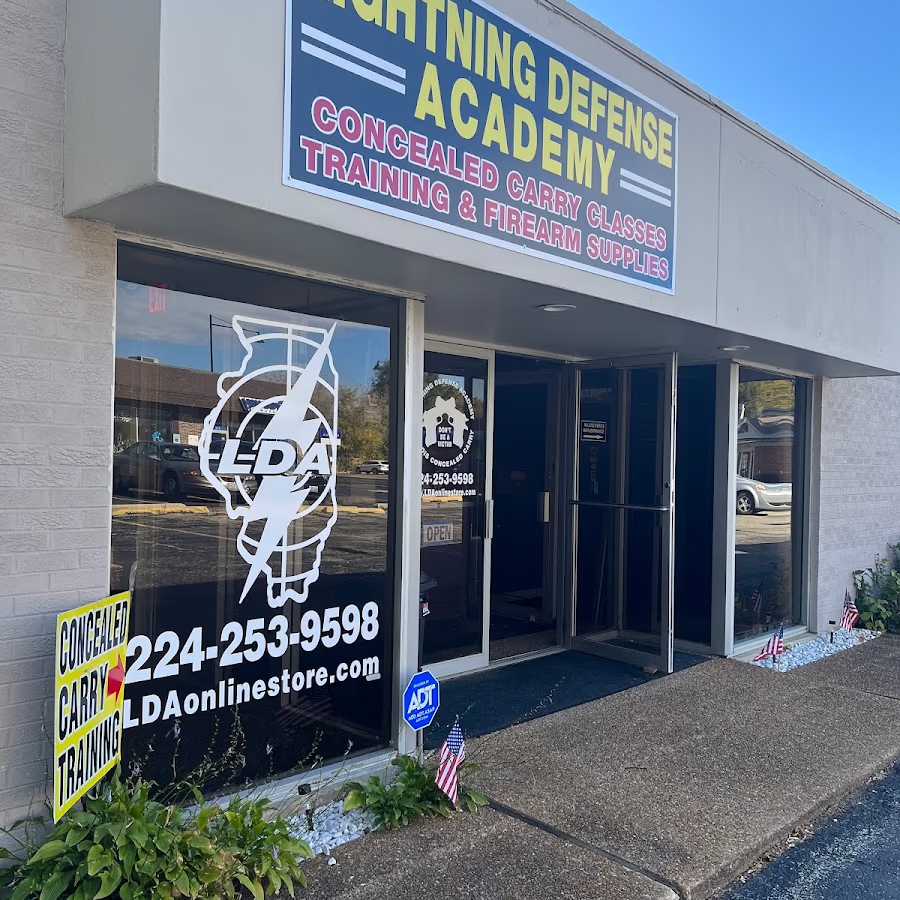
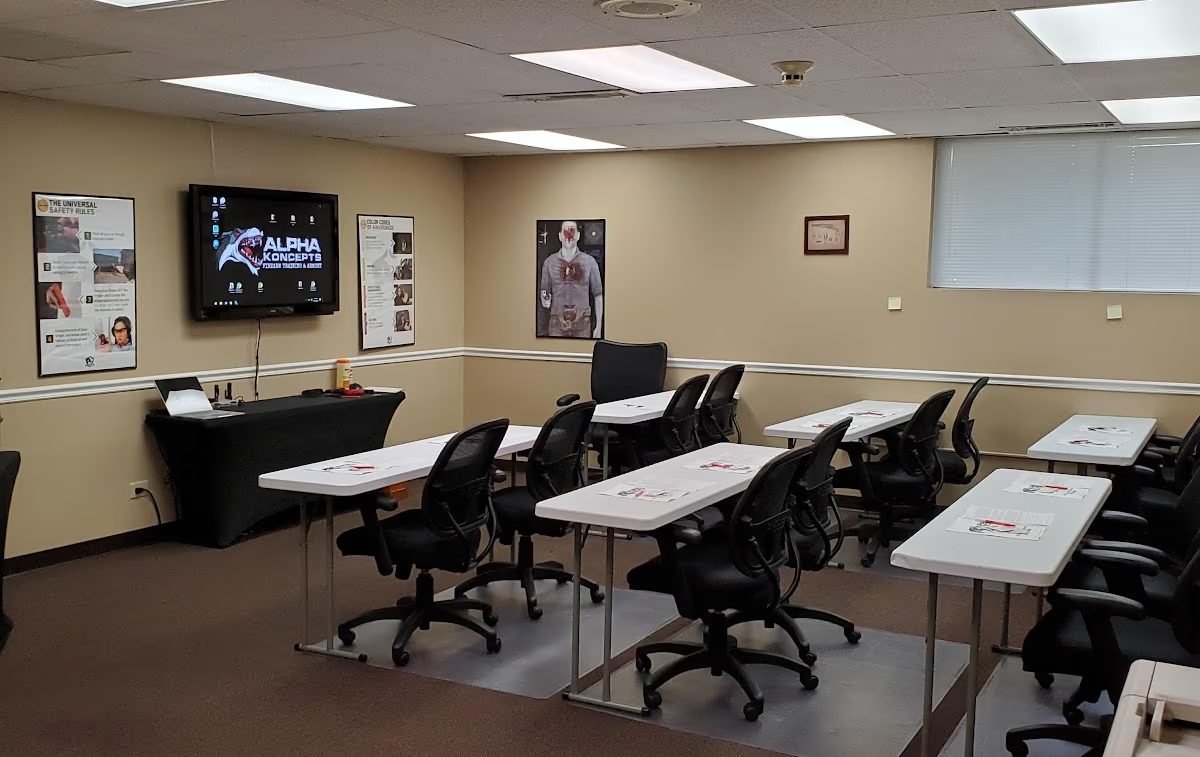
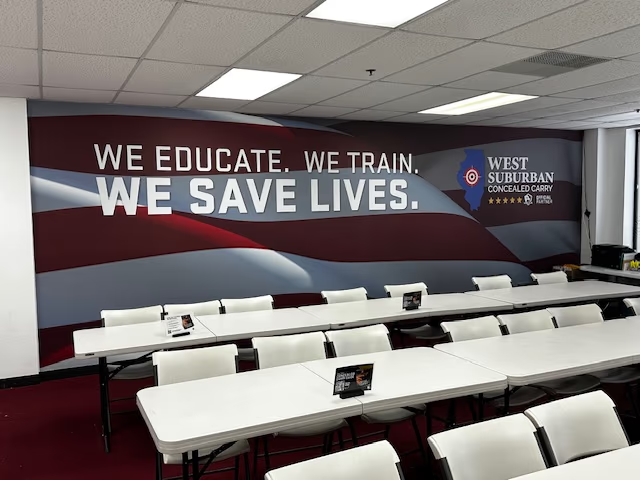
Businesses in our directory that offer firearms training. These are not state-verified as certified permit instructors — check against the official list above, or ask the provider directly.

All firearms training in Illinois →

Reciprocity

Carrying into Illinois

Illinois recognizes no out-of-state carry permits. A permit from another state does not authorize you to carry here. Illinois does, however, issue its own license to non-residents — see the application details above.

26 jurisdictions honor a Illinois permit

Derived from what each of those states officially publishes.

Alaska, Alabama, Arkansas, Arizona, Florida, Iowa, Idaho, Indiana, Kansas, Kentucky, Michigan, Minnesota, Missouri, Mississippi, Montana, North Carolina, Nebraska, Nevada, Ohio, Oklahoma, South Dakota, Tennessee, Texas, Utah, Virginia, Wisconsin

Official Illinois reciprocity page Full reciprocity matrix →

Building your own in Illinois

Build for personal use
Allowed
Serial number required
Yes

Illinois does not flatly outlaw assembling a firearm for personal use, but it has effectively closed the unserialized-build route, and getting this wrong is felony exposure. 720 ILCS 5/24-5.1 ('Serialization of unfinished frames or receivers; prohibition on unserialized firearms; exceptions; penalties') makes it unlawful for any person to knowingly possess, transport, or receive an UNFINISHED FRAME OR RECEIVER that is not serialized, and unlawful to knowingly possess, purchase, transport, or receive A FIREARM THAT IS NOT IMPRINTED WITH A SERIAL NUMBER. There is NO personal-use or hobbyist exception. Critically, an individual may NOT apply the serial number themselves: the statute provides that such items 'shall be serialized by a federally licensed firearms dealer or other federal licensee authorized to provide marking services with the licensee's abbreviated federal firearms license number as a prefix (which is the first 3 and last 5 digits) followed by a hyphen, and then followed by a number as a suffix,' marked to the federal permanence and placement standards of 27 CFR 478.124. So a lawful personal build in Illinois means starting from a frame/receiver that already bears an FFL-applied serial number, or having an FFL serialize it. Penalties: unlawful possession is a Class A misdemeanor for a first violation and a Class 3 felony for a second or subsequent violation; unlawful sale or transfer of an unserialized frame, receiver, or firearm is a Class 4 felony for a first violation and a Class 2 felony for a second or subsequent violation. Limited exceptions cover antique firearms as defined in 18 U.S.C. 921(a)(16), firearms manufactured before October 22, 1968, permanently inoperable firearms, and inherited firearms (short grace period to serialize); 3D-printed firearms carry a 30-day serialization window. There is no separate state firearm registration database for ordinary firearms, but a valid FOID card is required to possess any firearm or ammunition in Illinois, and Illinois's assault weapons and large-capacity magazine restrictions under the Protect Illinois Communities Act (P.A. 102-1116, eff. 1-10-23) independently prohibit building certain configurations. PICA IS IN FORCE TODAY: on 9 July 2026 the Seventh Circuit, in Barnett v. Raoul, Nos. 24-3060, 24-3061, 24-3062 and 24-3063 (St. Eve, J.; Brennan, C.J., dissenting), held 'We REVERSE the judgments of the district court, and we REMAND the cases with directions to enter judgments for the defendants,' undoing Judge McGlynn's judgment against the Act, and the ISP assault weapons page states that the Illinois Supreme Court reversed the Macon County judgment and 'the Protect Illinois Communities Act is enforceable across Illinois.' The Supreme Court has granted certiorari in Viramontes v. Cook County (No. 25-238), consolidated with Grant v. Higgins (No. 25-566), on whether the Second and Fourteenth Amendments protect a right to possess AR-15 platform and similar semiautomatic rifles, with argument set for 2 December 2026 - so the weapons-ban side of this may change, but none of it alters Illinois carry licensing.

720 ILCS 5/24-5.1 (added by Public Act 102-0889, eff. May 18, 2022; amended by P.A. 103-605, eff. July 1, 2024); 430 ILCS 65 (FOID Act)

Federal law, gunsmithing schools, and tools →

Statutes

What we could not confirm

  • Renewal fee: 430 ILCS 66/60(b)-(c) states that 'An applicant for a new license or a renewal shall submit $150' (residents) / $300 (non-residents), so renewal costs the same as the initial license. The ISP CCL page and FAQ state the $150/$300 figures as the application fee but do not separately restate a renewal amount, so the renewal figure rests on the statute rather than an ISP fee schedule. 430 ILCS 66/60 has not been amended since 2013, so this is stable, but it is an inference from 'a new license or a renewal' rather than a published renewal price.
  • The six 'substantially similar' states for non-resident CCL eligibility (Arkansas, Idaho, Mississippi, Nevada, Texas, Virginia) were re-read on the ISP CCL page and the ISP FAQ today and are unchanged. However, ISP sets this list administratively by surveying other states under 20 Ill. Adm. Code 1231.110(c) and posts it on its own website, and the page itself says 'This list will be updated as additional states are identified as substantially similar.' A non-resident should re-check the ISP CCL page immediately before applying rather than relying on this record.
  • There is no ISP-published reciprocity page, because Illinois has none. The 'honors: []' value rests on (a) the absence of any recognition provision anywhere in 430 ILCS 66, whose every section I read today, (b) the ISP FAQ's statement that everyone carrying concealed on the person in Illinois needs an Illinois CCL, and (c) the FAQ's only reciprocity answer, which addresses Illinois licensees travelling out of state and not out-of-state licensees coming in. It is a well-supported inference, not a quotation from a page titled 'reciprocity'.
  • Fingerprints: 430 ILCS 66/30(b)(8) lists fingerprints among required application contents but also provides that ISP 'may accept an application submitted without a set of fingerprints,' in which case ISP gets 30 days beyond the 90-day deadline. fingerprintsRequired is recorded as true because they are the default, are what the ISP checklist directs applicants to obtain, and are practically expected, but they are not strictly mandatory.
  • Illinois is classified 'shall-issue' because 430 ILCS 66/10(a) directs ISP to issue to a qualified applicant, and the Seventh Circuit in Barnett v. Raoul (9 July 2026) treated shall-issue regimes as presumptively constitutional. But 430 ILCS 66/10(a)(4) conditions issuance on the applicant not posing a danger 'as determined by the Concealed Carry Licensing Review Board,' and the Board can sustain a law enforcement objection on a preponderance of the evidence (430 ILCS 66/15, 66/20), with a mandatory ISP objection where an applicant has 5+ arrests in 7 years or 3+ gang-related arrests in 7 years. Some observers treat that as a residual discretionary element. I did not verify current Board grant/denial rates.
  • The full list of statutorily prohibited places in 430 ILCS 66/65(a) runs to roughly two dozen categories and is only summarised in this record; violations carry criminal penalties and the section has its own detailed exceptions and signage rules (20 Ill. Adm. Code and the ISP signage page), so a licensee should read 66/65 itself. The one previously unsettled piece is now settled: the public transit ban in 66/65(a)(8) was upheld by the Seventh Circuit in Schoenthal v. Raoul, 150 F.4th 889 (2 Sept. 2025), and certiorari was denied 6 April 2026 (No. 25-541).
  • The FOID card's fee ($10 new and $10 renewal, 430 ILCS 65/5) and 10-year term (430 ILCS 65/7) were verified from the statute today, and both are distinct from the CCL's $150/$300 fee and 5-year term. I did not, however, review the full body of FOID eligibility criteria (430 ILCS 65/4 and 65/8 run to many pages) or the ongoing litigation over the FOID requirement itself. Anyone whose eligibility is marginal should read 430 ILCS 65/8 directly.
  • The ILCS full-text pages served a 'Text of Section before amendment' / 'Text of Section after amendment' pair for 430 ILCS 65/5 because of P.A. 104-131, eff. 9-1-26. Because today is 15 September 2026, the post-amendment text is the one in force; the amendment only changes how the $10 fee is apportioned between State Police funds and does not change the fee, the term, or any carry requirement. No section of 430 ILCS 66 carried a pending-amendment marker.
  • OPERATIONAL WARNING FOR THE LINK CHECKER: every ilga.gov URL in this record returns HTTP 403 to a default curl/bot user agent and HTTP 200 to a browser user agent. The 403s are not link rot - the same URLs serve full statute text when a normal User-Agent header is sent. A checker that reports these as dead is producing false positives, and one that 'fixes' them by replacing the URLs will make the record worse. Separately, ilga.gov now accepts the short forms (ilga.gov/legislation/ilcs/documents/...) by 301-redirecting them to the /documents/legislation/... paths recorded here, and the legacy ilcs3.asp?ActID= query form redirects to /Legislation/ILCS/Articles?ActID=, so the recorded URLs are the canonical live ones.
  • The Protect Illinois Communities Act assault-weapons and magazine restrictions are in force today (Seventh Circuit, Barnett v. Raoul, 9 July 2026, reversing and remanding for judgment for the State; ISP's own page says the Act 'is enforceable across Illinois'). But the Supreme Court granted certiorari on 30 June 2026 in Viramontes v. Cook County (No. 25-238), consolidated with Grant v. Higgins (No. 25-566), on whether the Second and Fourteenth Amendments protect a right to possess AR-15 platform and similar semiautomatic rifles, with argument set for 2 December 2026. A decision could change what weapons may be possessed or built in Illinois. It does not bear on the CCL, the FOID card, or any carry requirement in this record, and nothing in this record should be read as predicting that outcome.

Sources