Connecticut requires a State Permit to Carry Pistols and Revolvers to carry. It is shall-issue, the minimum age is 21, and training is required.
Requirements at a glance
Permit name
State Permit to Carry Pistols and Revolvers
Issuing authority
Two-step. Stage 1: the "local permitting authority" — defined since P.A. 25-18 (eff. 10/1/2025) in C.G.S. § 29-28(a) as the chief of police, or where there is no chief of police the municipal chief executive officer, or, if that officer so designates, the resident state trooper or a state police officer of the troop with jurisdiction — issues a 60-day Temporary State Permit under § 29-28(c). If the applicant's bona fide permanent residence is within the jurisdiction of a federally recognized Native American tribe that has a law enforcement unit and that unit accepts applications, its chief of police issues the temporary permit instead, and no other law enforcement unit may. Stage 2: the Commissioner of Emergency Services and Public Protection, through the Connecticut State Police Special Licensing and Firearms Unit (SLFU), issues the 5-year State Permit. Non-residents skip stage 1 and apply directly to DESPP/SLFU under § 29-28(g).
System
shall-issue
Minimum age
21 — C.G.S. § 29-28(c)(10) bars issuance of a state or temporary state permit to any applicant who "is less than twenty-one years of age." (This disqualifier sat in § 29-28(b)(10) until P.A. 25-18, eff. 10/1/2025, inserted a new subsection (a) defining "local permitting authority" and redesignated former subsections (a)-(f) as (b)-(g).) No military or other under-21 exception exists for the carry permit. DESPP's applicant instruction sheet DPS-769-C (Rev. 09/11/2025) repeats the age-21 bar as item 13. By contrast, an eligibility certificate for long guns is available at 18 under § 29-37p — that is not a carry permit.
Training required
Yes, live fire required
State fee
$140 initial / $70 renewal — the state's own charge, not the total
Valid for
5 years
Processing time
Roughly 8 weeks for the local/temporary stage. C.G.S. § 29-28a(b)(1) requires the local permitting authority (or tribal chief of police) to inform the applicant of approval or denial not later than eight weeks after a sufficient application, with a detailed written reason for any denial. C.G.S. § 29-29(c) separately requires the issuing authority to notify the applicant in writing if national criminal history results have not come back within 8 weeks, and to decide within one week of receiving the results. If the local authority neither expressly denies nor issues within the 8-week window, § 29-28a(b)(1)(B) lets the applicant present an affidavit attesting to that failure to the Commissioner 16 weeks after submission (32 weeks for applications filed on or before 3/30/2024, and 32 weeks during a declared federal major disaster/emergency or a gubernatorial epidemic, public-health or natural-disaster declaration under § 29-28a(b)(2)); the Commissioner then accepts the affidavit in lieu of a temporary state permit. The Commissioner then has 8 weeks from receiving the approved application or affidavit to approve, deny, or report that the FBI check is outstanding. After the 60-day Temporary State Permit issues, the applicant has 60 days to appear at an SLFU location for the 5-year State Permit (§ 29-28(c); § 29-30(c)).
Fingerprints
Required
Non-resident permit
Available
What it actually costs
The state fee is rarely the whole bill. Fingerprinting is usually charged by a private
vendor, training is bought from an instructor, and several states add photographs,
notarisation or other requirements on top.
State fee
$140
Training course
$75–$250 (private instructor)
FBI national check
varies — § 29-30(a) asks for 'sufficient funds' to cover it and fixes no amount
Fingerprint processing
varies — not stated on the DESPP permit pages
Duplicate/replacement permit
varies — $5 to Treasurer, State of Connecticut, with form DPS-900-C-1
The $140 is collected in two $70 halves — one to the local permitting authority with the temporary-permit application, one to the State Treasurer when the 5-year state permit issues — and renewal is $70, so Connecticut's permit gets cheaper to hold than to get. Do not read DESPP's "The cost for obtaining a pistol permit is $70.00" as the total: that is the state half only. The statute then adds the FBI check as an open-ended pass-through, the same drafting choice that makes Washington impossible to total. No hour count is set, but the course must have been completed within two years of applying, so an old certificate does not carry here the way it does in Maine or Montana. From October 1, 2026, P.A. 26-41 adds a small consumer protection: if the local permitting authority misses its statutory deadlines, it owes the applicant a $70 refund and still has to finish the work.
C.G.S. § 29-30(a) (2026 Supplement): the fee for a state permit originally issued under subsection (c) of § 29-28 is $140 "plus sufficient funds as required to be transmitted to the Federal Bureau of Investigation to cover the cost of a national criminal history records check." The statute itself splits that $140 into two $70 halves: $70 "shall be retained by the local permitting authority" with the DPS-799-C temporary-permit application, and on approval of that application "seventy dollars shall be sent to the commissioner." In practice the applicant writes two $70 payments — one to the local authority, one to "Treasurer, State of Connecticut" when the 5-year state permit is issued — as stated on form DPS-799-C (Rev. 07/16/2024) and instruction sheet DPS-769-C (Rev. 09/11/2025). A reader who sees only DESPP's web page ("The cost for obtaining a pistol permit is $70.00") will underestimate the total by half: that $70 is the state half alone. Renewal is $70 (mail or online). Duplicate/replacement permit $5 (form DPS-900-C-1). Fingerprint-processing and FBI national-check fees are additional and paid separately (amount not stated on the DESPP permit pages). Training-course tuition is a separate private cost. New from October 1, 2026: P.A. 26-41, § 12 rewrites § 29-30(e) so that if the local permitting authority misses the deadlines in § 29-28a(b)(1) or § 29-29(b) or (c), it must refund $70 to the applicant — and the refund does not excuse it from finishing the work.
How to apply
Connecticut has no permitless carry: you need a Connecticut permit to carry a pistol or revolver anywhere outside your home, your own land, or your place of business (C.G.S. § 29-35(a)(1)), and open carry/display is separately prohibited by § 29-35(a)(2). No out-of-state permit works here.
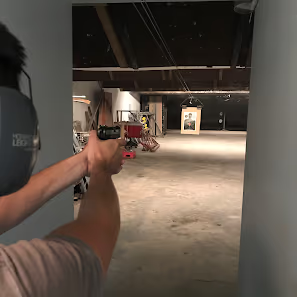
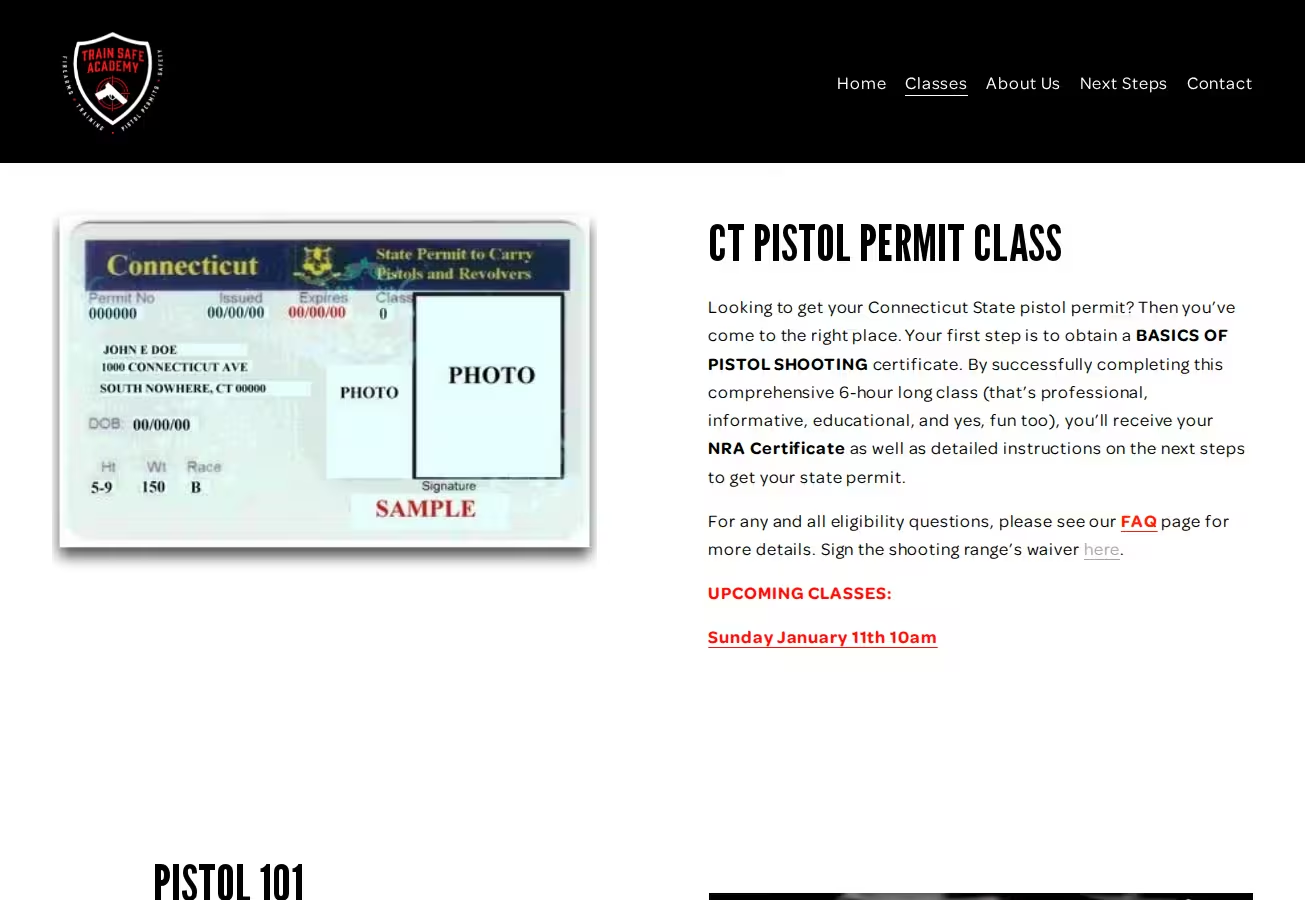
Complete a DESPP-approved firearms safety and use course within the two years before you apply (§ 29-28(c)(1)(B)). DESPP requires at least the equivalent of the NRA Basic Pistol Course and requires live fire with an actual semi-automatic pistol or revolver; NRA Home Firearms Safety and First Steps Pistol Orientation are not accepted. Keep the instructor-signed certificate. Approved instructors are listed on DESPP's CT Approved Instructors PDF.
Complete and notarize form DPS-799-C (Rev. 07/16/2024), checking "60 Day Temporary State Pistol Permit" (residents) or "Non-Resident State Pistol Permit" (non-residents).
Residents: submit DPS-799-C to your local permitting authority — your chief of police, or if your town has none, the municipal chief executive officer or the resident state trooper/state police officer that officer designates (§ 29-28(a)) — with the course certificate, a $70 fee payable to the local authority, and proof you are legally and lawfully in the United States (certified birth certificate, U.S. passport, or USCIS permanent-residence documentation).
If your bona fide permanent residence is within the jurisdiction of a federally recognized Native American tribe whose law enforcement unit accepts these applications, apply to that unit's chief of police instead — no other law enforcement unit may issue your temporary permit (§ 29-28(c)).
Be fingerprinted for state and national criminal history records checks (C.G.S. §§ 29-29(b), 29-17a); your local law enforcement agency handles the fingerprinting.
The local authority investigates your suitability and must approve or deny in writing within eight weeks (§ 29-28a(b)(1)). If approved, it issues a 60-day Temporary State Permit to Carry Pistols and Revolvers (form DPS-11-C).
If eight weeks pass with no express denial and no temporary permit, you may — 16 weeks after you filed (applications on or after 4/1/2024) — give the Commissioner an affidavit attesting to that failure, and the Commissioner must accept it in lieu of a temporary state permit (§ 29-28a(b)(1)). From October 1, 2026 the local authority must also refund $70 to you if it blew those deadlines (§ 29-30(e)(2), as amended by P.A. 26-41).
Within those 60 days, appear in person at DESPP Headquarters, 1111 Country Club Road, Middletown, or the satellite office at Troop G, 149 Prospect Street, Bridgeport (the Troop E Montville office is no longer listed), with the DPS-11-C, the state permit application form DPS-46 (obtained at the permit location), a $70 check or money order payable to "Treasurer, State of Connecticut" (or exact cash), proof of lawful U.S. presence, and valid photo ID. See instruction sheet DPS-769-C (Rev. 09/11/2025).
DESPP photographs you, takes your signature, and issues the laminated 5-year State Permit to Carry Pistols and Revolvers (§ 29-28(c); § 29-30(c)).
Non-residents: you must already hold a permit or license to carry a pistol or revolver issued by another state or U.S. subdivision; email SLFU.OOS@ct.gov with your full name and mailing address to request the out-of-state packet, and apply directly to the Commissioner under C.G.S. § 29-28(g) (the same disqualifiers and rules in subsections (c)-(f) apply).
Carry the permit on your person whenever you carry the pistol or revolver, and show it to a law enforcement officer who has reasonable suspicion of a crime and observes the firearm (§ 29-35(b)). Notify the issuing authority of any address change within two business days (§ 29-28(c)).
Renewal: DESPP mails or emails a renewal notice with form DPS-129-C at least 90 days before expiration (§ 29-30(f)). Renew by mail or through DESPP's online portal — there are no in-person renewals — with the $70 fee, proof of citizenship/legal residency, and a 2"x2" color passport photo taken within the previous six months. Renewal must be requested no earlier than 31 days before and no later than 31 days after the expiration date (§ 29-30(d)), and the permit stays valid for 90 days past expiration unless revoked or revocation is pending (§ 29-30(f)).
Denials, revocations and limitations may be appealed to the Board of Firearms Permit Examiners within 90 days (C.G.S. § 29-32b).
Not found to be a "suitable person" by the issuing authority, or found to intend other than lawful use — a discretionary suitability finding required by § 29-28(c), appealable de novo to the Board of Firearms Permit Examiners under § 29-32b
Conviction of a felony (§ 29-28(c)(2)(A))
Misdemeanor violation of § 21a-279 (drug possession) on or after October 1, 2015 (§ 29-28(c)(2)(B)(i))
Conviction in the preceding EIGHT years of a Connecticut misdemeanor under §§ 53a-58, 53a-61, 53a-61a, 53a-62, 53a-63, 53a-96, 53a-175, 53a-176, 53a-178 or 53a-181d (§ 29-28(c)(2)(B)(ii)) — the look-back was shortened from 20 years to 8 years by P.A. 25-43, §§ 4-6, effective October 1, 2025
Conviction of a Connecticut misdemeanor designated a family violence crime under § 46b-38h (§ 29-28(c)(2)(B)(iii); DESPP's DPS-769-C applies this to convictions on or after 10/1/2023)
Conviction in the preceding eight years of a misdemeanor in another state or a federal, tribal, military or foreign court that a reasonable reviewer would believe to constitute a crime of violence causing physical injury, a crime creating a risk of serious physical injury with extreme indifference to human life or negligently causing death (other than by motor vehicle), a crime causing another to reasonably fear for their safety, riot/inciting riot, or possession of a controlled or hallucinogenic substance other than under four ounces of cannabis, under one-half ounce of psilocybin, or nicotine (§ 29-28(c)(2)(B)(iv)) — new disqualifier added by P.A. 25-43, effective October 1, 2025
Adjudicated delinquent for a serious juvenile offense (§ 29-28(c)(3); § 46b-120)
Discharged from custody within the preceding 20 years after a finding of not guilty by reason of mental disease or defect (§ 29-28(c)(4); § 53a-13)
Confined by probate court order to a hospital for persons with psychiatric disabilities within the preceding 60 months, or voluntarily admitted (on/after Oct 1, 2013) or committed under an emergency certificate (on/after Oct 1, 2023) within the preceding 6 months for psychiatric care, not solely for alcohol or drug dependence (§ 29-28(c)(5))
Subject to a restraining or protective order issued in a case involving the use, attempted use or threatened use of physical force, including an ex parte order under § 46b-15 or § 46b-16a (§ 29-28(c)(6))
Subject to a pre-June 1, 2022 firearms seizure order after notice and hearing, or a risk protection order / risk protection investigation order issued on or after June 1, 2022 under § 29-38c (§ 29-28(c)(7))
Prohibited under 18 U.S.C. § 922(g)(2), (g)(4) or (g)(9) (§ 29-28(c)(8))
An alien illegally or unlawfully in the United States (§ 29-28(c)(9))
Applied for a temporary state permit more than once in the preceding 12 months (procedural bar in § 29-28(c), which must be attested to in writing on the application under penalty of false statement)
Where to get the required training
Connecticut publishes an official list of certified instructors. That list is
authoritative — a certificate from an instructor who is not on it may not be accepted.
View the official instructor list
Training providers in Connecticut
Businesses in our directory that offer firearms training. These are
not state-verified as certified permit instructors —
check against the official list above, or ask the provider directly.
Connecticut recognizes no out-of-state carry permits. A permit from another state does not authorize you to carry here. Connecticut does, however, issue its own license to non-residents — see the application details above.
26 jurisdictions honor a Connecticut permit
Derived from what each of those states officially publishes.
Verified against statute text 2026-09-15: building a firearm for personal use is legal in Connecticut, but only under a strict serialization-and-reporting regime — so the classification is self-manufacture ALLOWED, serialization REQUIRED. C.G.S. § 29-36a(a): no person may complete the manufacture of a firearm without subsequently (1) obtaining a unique serial number or other mark of identification from DESPP and (2) engraving or permanently affixing it in the manner federal law requires of licensed importers and manufacturers under 18 U.S.C. § 923(i). § 29-36a(b): not later than 30 days after completing manufacture the maker must notify DESPP and provide identifying information about the firearm and its owner; DESPP checks whether the person is prohibited from purchasing a firearm and, if not, issues the number immediately and in no case more than 3 business days after the request. "Manufacture" is defined broadly as "to fabricate or construct a firearm including the initial assembly" (§ 29-36a(j)). Since January 1, 2024, § 29-36a(c) makes it unlawful to possess any firearm lacking a serial number unless possession was timely declared to DESPP or a serial-number application is pending; pre-October 1, 2019 unserialized firearms had to be declared by January 1, 2024, and a person moving into Connecticut with an unserialized firearm has 90 days to serialize it, render it permanently inoperable, sell it to a federally licensed dealer, or remove it from the state. Transfer of a firearm manufactured in violation of the section is prohibited (§ 29-36a(e)), as is distributing, importing, keeping for sale, offering for sale or purchasing an unserialized firearm (§ 29-36a(c)(6)); § 29-36a(g) also forbids knowingly, recklessly or negligently facilitating, aiding or abetting manufacture by or for a prohibited person. Exemptions (§ 29-36a(f)): federally licensed manufacturers, antique firearms as defined in 18 U.S.C. § 921, firearms manufactured before December 16, 1968 if otherwise lawfully possessed, and delivery or transfer to a law enforcement agency. Penalty (§ 29-36a(i)): class C misdemeanor for a person otherwise eligible to possess firearms; class C felony (2-year non-suspendable minimum, $5,000 non-remittable fine) for a person ineligible to possess a firearm. Separately, C.G.S. § 53-206j governs unfinished frames and lower receivers: they may be purchased or transferred only through the same procedures that apply to pistols and revolvers under § 29-33(b)-(e), only if already serialized (via the ATF serial-numbering program or a DESPP-issued number engraved/affixed per § 923(i)), and since October 1, 2019 no one may possess an unfinished frame or lower receiver unless eligible to purchase a firearm. Violation of § 53-206j is a class C felony with a 2-year non-suspendable minimum (class B felony, 3-year minimum, if the item is known to be stolen or its markings altered). In practice, buying an unserialized "80%" lower in Connecticut is a felony; a self-built firearm must carry a DESPP-issued serial number and be reported to DESPP within 30 days. Section 29-36a's amendment history ends at P.A. 23-53 and § 53-206j's at P.A. 22-26; neither appears in the 2026 Supplement, so neither was amended in the 2025 sessions. Coming October 1, 2026 (P.A. 26-41, approved May 26, 2026): § 53-206j is rewritten to use the term "unfinished frame or unfinished lower receiver" and to broaden the definition from a body on which "most major machining operations have been completed" to any blank, casting, forging, printing, extrusion, machined body or similar item that "has reached a stage in manufacture where it may readily be completed into the frame or receiver of a functional firearm" or "is marketed or sold to the public to become or be used as the frame or receiver of a functional firearm once completed"; § 29-28(b) is amended to require a permit for the retail sale of unfinished frames or lower receivers; and §§ 29-36a(d) and 29-36b are conformed. The core self-manufacture-with-serialization rule is unchanged.
permitSystem classification is a judgment call. C.G.S. § 29-28(c) says the local permitting authority "may issue" a temporary state permit "provided such local permitting authority shall find that ... such person is a suitable person to receive such permit." There is no good-cause/proper-cause requirement (Connecticut never had one, so Bruen did not force a change), and denials get de novo review by the Board of Firearms Permit Examiners under § 29-32b — so it functions as shall-issue. But the discretionary "suitable person" standard is real and some classifications still call Connecticut may-issue. Treat as shall-issue-with-suitability-review.
Training hours: no hour figure appears in statute or in DESPP's published guidance. DESPP says the course must be "no less than the NRA's 'Basic Pistol Course'" (typically about 8 hours), but there is no officially mandated minimum number of hours, so training.hours is left blank rather than guessed.
Live-fire requirement: stated plainly on the DESPP pistol permit page ("Live fire is also required ... Students must fire a semi-automatic pistol or revolver"). It is not spelled out in the post-July-1-2024 statutory text of § 29-28(c)(1)(B), which describes course content generically. Sourced to the agency, not the statute.
Exact fingerprint-processing and FBI national criminal history check fees are not published on the DESPP permit pages; § 29-30(a) only says "sufficient funds" for the FBI check are added to the $140. The dollar amount of that add-on is unconfirmed, so the total cost of a Connecticut permit cannot be stated exactly.
Whether a non-resident applying directly to DESPP under § 29-28(g) pays the same $140 (which for residents is split $70 local / $70 state) or a different amount is not stated on the DESPP out-of-state material; the fee schedule in § 29-30(a) is written around the local-authority split, and the out-of-state packet is distributed only by email request to SLFU.OOS@ct.gov, which I could not obtain.
DESPP publishes no reciprocity page at all. The "honors nothing" conclusion is drawn from the absence of any recognition provision (zero hits for "reciproc" in the current Chapter 529 text, in the 2026 Supplement to Chapter 529, and in all 151 public acts of the 2026 regular session) plus the plain text of § 29-35(a)(1), rather than from an affirmative official statement. There is no DESPP page that says in so many words "Connecticut does not recognize out-of-state permits."
The cga.ct.gov /current/pub/ chapter pages are the BASE revision and carry a notice directing readers to the 2026 Supplement, revised to January 1, 2026, for sections amended in the 2025 sessions. Sections 29-28, 29-28a, 29-29, 29-30 and 29-32b are all in that supplement, so the /current/pub/ text of those five sections is stale and must not be quoted; this record cites the supplement for them and the base chapter only for sections (29-35, 29-36a, 29-36b, 29-17a, 53-206j) that the supplement does not contain. Neither page set yet contains the 2026-session amendments in P.A. 26-41, which take effect October 1, 2026.
DESPP's own web reproduction of the disqualifiers is out of date. The State Pistol Permit page (last modified 01/10/2025) still describes psychiatric confinement "within the preceding 12 months by order of a probate court" where § 29-28(c)(5) says 60 months, and it predates P.A. 25-43. Form DPS-769-C (Rev. 09/11/2025) is current and does carry the 8-year look-back and the new out-of-jurisdiction misdemeanor disqualifier. The disqualifiers in this record are taken from the statute, corroborated by DPS-769-C, not from the web page.
The SLFU "Special Licensing and Firearms Legislation" page is dated February 11, 2025 and therefore lists nothing from the 2025 or 2026 sessions; it was not relied on.
The August 2025 pass cited "P.A. 25-157" as a 2025 act affecting purchase eligibility and armed security officer permits. P.A. 25-157 (sHB 6859) exists, but it does not appear in the amendment-history line of § 29-28, § 29-29 or § 29-30, so it did not amend the carry-permit sections. The 2025 acts that did are P.A. 25-18 (renumbering; "local permitting authority" definition) and P.A. 25-43 (misdemeanor look-back and new out-of-jurisdiction disqualifier), both effective October 1, 2025.
P.A. 26-41 was approved May 26, 2026 but every operative section takes effect October 1, 2026 — after this verification date. Until then the $70 refund in § 29-30(e)(2) and the broadened "unfinished frame or unfinished lower receiver" definition in § 53-206j are enacted law but not yet in force. A record consumed after October 1, 2026 should treat them as current.
Amendment hunting was done by code section, not bill title: I read the parenthetical amendment-history line and History narrative for each section relied on (§§ 29-28, 29-28a, 29-29, 29-30, 29-35, 29-36a, 29-36b, 53-206j) and then downloaded and text-searched all 151 public acts of the 2026 regular session for those section numbers. Only P.A. 26-41 amends any of them; P.A. 26-45 (the DESPP omnibus) touches only the bail-enforcement supplemental permit in § 29-152m. No 2026 special session is listed. What I did NOT do is search for 2026 acts that change carry law without citing these section numbers at all (for example a wholly new section), so a brand-new free-standing provision could in principle have been missed.