California requires a License to Carry a Pistol, Revolver, or Other Firearm Capable of Being Concealed Upon the Person (commonly "CCW license") to carry. It is shall-issue, the minimum age is 21, and 16 hours of training is required.
Requirements at a glance
Permit name
License to Carry a Pistol, Revolver, or Other Firearm Capable of Being Concealed Upon the Person (commonly "CCW license")
Issuing authority
County sheriff (Pen. Code § 26150) or the chief of a municipal police department (Pen. Code § 26155). The California DOJ Bureau of Firearms prescribes the standard application form (BOF 4012), the non-resident supplement (BOF 4013) and the uniform license (BOF 4501, Rev. 09/2026, which now includes non-resident standard and judicial license types) and runs the background check, but the DOJ does NOT issue CCW licenses. The DOJ CCW FAQ states: "County sheriffs and police departments are the licensing authorities responsible for issuing CCWs, not the DOJ."
System
shall-issue
Minimum age
21 — Pen. Code § 26150(a)(2) and § 26155(a)(2) require the applicant to be "at least 21 years of age" with clear evidence of identity and age. The same 21-year minimum applies to non-resident applicants under § 26150(b)/§ 26155(b) (AB 1078, Stats. 2025, ch. 570, effective 1/1/2026), who must present clear evidence of identity, age AND state of residence. There is no lower age tier.
Training required
Yes — 16 hours, live fire required
State fee
$93 initial / $93 renewal — the state's own charge, not the total
Valid for
2 years
Processing time
Statutory deadlines (Pen. Code § 26205, as amended by AB 1078): for a NEW license the licensing authority must give written notice of approval or denial within 120 days of receiving the completed application, or 30 days after receipt of the DOJ firearms eligibility information, whichever is later. For RENEWALS submitted before September 1, 2026: within 120 days of the completed application (§ 26205(a)(2)). For renewals submitted on or after September 1, 2026 — the rule now in force — within 120 days of the completed application, or 30 days after receipt of the DOJ firearms eligibility check information, whichever is later (§ 26205(a)(3)). A denial must state which requirement was not satisfied. Since September 1, 2026 a licensing authority is also 'not authorized to issue a renewal CCW license' until the applicant's fingerprints and fees have been submitted to DOJ and DOJ has confirmed eligibility (Pen. Code § 26185(b)(2), (c)(3); IB 2026-DLE-14), which in practice lengthens renewals. Actual waits in large counties frequently exceed these deadlines.
Fingerprints
Required
Non-resident permit
Available
What it actually costs
The state fee is rarely the whole bill. Fingerprinting is usually charged by a private
vendor, training is bought from an instructor, and several states add photographs,
notarisation or other requirements on top.
State fee
$93
Fingerprinting
$15–$45 — our estimate; no vendor publishes a rate
Training course
$150–$350 (private instructor)
County or city fee
varies — Pen. Code § 26190 lets each authority set its own, capped at its reasonable costs, with no more than 50% collectible at filing. Observed range: about $40 (El Dorado), $100 total (Placer: $20 filing + $80 on approval), $156.50 (San Luis Obispo), $300 (Orange County). This is the largest and most variable component.
Psychological assessment
$150 — only where the licensing authority requires one; capped at its reasonable cost. Non-residents may be offered a virtual assessment or a provider within 75 miles of their residence.
Realistic total
$358–$938 — includes an estimated component
The $93 is the DOJ portion only, and since September 1, 2026 it is also the DOJ renewal fee for a standard license (up from $52). California is the widest gap in the country between the published fee and the real one: with a county fee, Live Scan, 16 hours of mandatory training and a psychological assessment where the authority requires one, the realistic outlay is several hundred dollars — roughly $358 in a cheap county with cheap training and no psych evaluation, and $900+ in an expensive one. The psychological assessment fee is capped at the authority's reasonable cost and is unique to California among the states we have checked.
The $93 figures are the STATE DOJ portion ONLY. DOJ published its own fee table in Information Bulletin 2026-DLE-14 (08/31/2026): effective September 1, 2026 the CCW fees are Employment $71, Standard $93, Judge $115, Reserve Officer $137, Custodial Officer $137. The bulletin states that 'the renewal fees for CCW licenses will increase effective September 1, 2026, pursuant to Penal Code section 26190, to include costs associated with processing the fingerprinting requirement' — so the standard-CCW RENEWAL DOJ fee rose from $52 to $93 (employment $30 to $71; judicial $74 to $115). On top of the DOJ fee, Pen. Code § 26190 authorizes each county/city to charge its own fee covering the reasonable costs of processing, issuing and enforcing the license; these vary enormously (Orange County $300 initial / $111 renewal effective 7/1/2025; San Luis Obispo $156.50 initial; Placer County $20 filing + $80 on approval, $77 renewal; El Dorado County about $40). Only the first 50 percent of the local fee may be collected at filing; 'the balance of the fee shall be collected only upon issuance of the license.' ADDITIONAL costs not included: the Live Scan rolling fee charged by the operator; the psychological assessment fee where the authority requires one (actual cost, capped at the authority's reasonable cost; may be virtual or within 75 miles of a non-resident's residence); and privately priced 16-hour training. Realistic all-in initial cost commonly runs several hundred dollars depending on county and training provider.
How to apply
Understand that a license is mandatory: California has no permitless carry, and only a license issued by a California sheriff or California police chief exempts you from the Pen. Code § 25400 concealed-carry crime (Pen. Code § 25655). No out-of-state permit is recognized.
Confirm threshold eligibility: 21 or older; a resident of (or principally employed/doing business in) the county or city where you apply — or, since January 1, 2026, a non-resident who attests under oath that the jurisdiction is your primary California destination; and not a 'disqualified person' under Pen. Code § 26202.
Identify your licensing authority — the sheriff of the county where you reside, or your city's chief of police (some cities delegate processing to the sheriff by agreement). Each authority publishes its own written policy, appointment system, and local fee schedule; there is no statewide application portal.
Complete DOJ form BOF 4012, the Standard Initial and Renewal Application for License to Carry a Weapon Capable of Being Concealed, prescribed under Pen. Code § 26175 and available at oag.ca.gov/firearms/forms. Non-residents must also complete supplemental attestation form BOF 4013 (Rev. 01/2026).
Submit the application to your licensing authority and pay the initial installment — no more than 50% of the local fee may be collected at filing, with the balance collected only on issuance (Pen. Code § 26190).
Submit fingerprints for the Pen. Code § 26185 eligibility check. Residents: complete form BCIA 8016 (current version at oag.ca.gov/fingerprints/forms) and have prints captured and transmitted by an authorized Live Scan operator in California (Cal. Code Regs., tit. 11, § 4420). Non-residents may instead have prints taken by a law enforcement agency in their home state on an FBI Form FD-258 card (on cardstock, using the California licensing authority's ORI) and mail it with the § 26185 fees to their California licensing authority (DOJ IB 2026-DLE-13) — so appearing in California for Live Scan is no longer the only route.
Complete the § 26202(b) investigation: an in-person or virtual (video and audio) interview with the licensing authority, three character references who will be contacted, and review of publicly available statements. The authority may also require a psychological assessment by an approved licensed psychologist (virtual, or within 75 miles of your residence, for non-residents).
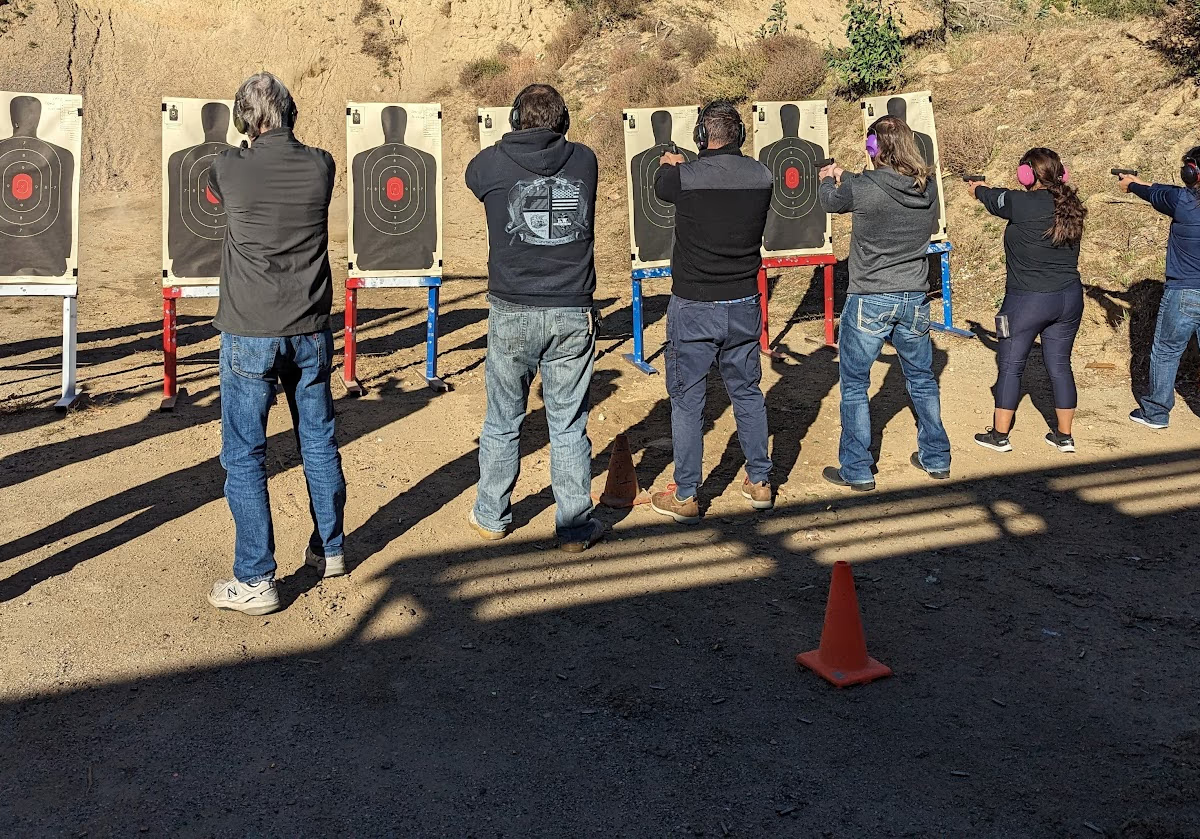
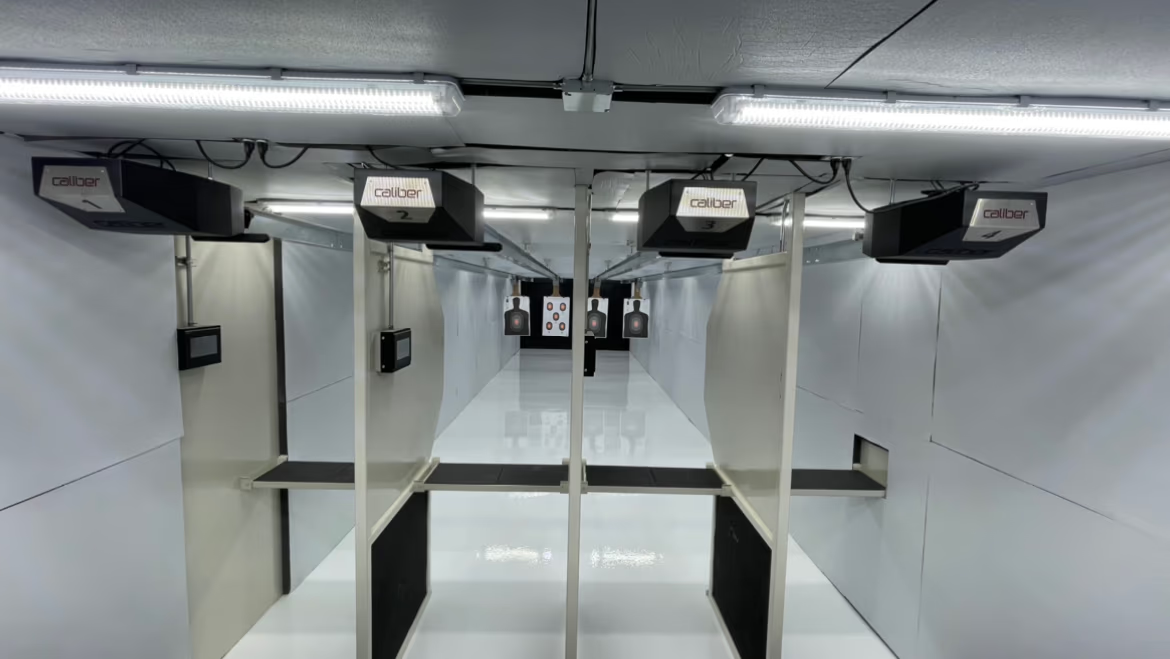
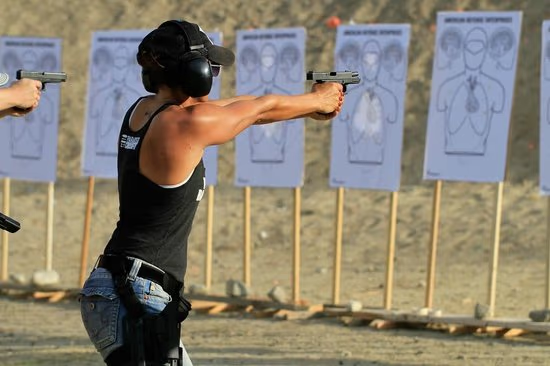
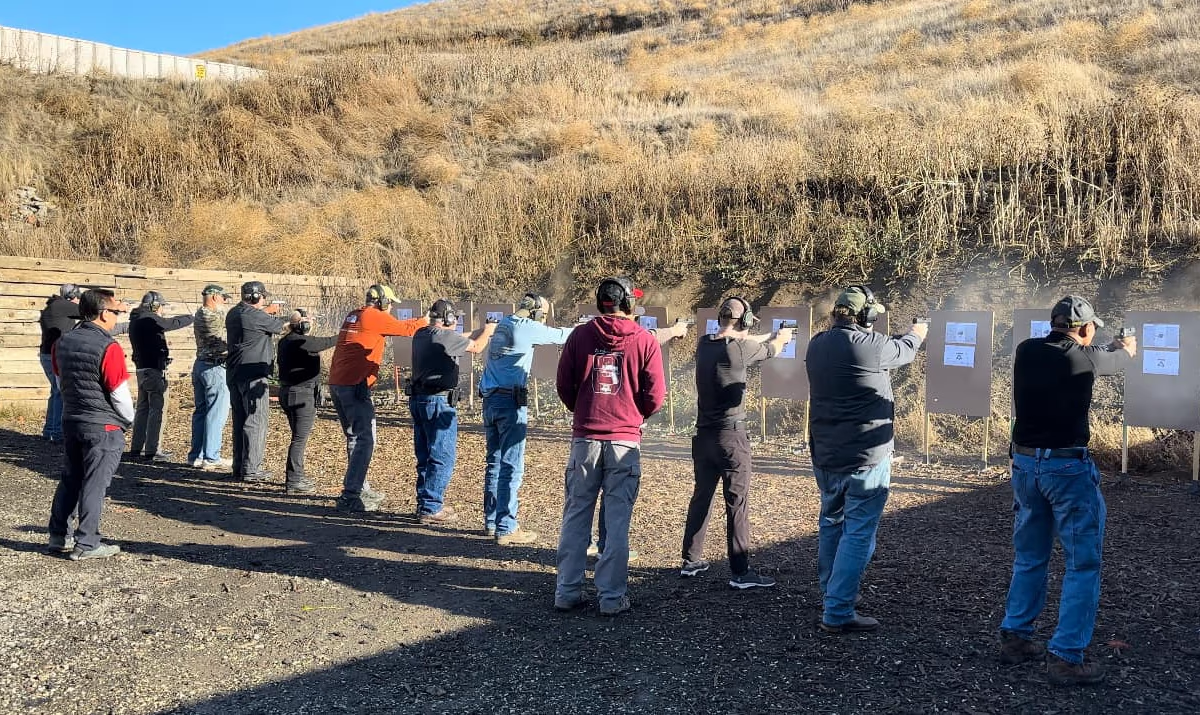
After the authority determines you are not a disqualified person, complete the 16-hour DOJ-certified-instructor course including the one-hour mental health component, pass the written exam, and complete live-fire proficiency on a range with each firearm you want listed. You may not be charged for training before that determination is made.
Ensure each handgun to be listed is recorded to you in the DOJ Automated Firearms System (residents, § 26150(a)(5)); non-residents instead list make, model, caliber, and serial number of each firearm on the application.
Await written notice of approval or denial — due within 120 days of the completed application or 30 days after DOJ returns the eligibility check, whichever is later (Pen. Code § 26205(a)(1)). A denial must state which requirement was not satisfied.
Pay the balance of the local fee plus the DOJ fee ($93 for a standard license) on approval and receive the uniform statewide CCW license (BOF 4501, Rev. 09/2026).
RENEWAL (rules now in force): apply before expiration and complete the 8-hour renewal course. Since September 1, 2026 a renewal applicant must submit fingerprints by Live Scan (BCIA 8016) — or FD-258 for non-residents — and the authority may not issue the renewal until DOJ confirms eligibility (Pen. Code § 26185(b)(2), (c)(3)); the DOJ renewal fee for a standard license is $93. Decisions on renewals filed on or after September 1, 2026 are due within 120 days or 30 days after the DOJ eligibility information, whichever is later (§ 26205(a)(3)). Failing to apply within 90 days after expiration requires the authority to have DOJ terminate subsequent-notification service (Pen. Code § 26225(e)).
Determined 'reasonably likely to be a danger to self, others, or the community at large' based on the application, investigation, or psychological assessment (Pen. Code § 26202(a)(1))
Conviction for contempt of court under Pen. Code § 166, or under any federal law or the law of any other state containing comparable elements (out-of-state/federal equivalents added by AB 1078)
Subject to a restraining, protective, or other comparable court order (California, federal, or other state), including Criminal Protective Orders, Domestic Violence Restraining Orders, Civil Harassment Restraining Orders and Gun Violence Restraining Orders. This does not disqualify if (1) the order expired, was vacated or was otherwise canceled more than five years before the authority received the completed application, or (2) the order expired/was vacated/was canceled and the applicant did not receive notice and an opportunity to be heard before it was issued. Licensing authorities must nonetheless review the California Restraining and Protective Order System (CARPOS) via CLETS as part of the disqualified-person investigation
Conviction within the preceding 10 years of an offense listed in Pen. Code §§ 422.6, 422.7, 422.75, or 29805, or of a federal or other-state offense with comparable elements
Unlawful or reckless use, display, or brandishing of a firearm
Charge within the preceding 10 years under Pen. Code §§ 290, 667.5, 1192.7, 1192.8, or 29805 (or comparable federal/other-state law) that was dismissed pursuant to a plea or dismissed with a People v. Harvey waiver
Incarcerated, on probation, or on parole within the preceding 5 years for a controlled-substance or alcohol-related conviction
An 'unlawful user of or addicted to any controlled substance' under 18 U.S.C. § 922(g)(3) (Pen. Code § 26202(a)(8), added by AB 1078). ATF's interim final rule of January 22, 2026 revised that definition at 27 C.F.R. § 478.11, effective the same day; DOJ also directs licensing authorities to United States v. Hemani, No. 24-1234 (U.S. June 18, 2026). Such a determination must be reported by the licensing authority to the NICS Index within 5 days on form BOF 1032 (Rev. 03/2026) with supporting documentation (Pen. Code § 26202(f))
Currently abusing controlled substances or alcohol to the point of having lost the power of self-control (Pen. Code § 26202(a)(9); AB 1078 added a statutory definition of 'abusing')
Loss or theft of multiple firearms within the preceding 10 years due to non-compliance with storage/security requirements
Failure to report the loss or theft of a firearm as required by Pen. Code § 25250
Prohibited from possessing, receiving, owning, or purchasing a firearm under any state or federal law, per the DOJ eligibility check (Pen. Code § 26195)
Knowingly providing inaccurate or incomplete information on a new, renewal, or amendment application (Pen. Code § 26195) — this is a mandatory ground for both denial and revocation
Failure to inform the issuing licensing authority of any restraining order, arrest, charge, or conviction of a crime referenced in Pen. Code § 26202 (mandatory denial and revocation ground added by AB 1078)
Not the DOJ-recorded owner of the firearm(s) to be listed on the license (Pen. Code § 26150(a)(5)); non-residents must instead list make, model, caliber and serial number, and identification of a firearm that cannot lawfully be carried or possessed in California is cause for denial as to that firearm
Failure to satisfy the § 26202(b) investigation: in-person or virtual (video and audio) interview, three character references, and review of publicly available statements
Where to get the required training
California does not publish a central list of certified instructors. Confirm directly
with County sheriff (Pen. Code § 26150) or the chief of a municipal police department (Pen. Code § 26155). The California DOJ Bureau of Firearms prescribes the standard application form (BOF 4012), the non-resident supplement (BOF 4013) and the uniform license (BOF 4501, Rev. 09/2026, which now includes non-resident standard and judicial license types) and runs the background check, but the DOJ does NOT issue CCW licenses. The DOJ CCW FAQ states: "County sheriffs and police departments are the licensing authorities responsible for issuing CCWs, not the DOJ." that a course will be accepted before you pay for it.
Training providers in California
Businesses in our directory that offer firearms training. These are
not state-verified as certified permit instructors —
check against the official list above, or ask the provider directly.
California recognizes no out-of-state carry permits. A permit from another state does not authorize you to carry here. California does, however, issue its own license to non-residents — see the application details above.
25 jurisdictions honor a California permit
Derived from what each of those states officially publishes.
Building a firearm for personal use is legal in California but heavily conditioned. (1) VOLUME CAP: Pen. Code § 29010(a) — 'A person shall not manufacture more than three firearms within this state in a calendar year unless that person is licensed' under § 29030 et seq.; violation is a misdemeanor. (2) SERIAL NUMBER REQUIRED IN ADVANCE: Pen. Code § 29180 (as amended by AB 1621, Stats. 2022, ch. 76, § 22, eff. 6/30/2022) requires that BEFORE manufacturing or assembling a firearm lacking a valid state or federal serial number, the person must apply to and obtain a unique serial number from the DOJ under § 29182, engrave or permanently affix it within 10 days of assembly in compliance with federal ATF marking standards, and then notify the DOJ that marking is complete with owner and firearm identifying information — which enters the firearm in the state's Automated Firearms System, so a self-made firearm IS state-registered in California. (3) ELIGIBILITY GATE: § 29182 requires a § 28220 firearms eligibility check, age 21+, a valid Firearm Safety Certificate, and a description of the firearm; DOJ must DENY if the firearm would be an unsafe handgun, assault weapon, machinegun, .50 BMG rifle, destructive device, short-barreled rifle or shotgun, unconventional pistol, or otherwise unlawful. DOJ must grant or deny within 90 calendar days for applications received on or after 1/1/2024. (4) DETECTABILITY: a largely polymer firearm must have 3.7 ounces of 17-4 PH stainless steel embedded during construction. (5) NO SALE: an unlicensed person may not sell or transfer a self-assembled firearm (narrow law-enforcement exception). (6) Prohibited persons may not manufacture at all. (7) LEGACY: anyone already owning an unserialized firearm had to comply by January 1, 2024, or within 60 days of moving to California. (8) NEW FOR 2026 — AB 1263 (Stats. 2025, ch. 636), effective 1/1/2026, creates a new misdemeanor for knowingly or willfully causing another person to engage in the unlawful manufacture of firearms, or aiding, abetting, promoting or facilitating it; it also adds a 10-year firearm prohibition on conviction (on or after 1/1/2026) of specified offenses including manufacturing an undetectable firearm, unlawfully selling unserialized firearms, and 'unlawful use or sale of a three-dimensional printer or CNC milling machine which has the sole or primary function of manufacturing firearms,' and it tightens the Firearm Industry Responsibility Act's rules on sales of firearm accessories, 'firearm manufacturing machines' and unattached barrels and on distribution of digital firearm manufacturing code (DOJ Information Bulletin 2026-DLE-02, 01/30/2026). PENALTIES under § 29180: up to 1 year in county jail and/or $1,000 fine for a handgun; up to 6 months and/or $1,000 for other firearms; each firearm is a separate offense.
TOTAL COST IS NOT A STATEWIDE NUMBER. The $93 DOJ figure is now taken directly from the California DOJ's own fee table in Information Bulletin 2026-DLE-14 (08/31/2026), not inferred from county schedules, so the state portion is solid. The local portion is set independently by 58 counties and hundreds of cities and ranges at least from about $40 (El Dorado) and $100 (Placer: $20 filing plus $80 on approval) to $300 (Orange County). Check the specific licensing authority before relying on any total. I still could not read the underlying fee regulation, Cal. Code Regs. tit. 11, § 4147, because govt.westlaw.com is not fetchable from this environment.
LICENSE TERM IS MID-CHANGE. As of today (September 15, 2026) Pen. Code § 26220 as displayed on leginfo still reads 'not to exceed two years,' and its stated amendment history ends with SB 2 (Stats. 2023, ch. 249). AB 1948 (Stats. 2026, ch. 44), approved and filed June 30, 2026, replaces 'two years' with 'three years'; I read the bill text and it contains no urgency clause and no special operative date, so the ordinary January 1, 2027 effective date should apply. I found no DOJ bulletin confirming that date or stating whether the longer term will apply to licenses issued before it.
SENSITIVE-PLACES LIST SHOULD NOT BE RELIED ON AS PRINTED IN THE CODE. Six subdivisions of Pen. Code § 26230(a) have been enjoined since the December 20, 2023 preliminary injunction in May v. Bonta (C.D. Cal. No. 8:23-cv-01696) and Carralero v. Bonta (No. 8:23-cv-01798), as narrowed by the Ninth Circuit's September 6, 2024 opinion and January 23, 2025 mandate: (a)(7) hospitals and medical facilities, (a)(8) public transit, (a)(10) permitted public gatherings, (a)(22) places of worship, (a)(23) financial institutions, and (a)(26) other privately owned commercial establishments open to the public. The other 20 listed places are enforceable; DOJ Information Bulletin 2025-DLE-06 (03/27/2025) says so expressly and is still the most recent DOJ statement on the subject. On June 25, 2026 the U.S. Supreme Court decided Wolford v. Lopez, No. 24-1046, holding 6-3 that Hawaii's materially identical private-property default rule violates the Second and Fourteenth Amendments; that reinforces the existing injunction as to California's § 26230(a)(26) but does not itself change which California subdivisions are enjoined.
I COULD NOT VERIFY POST-WOLFORD DISTRICT-COURT ACTIVITY FROM A PRIMARY SOURCE. Secondary reporting says the district court lifted its stay in May v. Bonta in mid-July 2026 and reopened proceedings. I could not confirm this: the CourtListener docket returned HTTP 403 and the San Diego County Sheriff's official 'Legal Updates Regarding CCW Licenses' page also returned HTTP 403, so I did not cite either. Nothing I could read indicates that the enjoined/enforceable split above has changed, and DOJ has published no bulletin superseding 2025-DLE-06.
'Shall-issue' is the correct legal classification post-SB 2 (§ 26150 says the authority 'shall issue' to an applicant who is not a disqualified person), but the § 26202(a)(1) 'reasonably likely to be a danger to self, others, or the community at large' standard, the mandatory § 26202(b) investigation, and a discretionary psychological assessment give California licensing authorities materially more judgment than a typical shall-issue state.
PROCESSING TIME reported is the statutory deadline, not observed reality, and the new September 1, 2026 renewal sequence (fingerprints plus DOJ eligibility confirmation before a renewal may issue) is too recent for anyone to have data on its real-world effect. I found no official statewide data on actual issuance times.
California publishes no reciprocity page at all. The 'honors: []' conclusion is inferred from the structure of Pen. Code §§ 25400 and 25655 — I read both in full today and no out-of-state exemption exists anywhere in the exemption chapter — rather than quoted from an affirmative agency statement. The DOJ CCW FAQ says nothing about reciprocity either way. I regard the conclusion as solid but flag the sourcing.
No public roster of DOJ-certified CCW instructors exists — the DOJ FAQ directs applicants to their local sheriff or police department — so instructorRegistryUrl is null by fact, not for lack of searching.
I did not verify each county's specific residency/employment nexus policy, appointment backlog, psychological-assessment practice, or whether particular counties require training beyond the 16-hour statutory floor (many do).
Licensing authorities must enroll in the FBI's Next Generation Identification Noncriminal Justice Rap Back Service by December 31, 2026 (Pen. Code § 11105(u)(4); DOJ IB 2026-DLE-14). DOJ says there is no additional fee for Rap Back, but because enrollment is still rolling out, applicants may encounter inconsistent renewal handling between now and year end.