Arizona allows permitless carry for non-prohibited adults 21+. A CWP (commonly "CCW permit") is still available and is what other states recognize.
Permitless carry is legal in Arizona
A non-prohibited adult aged 21 or older may
carry a concealed handgun without a permit
(since 2010).
NO PERMIT IS NEEDED TO CARRY A CONCEALED FIREARM IN ARIZONA. Every figure elsewhere in this record that describes training, fees, fingerprints, processing time or validity describes the OPTIONAL Arizona Concealed Weapons Permit, not the legal minimum for carrying. A.R.S. section 13-3102(A)(2) makes it misconduct involving weapons to carry a deadly weapon (except a pocket knife) concealed on the person, or concealed within immediate control in or on a means of transportation, only 'if the person is under twenty-one years of age.' A non-prohibited person 21 or older therefore needs no permit, no training and no paperwork to carry concealed anywhere concealed carry is not separately barred. This has been the law since 2010 (S.B. 1108). A violation of (A)(2) is only a class 3 misdemeanor. LIMITS THAT STILL APPLY AT ANY AGE: A.R.S. section 13-3102(A)(1) - carrying concealed in furtherance of a serious offense (section 13-706), a violent crime (section 13-901.03) or any other felony offense, and failing to accurately answer a law enforcement officer who asks whether you are carrying a concealed deadly weapon; section 13-3102(A)(4) - a prohibited possessor may not possess at all; section 13-3102(A)(10)-(A)(13) - public establishments and events after a request to disarm, election polling places on election day, school grounds, and nuclear or hydroelectric generating stations. EXCEPTIONS TO THE UNDER-21 BAN: section 13-3102(B) exempts a person in their own dwelling, on their own business premises, or on real property owned or leased by them or their parent, grandparent or legal guardian; an authorized sheriff's posse or reserve member under section 11-441; and any firearm carried openly or in a partially or wholly visible holster, scabbard or case, in luggage, or in a case, holster, scabbard, pack or luggage carried within a vehicle or in a vehicle's storage compartment, map pocket, trunk or glove compartment. So an 18-20 year old may carry openly or in a vehicle compartment, just not concealed on the person. OUT-OF-STATE PERMIT HOLDERS UNDER 21: A.R.S. section 13-3112(S) is explicit that a person with an out-of-state concealed weapons permit may NOT carry concealed in Arizona if under 21, or if under indictment for or convicted of a felony that has not been expunged, set aside or vacated or for which rights have not been restored. WHY PEOPLE STILL GET THE PERMIT: other states' reciprocity, the 19-20 military age band under section 13-3112(E)(2), and the federal NICS-alternative exception - the ATF Brady Permit Chart lists the Arizona 'Conceal Carry Permit' as qualifying, so a dealer may accept a current permit in place of a background check on a purchase in Arizona (18 U.S.C. section 922(t)(3)). A permit is also a state license for the federal Gun-Free School Zones Act exception in 18 U.S.C. section 922(q)(2)(B)(ii), which applies only to a license issued by the state where the school zone sits; note that Arizona law itself still bars deadly weapons on school grounds under section 13-3102(A)(12), and a CCW permit is not one of the section 13-3102(I) exceptions.
Getting the permit anyway is still worth it for most people: other states recognize
the permit, not your residency, so without one you generally cannot carry
across state lines.
A.R.S. § 13-3102(A)(2)
There are 9 details on this page we
could not confirm from a primary source.
Read what they are
before relying on this.
Requirements at a glance
Permit name
Concealed Weapons Permit
Issuing authority
Arizona Department of Public Safety - Concealed Weapons Permit Unit (AZ DPS CWPU)
System
shall-issue
Minimum age
21 — 21 for the standard resident permit. A.R.S. section 13-3112(E)(2) also qualifies an applicant who is at least nineteen years of age and provides evidence of current military service or proof of honorable discharge or general discharge under honorable conditions from the United States armed forces, the United States armed forces reserve or a state national guard (typically a DD Form 214). PERMITLESS concealed carry is 21+ with no military exception, and A.R.S. section 13-3112(S) bars an under-21 holder of an out-of-state permit from carrying concealed in Arizona. An 18-20 year old may still carry openly or in a vehicle compartment under the section 13-3102(B) exceptions.
Training required
Yes
State fee
$60 initial / $43 renewal — the state's own charge, not the total
Valid for
5 years
Processing time
AZDPS asks applicants to allow 75 days for the Concealed Weapons Permit Unit to process a new application. RENEWAL WINDOW (this is a window, not a deadline): a renewal must be submitted NO MORE THAN 90 days before and NO MORE THAN 60 days after the expiry date. Submitted earlier than 90 days before expiry, the application is returned; received 61 or more days after expiry, the holder must file a full NEW application packet instead. DPS mails a Notice of Renewal 60 days before expiry. A service member on federal active duty deployed overseas when the permit expires may renew within 90 days after the deployment ends, with evidence of the deployment. Statutory checks: DPS must complete all qualification checks within 60 days of receiving the application and issue within 15 working days after that (A.R.S. section 13-3112(H)); a denial must be explained in writing within 15 working days, the applicant then has 20 days to submit more documentation, and DPS has 20 days to reconsider, with a hearing available under Title 41, Ch. 6, Art. 10.
Fingerprints
Required
Non-resident permit
Available
What it actually costs
The state fee is rarely the whole bill. Fingerprinting is usually charged by a private
vendor, training is bought from an instructor, and several states add photographs,
notarisation or other requirements on top.
State fee
$60
Fingerprinting
$15–$45 — our estimate; no vendor publishes a rate
Training course
$75–$250 (private instructor)
Realistic total
$150–$355 — includes an estimated component
A.R.S. section 13-3112(F) authorises only 'a reasonable fee determined by the director', so the $60 comes from the DPS fee schedule rather than the statute and can be changed administratively; note that the codified rule, A.A.C. R13-9-102(A)(1), still says $43 for a new permit, while the DPS fee page and form DPS 802-07202 Rev. 07/2026 both say $60 - the forms and the fee page are what DPS actually collects. Fingerprinting and training are separate third-party costs, and the fingerprint figure above is our estimate rather than a published rate. Arizona sets no hour count and requires no live fire - A.R.S. section 13-3112(N) is a menu of eight routes, and the Administrative Code article that once regulated training organisations and instructors (A.A.C. 13 Ch. 9, Art. 3) is entirely repealed or expired. A hunter-education, military-service or qualifying-out-of-state-permit route through the menu costs nothing, which would take the real low end down to about $75. Fees are non-refundable unless A.R.S. section 41-1077 applies. And none of this is needed in order to carry: at 21 or older, permitless carry costs $0.
New permit $60.00; renewal $43.00; replacement card or profile change $10.00; LEOSA certificate of firearms proficiency $20.00; LEOSA instructor certification and CCW permit self-surrender are free. AZDPS states payment must be a cashier's check, certified check, money order, or credit card if applying online or in person; personal checks, business checks and cash are NOT accepted and a paper application tendered with them is returned unprocessed. Fingerprinting and the training course are separate third-party costs not included above. A.R.S. section 13-3112(F) authorises only 'a reasonable fee determined by the director', so these amounts come from the DPS fee schedule and can change administratively. TWO LIVE CONFLICTS WITH THE CODIFIED RULE, both resolved in favour of the DPS schedule and the current forms: A.A.C. R13-9-102(A)(1) still sets a new-permit fee of $43, not $60, and R13-9-102(C) still says the Department does not accept credit cards. The published DPS fee page and the 07/2026 application forms are the operative figures ($60 new, $43 renewal), and the forms themselves demand $60. Fees are non-refundable unless A.R.S. section 41-1077 applies (R13-9-102(C)).
How to apply
FIRST, CHECK WHETHER YOU NEED A PERMIT AT ALL. Arizona has had permitless concealed carry since 2010: under A.R.S. section 13-3102(A)(2) it is an offence to carry a concealed deadly weapon only if you are under twenty-one, so a non-prohibited person 21 or older may carry concealed in Arizona with no permit, no training and no application. Apply only if you want the document - for other states' reciprocity, for the 19-20 military age band, or to use the permit as a NICS alternative when buying a firearm in Arizona.
Confirm eligibility under A.R.S. section 13-3112(E) and A.A.C. R13-9-201: Arizona resident or U.S. citizen; 21 or older, or at least 19 with evidence of current military service or an honorable or general-under-honorable-conditions discharge; not under felony indictment; no unexpunged felony conviction; no mental illness, incompetency adjudication or commitment; lawfully present; and not currently a prohibited possessor under A.R.S. section 13-3101(A)(7) or 18 U.S.C. section 922(g). A non-citizen must be an Arizona resident - conditional residents do not qualify.
Satisfy the firearms-competence requirement by ANY ONE route in A.R.S. section 13-3112(N): a DPS-approved or NRA-instructor-taught safety course; Arizona Game and Fish (or another state's) hunter education; any NRA firearms safety or training course; a DPS-approved law enforcement or security firearms course; current or prior honorable military service; a valid current OR EXPIRED out-of-state permit that required training or testing for initial issuance; a governmental police agency firearms course with duty qualification; or any course run by a DPS-approved or NRA-certified instructor. There is no minimum hour count and no live-fire requirement in the statute or in any DPS rule. NRA ONLINE-ONLY courses are not accepted.
Collect the 'adequate documentation' A.R.S. section 13-3112(E)(6) requires: a current or expired Arizona DPS permit; a certificate, card or document of completion, or an instructor, school, club or organisation affidavit; a DD-214, basic-training certificate or other proof of military service; or a copy of the qualifying out-of-state permit. Copies are accepted - do not mail originals, they are not returned.
Gather proof of identity: a government-issued photo ID such as a driver licence, state ID card or passport. If you were born outside the U.S. or its territories, add a certificate of naturalization, a record of birth abroad to an American citizen, a record of birth to armed service personnel, or a current U.S. passport. If you are not a U.S. citizen, add the front and back of your permanent resident alien card (or Form I-94 or other federal authorising document, with a visible 'A' number valid for the whole permit term) plus proof of Arizona residency under A.R.S. section 28-2001 - an Arizona driver licence or ID card matching your application address, or two documents from separate businesses or agencies showing your legal name and physical street address (no PO box).
Get fingerprinted. A.R.S. section 13-3112(F) and A.A.C. R13-9-202(2)(c) require TWO full sets of classifiable fingerprints taken by a qualified technician, with every box on the card completed; do not bend or fold the cards. If you apply online, DPS routes you to schedule an appointment at a FieldPrint kiosk after you submit; otherwise use your local police department, sheriff's office or a commercial fingerprint service. Renewals require no new fingerprints (A.R.S. section 13-3112(K)).
ROUTE A - ONLINE: apply through the DPS portal at https://azdpsccw.permitium.com/entry (new-permit entry point: https://azdpsccw.permitium.com/ccw/application?permittype=new), upload your training documentation and identity documents, pay the $60 fee by credit card, and schedule your FieldPrint fingerprint appointment.
ROUTE B - PAPER: complete form DPS 802-07202 (Rev. 07/2026) in black ink, or fill the PDF and print it, answer all twelve screening questions, attest under penalty of perjury that you have read A.R.S. Title 13, Chapters 4 and 31, and name the provider of your firearms safety course. Mail the packet - application, supporting documents, two fingerprint cards and a $60 money order, cashier's check or certified check payable to AZ DPS with your name written on it - to AZ DPS CWPU, PO Box 6488, Mail Drop 3170, Phoenix, AZ 85005. NO personal checks, business checks or cash: the packet will be returned unprocessed. Incomplete or incorrect applications are returned.
DPS runs the state and federal criminal history record check under A.R.S. section 41-1750 and may exchange fingerprint data with the FBI. Statutorily DPS must finish all qualification checks within 60 days and issue within 15 working days after that; in practice DPS asks you to allow 75 days.
If the application is denied, DPS must tell you in writing with reasons within 15 working days of completing the checks. You then have 20 days to submit additional documentation, DPS has 20 days to reconsider and report the result, and if still denied you may request a hearing under A.R.S. Title 41, Chapter 6, Article 10.
The permit is valid five years (A.R.S. section 13-3112(I)). To renew, file form DPS 802-07201 (Rev. 07/2026) with the $43 fee and a copy of your current permit within the window in A.A.C. R13-9-204(B): NO MORE THAN 90 days before and no more than 60 days after the expiry date. Filed earlier than 90 days out it is returned; received 61 or more days after expiry you must file a full new application instead. DPS mails a renewal reminder 60 days before expiry. No new training and no new fingerprints are required. A member of the armed forces, Arizona National Guard or reserves on federal active duty and deployed overseas at expiry may renew within 90 days after the deployment ends, with evidence of the deployment.
Obligations once issued: you must carry the permit and present it to a law enforcement officer on request whenever you are in actual possession of the concealed weapon and section 4-229 or section 4-244 requires carrying it, or face a civil penalty of up to $300 and immediate suspension (A.R.S. section 13-3112(C)). A replacement card or a profile change costs $10, and self-surrendering the permit is free.
Under 21 years of age - and the 19-20 military route (current service, or honorable / general-under-honorable-conditions discharge) is the only exception - A.R.S. section 13-3112(E)(2)
Neither a resident of Arizona nor a United States citizen - A.R.S. section 13-3112(E)(1). A non-citizen applicant must be an Arizona resident, must document lawful status (permanent resident alien card front and back, USCIS Form I-94, or other federally issued authorising document with a visible 'A' number valid for the whole permit term) and must prove Arizona residency as defined by A.R.S. section 28-2001; CONDITIONAL RESIDENTS DO NOT QUALIFY (form DPS 802-07202 Rev. 07/2026)
Unlawfully present in the United States - A.R.S. section 13-3112(E)(5)
Under indictment for a felony offense in any jurisdiction - A.R.S. section 13-3112(E)(3)
Convicted of a felony in any jurisdiction, unless the conviction was expunged, set aside or vacated or the applicant's rights have been restored AND the applicant is currently not a prohibited possessor under state or federal law - A.R.S. section 13-3112(E)(3); court documentation required
Adjudicated delinquent for a felony, unless firearm rights have been restored; court documentation required (form DPS 802-07202 Rev. 07/2026, question 6)
Suffers from mental illness, or has been adjudicated mentally incompetent or committed to a mental institution - A.R.S. section 13-3112(E)(4). (The broader 'danger to self or others', 'persistently or acutely disabled' and 'gravely disabled' language sits in the prohibited-possessor definition at A.R.S. section 13-3101(A)(7)(a), not in section 13-3112(E)(4) itself)
A prohibited possessor under A.R.S. section 13-3101(A)(7) - which includes a person found to constitute a danger to self or others or to be persistently or acutely disabled or gravely disabled whose right to possess has not been restored, a convicted felon whose civil rights have not been restored, a person serving a term of imprisonment or on probation for a domestic violence or felony offence or on parole, community supervision, work furlough, home arrest or other release from confinement, an undocumented or non-immigrant alien (with exceptions), and a person found incompetent or guilty except insane - A.A.C. R13-9-201 also requires that the applicant not currently be a prohibited possessor
Prohibited from possessing or receiving a firearm under 18 U.S.C. section 922(g) - A.A.C. R13-9-201
Under indictment for a misdemeanor crime of domestic violence (form DPS 802-07202 Rev. 07/2026, question 9)
Convicted of a misdemeanor crime of domestic violence, unless the conviction was set aside, vacated, expunged or pardoned; court documentation required (form question 10; federal bar at 18 U.S.C. section 922(g)(9))
Subject to a qualifying court order of protection or restraining order (18 U.S.C. section 922(g)(8))
Discharged from the United States armed forces under dishonorable conditions (form question 11; 18 U.S.C. section 922(g)(6))
Renounced United States citizenship (18 U.S.C. section 922(g)(7))
An unlawful user of or addicted to a controlled substance - the current form asks separately about compulsive use with impaired control (question 7) and about regular extended use without a lawful prescription or substantially outside one (question 8). DPS adds an express notice that marijuana remains a federally controlled substance but that a 'yes' answer does not by itself establish a prohibition or automatically result in denial, and that DPS may request more information
PERMIT-HOLDER GROUNDS FOR LOSS: the permit is immediately suspended and seized on arrest or indictment for an offence that would make the holder unqualified, and revoked on conviction; it is restored on court or county-attorney documentation of acquittal or dismissal - A.R.S. section 13-3112(B). DPS must suspend or revoke whenever a holder becomes ineligible under subsection (E) - section 13-3112(M), A.A.C. R13-9-601
SEPARATE FROM ELIGIBILITY - an out-of-state permit is not honoured in Arizona if the holder is under 21, or is under indictment for or convicted of an unexpunged felony - A.R.S. section 13-3112(S)
Where to get the required training
Arizona does not publish a central list of certified instructors. Confirm directly
with Arizona Department of Public Safety - Concealed Weapons Permit Unit (AZ DPS CWPU) that a course will be accepted before you pay for it.
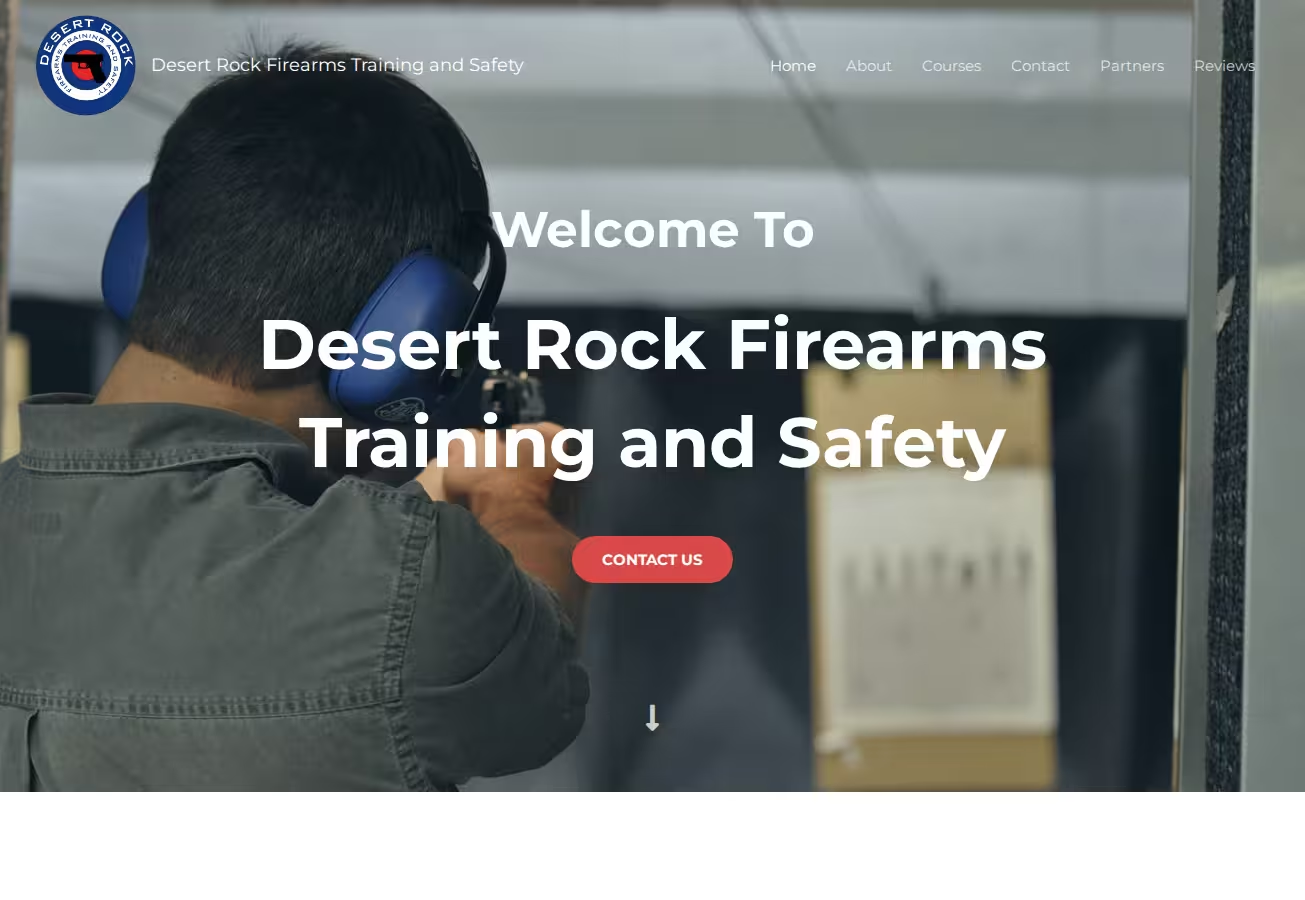
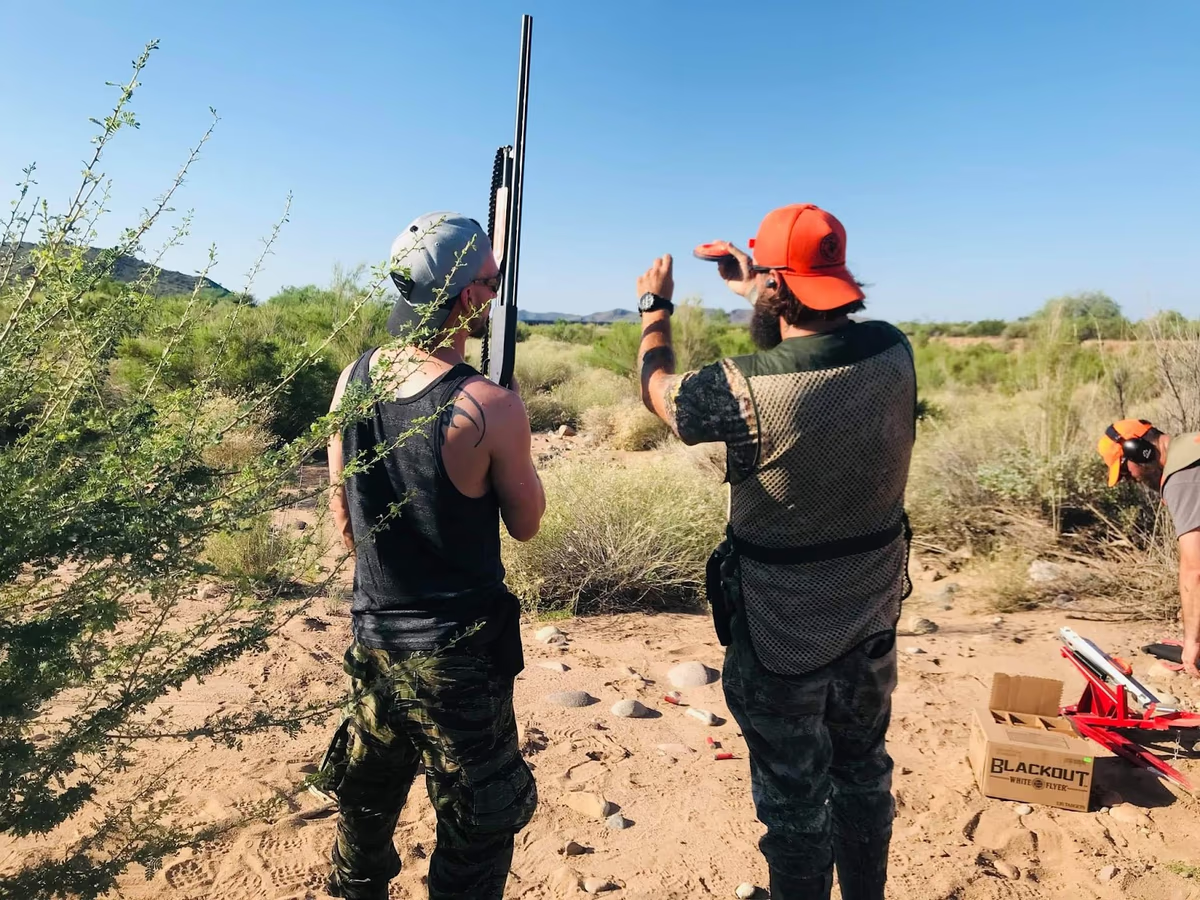
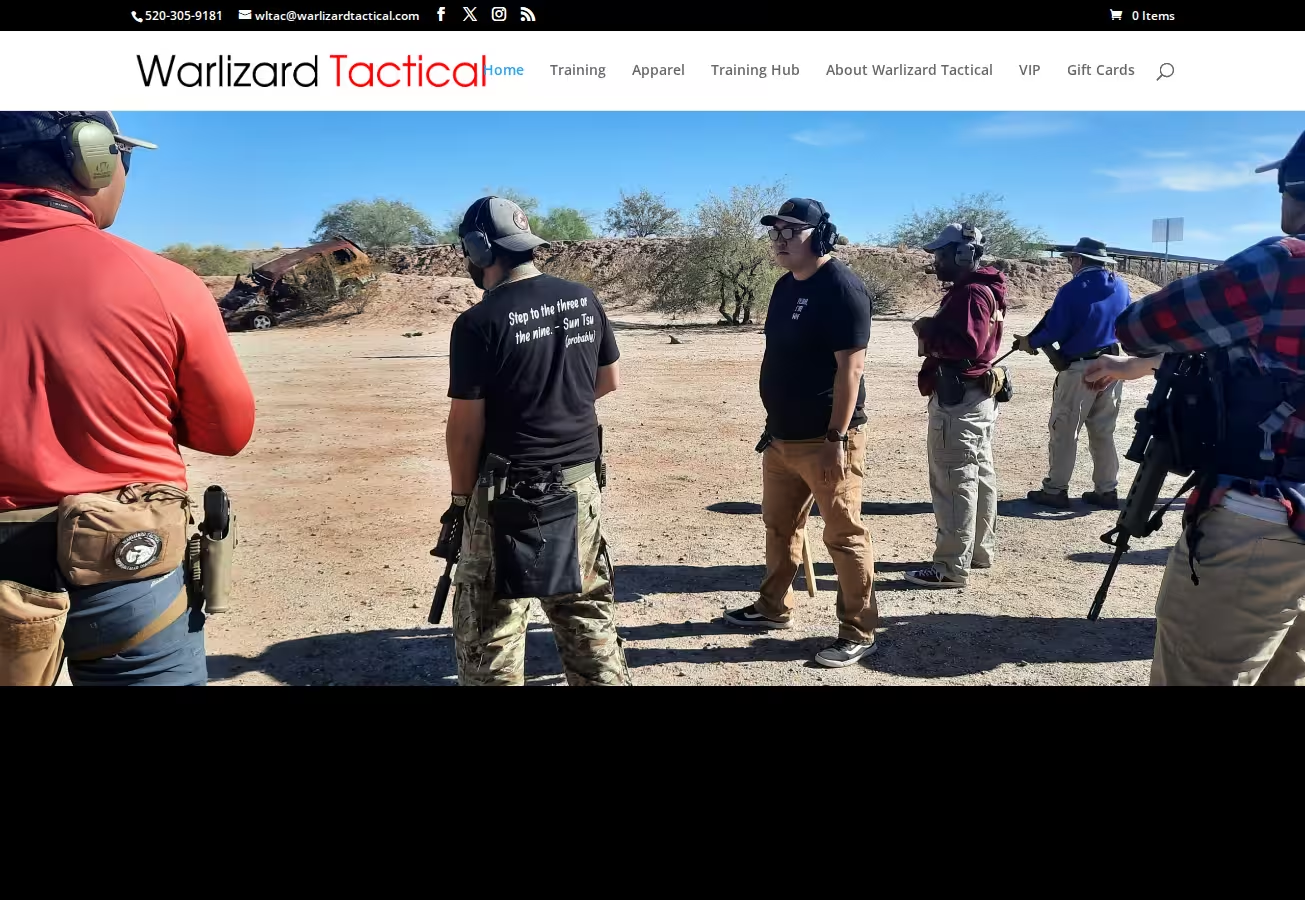
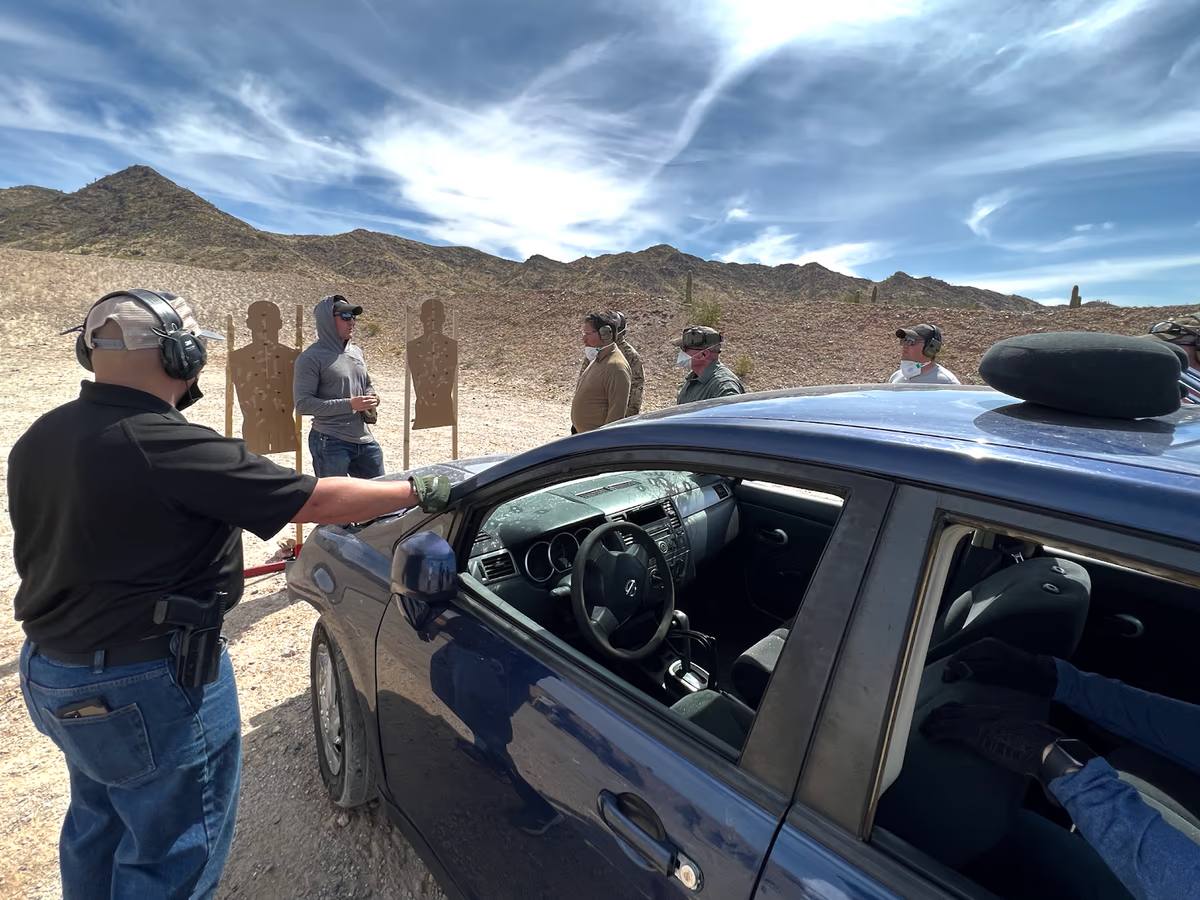
Training providers in Arizona
Businesses in our directory that offer firearms training. These are
not state-verified as certified permit instructors —
check against the official list above, or ask the provider directly.
Arizona has no state statute prohibiting a non-prohibited person from manufacturing a firearm for personal use, and no state firearm registration of any kind - A.R.S. § 13-3108 preempts political subdivisions from requiring firearm registration or licensing. No Arizona statute requires a serial number on a firearm built for your own use. The one marking provision, A.R.S. § 13-3114(E), applies only to guns manufactured AND SOLD in-state under that section: 'A firearm that is manufactured and sold in this state pursuant to this section shall have the words "made in Arizona" clearly stamped on a central metallic part such as the receiver or frame.' A personal-use build that is never sold falls outside it. A.R.S. § 13-3114 (the 2010 Arizona Firearms Freedom Act) also purports to exempt Arizona-made, Arizona-retained firearms from federal regulation; courts rejected identical Firearms Freedom Acts elsewhere (Montana Shooting Sports Ass'n v. Holder, 9th Cir. 2013), so it is not a defense to federal law. Two real limits: (1) A.R.S. § 13-3102(A)(6) and (A)(7) make it a class 6 felony to DEFACE a deadly weapon or knowingly possess a defaced one - 'deface' is defined in A.R.S. § 13-3101 as removing, altering, or destroying the manufacturer's serial number, so it reaches an obliterated factory serial, not a homemade gun that never bore one. (2) Federal law applies independently: the ATF 'Definition of Frame or Receiver' final rule (2021R-05F) and its marking consequences, the National Firearms Act, and 18 U.S.C. § 922(o) and 922(r); manufacturing for sale requires a federal license.
DC AND U.S. TERRITORIES: A.R.S. section 13-3112(Q) recognizes a permit 'issued by another state or a political subdivision of another state.' The District of Columbia, Puerto Rico, Guam, the U.S. Virgin Islands and the Northern Mariana Islands are arguably not 'another state,' so DC and the territories are excluded from the honors list rather than guessed at. I found no official AZDPS or Attorney General statement resolving whether a DC concealed pistol licence is recognized in Arizona. In practice this rarely matters, because permitless carry covers any non-prohibited adult 21 or older.
NO OFFICIAL CCW INSTRUCTOR REGISTRY: AZDPS publishes a searchable instructor directory only for LEOSA (retired law enforcement) instructors, at /services/public/cwp/instructors, and the eligibility text there concerns AZPOST-certified or NRA instructors for LEOSA qualification. There is no official DPS-published list of approved CCW firearms safety instructors for civilian permit applicants, which is consistent with A.A.C. 13 Ch. 9 Art. 3 - the article that used to regulate training organisations and instructors - being entirely repealed or expired. instructorRegistryUrl is therefore null rather than pointed at the LEOSA list, which would mislead a reader.
TRAINING HOURS AND LIVE FIRE: there is no statutory or administrative minimum. A.R.S. section 13-3112(N) sets none, and every section of A.A.C. Title 13, Ch. 9, Article 3 (R13-9-301 through R13-9-310) is repealed or expired, so no rule sets course hours, content, live fire or instructor approval. training.hours is null and liveFireRequired is false on that basis. Individual DPS-approved courses commonly run about 8 hours and many include live fire, but that is instructor practice and not a legal requirement, so do not treat '8 hours' as a rule.
FEE AMOUNTS ARE SET ADMINISTRATIVELY AND THE CODIFIED RULE IS OUT OF DATE. The $60 new-permit and $43 renewal figures come from the DPS fee schedule and the 07/2026 forms under A.R.S. section 13-3112(F), not from statute, and the director can change them without a legislative amendment. The Administrative Code rule that is supposed to state them, A.A.C. R13-9-102(A)(1), still reads $43 for a new permit, and R13-9-102(C) still says DPS does not accept credit cards - both of which the current DPS page and forms contradict. I resolved the conflict in favour of DPS's published schedule and forms, because those are what DPS collects, but verify the fee on the DPS fees tab before relying on it.
THE ADMINISTRATIVE CODE WAS READ FROM AN ARCHIVE, NOT LIVE. apps.azsos.gov serves a Cloudflare 'Just a moment' challenge to my requests, so A.A.C. Title 13, Ch. 9 was read from an Internet Archive capture dated 6 March 2025 of the Secretary of State PDF. That PDF is Supplement 21-4, covering rules filed through 31 December 2021, and its content hash matches captures from 2022, 2023 and 2024, so the chapter appears not to have been re-published since. A newer supplement could nonetheless exist and could, in principle, have restored a training rule or updated the fee rule. Anyone relying on the training-rule or fee-rule findings should re-check the live PDF at https://apps.azsos.gov/public_services/Title_13/13-09.pdf.
AZLEG.GOV PUBLISHES NO 'CURRENT THROUGH' DATE AND NO AMENDMENT-HISTORY LINE ON ITS A.R.S. PAGES, so the statute pages cannot be dated from their own face. As a cross-check, today's section 13-3112 page is line-for-line identical to the Internet Archive capture of 27 January 2026, and the section 13-3102 page's content hash matches the capture of 11 August 2026.
I COULD NOT COMPLETE A 2025-SESSION CHAPTER SWEEP. I swept all 264 chaptered session laws of the 2026 regular session (57th Legislature, 2nd Regular) and grepped every one of them for sections 13-3101, 13-3102, 13-3108, 13-3112 and 13-3114 by code section rather than by bill title. Partway into the equivalent 2025 sweep azleg.gov began returning HTTP 429 rate-limit responses, and I stopped rather than work from a partial result. The 2025 enactments are reflected in the live statute text I read, so this is a provenance gap rather than a content gap, but I cannot name the bill that produced the current wording of section 13-3112 subsections (A), (E)(6) and (V).
THE 2026 SECTION 13-3102 AMENDMENT TOOK EFFECT THREE DAYS AGO. Laws 2026, Ch. 21 (H.B. 2131) was approved 7 April 2026 with no emergency clause, so it took effect on the 2026 session's general effective date of 12 September 2026 - after the baseline was researched. It did not touch the under-21 concealed carry rule in section 13-3102(A)(2), but it added (A)(16), added a new sentencing subsection N and renumbered the old definitions subsection N as O, so any older citation to 'section 13-3102(N) definitions' now points at the wrong subsection. Two other 2026 bills that would have amended section 13-3112 - S.B. 1053 (concealed weapons permits; fees) and S.B. 1012 (concealed weapons; notice; repeal) - were both vetoed by the Governor on 19 June 2026 and changed nothing.
THE ATF BRADY PERMIT CHART WAS ALSO READ FROM AN ARCHIVE. atf.gov returns 403 to my requests, so the Arizona row ('Conceal Carry Permit - Yes') and the chart's 'Last Reviewed June 4, 2025' line come from an Internet Archive capture dated 12 July 2025. The NICS-alternative exception in 18 U.S.C. section 922(t)(3) also requires the permit to be no more than five years old and issued by the state where the transfer occurs, and an individual FFL may still decline to rely on a permit, so treat this as the general rule rather than a guarantee at the counter.