Alabama allows permitless carry for non-prohibited adults 19+. A CCP is still available and is what other states recognize.
Permitless carry is legal in Alabama
A non-prohibited adult aged 19 or older may
carry a concealed handgun without a permit
(since 2023).
STILL IN FORCE AS OF 15 SEPTEMBER 2026. The 2026 Regular Session saw a serious attempt to repeal permitless carry — SB267 (Sens. Singleton, Coleman-Madison, Stewart, Smitherman, Figures, first read 05-Feb-2026) would have required a permit to carry a pistol in a vehicle or concealed on the person, made violation a crime, and repealed § 13A-11-74.1, with an effective date of OCTOBER 1, 2026. IT DID NOT PASS: its last recorded action is referral to the Senate Judiciary Committee on 05-Feb-2026, and the Legislature adjourned the 2026 Regular Session sine die in April 2026 without acting on it. SB267's own synopsis states the baseline of existing law: "Under existing law, an individual is not required to possess a permit to carry a pistol in this state." CONFIRMED FROM THE OFFICIAL CODE: the Alabama Legislature's own Code of Alabama entry for § 13A-11-73 now reads only "THIS SECTION WAS REPEALED IN THE 2022 REGULAR SESSION BY ACT 2022-133 EFFECTIVE JANUARY 1, 2023." A non-prohibited adult may therefore carry a concealed pistol in Alabama with no permit, no background check and no training. Age floor: no statute states an express permitless-carry age, but Ala. Code § 13A-11-72(b)(1) bars a "minor" from possessing a pistol and Ala. Code § 26-1-1 sets Alabama's age of majority at 19, so 19 is the operative floor (the Jefferson County Sheriff's Office, an issuing agency, states 19, or 18 for active/retired/honorably discharged military and law enforcement). CAVEATS THAT SURVIVE PERMITLESS CARRY: (1) Ala. Code § 13A-11-52 still makes it an offense to carry a pistol on private property not your own or under your control UNLESS you hold a valid permit or have the owner's or legal possessor's consent. (2) Ala. Code § 13A-11-61.2(a)(5)-(6) bars carry inside facilities hosting school/college athletic events and professional athletic events UNLESS you hold a permit issued under § 13A-11-75 or recognized under § 13A-11-85. (3) § 13A-11-61.2(a)(1)-(4) bars carry, permit or not, inside police/sheriff/highway-patrol station buildings, prisons and jails, inpatient psychiatric facilities, courthouses and courthouse annexes, district attorney offices, buildings where a county commission or city council is meeting, and the primary office of any elected official; § 13A-11-61.2(b) adds any building secured by continuously posted guards plus magnetometers, key cards or turnstiles. Violation of § 13A-11-61.2 is a Class C misdemeanor.
Getting the permit anyway is still worth it for most people: other states recognize
the permit, not your residency, so without one you generally cannot carry
across state lines.
Ala. Code § 13A-11-74.1 ("Carrying a Pistol Without a Permit"), added by Act 2022-133 (2022 Reg. Sess.) effective January 1, 2023 — this is the dedicated permitless-carry section. The same Act 2022-133 REPEALED Ala. Code § 13A-11-73 (the former prohibition on carrying a pistol concealed without a permit), also effective January 1, 2023. See also Ala. Code § 13A-11-85(a), whose final sentence reads: "The issuance of a permit to carry a pistol pursuant to Section 13A-11-75 or the recognition of a nonresident license under this section does not impose a general prohibition on the carrying of a pistol without a permit."
There are 15 details on this page we
could not confirm from a primary source.
Read what they are
before relying on this.
Requirements at a glance
Permit name
Concealed Carry Permit (the Code also calls it a "Pistol Permit"; a Lifetime Concealed Carry Permit is the same permit issued for life)
Issuing authority
Sheriff of the applicant's county of residence (all 67 counties). The Alabama Law Enforcement Agency (ALEA) does not issue permits; it maintains the statewide Firearms Prohibited Person (FPP) database that sheriffs must check.
System
shall-issue
Minimum age
19 — Ala. Code § 13A-11-75(a)(1): "An Alabama resident who is 19 years of age or more may apply to the sheriff of his or her county of residence." § 13A-11-75(a)(2) lowers this to 18 for a service member (as defined in § 35-10-70) or a retired or honorably discharged military veteran. Alabama's general age of majority is 19 (§ 26-1-1).
Training required
No
State fee
$125 initial / $125 renewal — the state's own charge, not the total
Valid for
5 years
Processing time
Ala. Code § 13A-11-75(c): the sheriff must approve or deny within 30 days of receiving a completed application. § 13A-11-75(e)(2) requires the secure permit card to be issued immediately upon approval; if a hard card cannot be produced then, a 30-day temporary paper permit is issued and the card mailed within 15 days. In practice many counties issue same-day or within a few business days (Shelby County processes mailed renewals within two business days).
Fingerprints
Not required
Non-resident permit
Not available
What it actually costs
The state fee is rarely the whole bill. Fingerprinting is usually charged by a private
vendor, training is bought from an instructor, and several states add photographs,
notarisation or other requirements on top.
State fee
$125
Fingerprinting
$0
County fee where local law sets one
varies — confirmed sheriff schedules: Jefferson $37.50, Tuscaloosa $100, Mobile and Shelby $125, all for five years
Realistic total
$37.50–$125
Ala. Code § 13A-11-75(f) sets $125 for a five-year permit only where no local law exists: 'the fee for a concealed carry permit for a term of one year or five years shall be the same as currently provided by local law for that county.' No training and no fingerprints are required, so whatever the county charges is the entire bill — which also means the published $125 overstates it in some counties rather than understating it. Service members, veterans, and serving and honorably retired law enforcement officers pay nothing.
Set by Ala. Code § 13A-11-75(f), but LOCAL LAW CONTROLS where one exists: "The fee for a concealed carry permit for a term of one year or five years shall be the same as currently provided by local law for that county." Statutory defaults where no local law exists: $25 for one year, $125 for five years. Lifetime permit: $300 statewide, reduced to $150 if the applicant is 60 or older; if applied for within one year after an existing permit expires, the lifetime fee is reduced by the amount paid for that expired permit. NO FEE AT ALL for a service member, a retired or honorably discharged military veteran, a law enforcement officer (§ 36-30-20), or an honorably retired LEO (§ 36-21-9). Replacement after address change, loss, theft or damage: not to exceed $25. Real-world county spread confirmed on issuing-agency sites: Jefferson County $7.50/1yr and $37.50/5yr (local law); Mobile County $20/1yr, $125/5yr, $300 lifetime, $150 lifetime 60+; Shelby County $20/1yr, $125/5yr; Tuscaloosa County $20/1yr, $100/5yr, $300/$150 lifetime. Check your own county sheriff. PERMIT TERMS AVAILABLE: one year, five years, or lifetime (§ 13A-11-75(a) and (e)(2)a) — the 2-, 3- and 4-year options were eliminated.
How to apply
Confirm you actually need a permit. Since January 1, 2023 a non-prohibited adult may carry concealed in Alabama without one. A permit is still worth holding for: carry on private property not your own without the owner's express consent (§ 13A-11-52), carry at school/college and professional athletic-event facilities (§ 13A-11-61.2(a)(5)-(6)), and reciprocity when traveling out of state.
Apply to the sheriff of YOUR county of residence — there is no statewide application. Only Alabama residents may apply; Alabama issues no non-resident permits.
Choose a term: one year, five years, or lifetime. A lifetime permit requires that you already hold a valid concealed carry permit, and the sheriff may require you to have held one for up to five consecutive years first (§ 13A-11-75(a)(3)).
Complete the county sheriff's application — most counties offer an online start plus an in-person visit — and present a valid Alabama driver's license or state ID.
Pay the county's fee. Service members, retired and honorably discharged veterans, and active or honorably retired law enforcement officers pay nothing (§ 13A-11-75(f)(1)c and (f)(2)c); bring a DD-214, military ID or separation documentation.
The sheriff runs a NICS check, reviews the state Firearms Prohibited Person database and other criminal-history databases; non-citizens also get an ICE Immigration Alien Query (§ 13A-11-75(b)). No fingerprints or training are required by statute.
Receive an approval or a written denial within 30 days. A denial must state the specific reasons, the background-check completion date, and the name and signature of the sheriff whose office ran it.
If denied or revoked, appeal to the district court of your county of residence; the sheriff must prove by clear and convincing evidence that you are prohibited or otherwise should not hold a permit (§ 13A-11-75(j)).
After issuance: report any change of permanent address to the sheriff of your new county within 30 days or the permit becomes subject to revocation, and report a lost or stolen permit within 30 days (§ 13A-11-75(g)). A permit expires automatically if you establish residence in another state (§ 13A-11-75(n)).
Lifetime permit holders are re-screened by the sheriff at least once every five years, at no cost (§ 13A-11-75(h)).
Convicted in Alabama or elsewhere of any felony within the previous five years (Ala. Code § 13A-11-72(a)(1)a)
Convicted in Alabama or elsewhere of three or more felony offenses of any kind at any time, each arising from a different indictment or complaint or a different date of charge (§ 13A-11-72(a)(1)b)
Convicted of committing or attempting a "crime of violence" as defined in § 13A-11-70(3), a misdemeanor offense of domestic violence, or a violent offense under § 12-25-32 (§ 13A-11-72(a)(1)c)
Subject to a valid protection order for domestic abuse (§ 13A-11-72(a)(1)d)
Of unsound mind (§ 13A-11-72(a)(1)e)
A minor (under 19), an habitual drunkard, or a person with a drug addiction — barred from owning or possessing a pistol, a Class A misdemeanour (§ 13A-11-72(b)). The minor bar is qualified ("except under the circumstances provided in this section"): a minor with permission from a non-prohibited parent or legal guardian may possess a pistol while at a hunter-education or firearms safety course, practising at an established range under adult supervision, in organized competition, hunting or fishing under a valid license, on property controlled by a parent, guardian or grandparent, on armed-services or National Guard duty, or travelling by motor vehicle to any of those (§ 13A-11-72(e)-(g)). None of those exceptions authorizes general concealed carry in public.
An alien illegally or unlawfully in the United States, or admitted on a nonimmigrant visa with no 18 U.S.C. § 922(y)(2) exception (§ 13A-11-72(c)); a person unlawfully present in Alabama may not be issued a permit (§ 13A-11-75(b)(3))
Prohibited from possessing a pistol or firearm under any state or federal law (§ 13A-11-75(d)(1))
Found guilty but mentally ill; found not guilty by reason of insanity or mental disease or defect; declared incompetent to stand trial; asserted an insanity defense; or found not guilty only by reason of lack of mental responsibility under the UCMJ (§ 13A-11-75(c)(1)-(5))
Required involuntary inpatient psychiatric treatment, involuntary outpatient treatment based on a finding of imminent danger, or involuntary commitment for any reason including drug use (§ 13A-11-75(c)(6)-(8))
Is or was the subject of a prosecution, commitment or incompetency proceeding that could lead to a firearms prohibition (§ 13A-11-75(c)(9))
Falsified any portion of the permit application (§ 13A-11-75(c)(10); a knowing false statement is a Class C misdemeanor under § 13A-11-75(o))
Causes "justifiable concern for public safety" in the sheriff's judgment (§ 13A-11-75(c)(11)) — the sheriff must clearly articulate the reasoning in the written denial and, on appeal, bears the burden of clear and convincing evidence (§ 13A-11-75(d)(3)b and (j)(1))
Charged with committing or attempting a crime of violence (§ 13A-11-70), a misdemeanor offense of domestic violence (§ 13A-11-72), or a violent offense listed in § 12-25-32(15), and thereafter released pending or during trial — knowing possession or control of a firearm is then a Class C felony (§ 13A-11-72.2, ADDED by Act 2025-— / SB119, 2025 Reg. Sess., effective October 1, 2025). Conviction under this section generally requires that the person first be convicted of the underlying charge or a lesser included offense, unless the defendant waives that requirement (§ 13A-11-72.2(b)).
Where to get the required training
Alabama does not publish a central list of certified instructors. Confirm directly
with Sheriff of the applicant's county of residence (all 67 counties). The Alabama Law Enforcement Agency (ALEA) does not issue permits; it maintains the statewide Firearms Prohibited Person (FPP) database that sheriffs must check. that a course will be accepted before you pay for it.
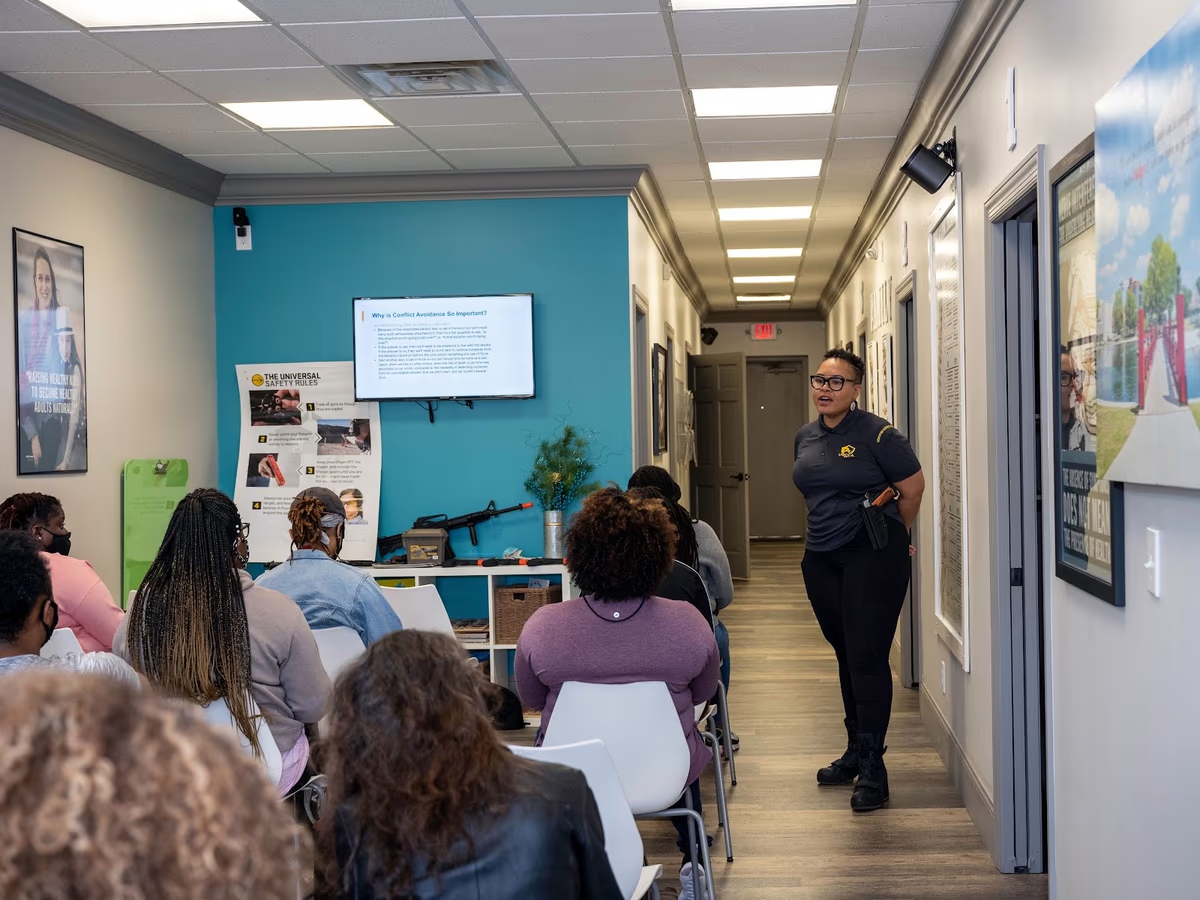
Training providers in Alabama
Businesses in our directory that offer firearms training. These are
not state-verified as certified permit instructors —
check against the official list above, or ask the provider directly.
Alabama law does not prohibit a non-prohibited person from building a firearm for personal use, does not require a serial number on a self-made firearm, and has no state firearm registration of any kind. § 13A-11-64 punishes DEFACING an identification that already exists — it does not obligate you to add one to a firearm that never had one, though a build using a part whose serial was removed would fall squarely within it. Local ordinances cannot fill the gap because § 13A-11-61.3 preempts them and voids any contrary ordinance. FEDERAL LAW IS THE REAL CONSTRAINT: a prohibited person may not make or possess a firearm at all; manufacturing for sale or distribution requires an FFL; commercially sold frames, receivers and parts kits are "firearms" under ATF's 2022 frames-and-receivers rule (upheld in Bondi v. VanDerStok, 2025) and arrive already serialized with a background check; NFA items (short-barreled rifles and shotguns, suppressors, machine guns) require prior federal approval and marking; and 18 U.S.C. § 922(p) bars undetectable firearms. I found no Alabama Attorney General opinion or ALEA guidance interpreting state law on self-manufacture — this conclusion rests on the absence of any such provision in the Code of Alabama.
No Alabama statute addresses privately made or self-manufactured firearms. A full-text search of the official Code of Alabama returns zero hits for "privately made firearm," "unfinished frame," "unserialized" and "undetectable firearm." Adjacent provisions: Ala. Code § 13A-11-64 (Class C felony to change, alter, remove or obliterate the maker, model, manufacturer's number or other identification of any firearm, or to possess, obtain, receive, sell or use a firearm after such identification has been altered or removed); Ala. Code § 13A-11-61.3 (the Legislature preempts the entire field of firearm regulation, voiding any city or county ordinance on the subject); Ala. Code § 13A-11-63 (Class C felony to possess a short-barreled rifle or shotgun in violation of federal law).
The exact permit fee is county-specific. Ala. Code § 13A-11-75(f)(1)a defers to local law where one exists, and confirmed county fees range from $7.50/year (Jefferson) to the $25/year statutory default. I verified only four of Alabama's 67 counties directly; the $125 five-year figure recorded here is the statutory default, not a guarantee for any given county.
Whether Alabama is cleanly "shall-issue" is arguable. § 13A-11-75(c)(11) lets a sheriff deny an applicant who "causes justifiable concern for public safety" — real discretion. It is heavily constrained (written articulated reasons, 30-day deadline, and a clear-and-convincing burden on the sheriff on appeal under § 13A-11-75(j)), so shall-issue is the fair label, but it is not a purely ministerial standard.
No statute sets an explicit minimum age for PERMITLESS carry. I derived 19 from § 13A-11-72(b)(1) (minors may not possess a pistol) plus § 26-1-1 (majority = 19), corroborated by the Jefferson County Sheriff's Office. I found no Attorney General opinion or ALEA rule stating the permitless-carry age directly.
The interaction between § 13A-11-75(a)(2) (an 18-year-old service member or honorably discharged veteran MAY hold a permit) and § 13A-11-72(b)(1) (minors, i.e. under 19, may not possess a pistol) is not expressly reconciled anywhere in the Code. An 18-year-old veteran's permit appears to authorize carry, but I could not confirm that reading from a primary interpretive source.
Fingerprints: § 13A-11-75(b) requires only NICS plus database checks and mentions no fingerprinting, and none of the four county sheriff pages I read mention it, so I recorded false. I did not review all 67 county procedures; § 13A-11-75(e) arguably bars a sheriff from adding conditions, but a local practice cannot be entirely ruled out.
There is no single statewide application form or portal, re-confirmed today: the Alabama Sheriffs Association's own "Pistol Permits" page loads with no substantive content, and ALEA's gun-laws page says only that "a person may apply for a concealed handgun permit to the Sheriff of the county in which they reside." officialApplicationUrl therefore points to ALEA's gun-laws page because ALEA is the state-level firearms authority, not because ALEA accepts applications — applicants must go to their own county sheriff. Madison County's sheriff site previously returned HTTP 403 and was not re-checked this round.
Whether § 13A-11-85(a)'s phrase "any state" reaches the District of Columbia, Puerto Rico, Guam or the U.S. Virgin Islands is not addressed by the statute or by any AG guidance I could locate. Of little practical consequence given permitless carry.
The Alabama Attorney General's reciprocity PDF is current as of May 1, 2026, but it is the outbound list only. Alabama publishes no inbound list because § 13A-11-85(a) recognizes all of them by operation of law.
homeManufacture rests on the ABSENCE of any Alabama statute (verified by full-text search of the official Code), not on an affirmative authorization. No Alabama AG opinion or ALEA guidance on privately made firearms was located, and my attempt to cross-check ATF's "State Laws and Published Ordinances – Alabama" compilation failed because atf.gov blocked the download.
I still could not retrieve the enrolled text of Act 2022-133 itself (the Legislature's document URLs return 404 or do not render). The repeal of § 13A-11-73 and the addition of § 13A-11-74.1 are nonetheless confirmed by two Legislature-published documents: the Code of Alabama entry for § 13A-11-73 reciting the repeal, the act number and the January 1, 2023 effective date, and Section 4 of SB267 (2026), which repeals § 13A-11-74.1 and describes it as "relating to carrying a pistol without a permit."
Permitless carry survived a repeal attempt this session and the margin of safety is thinner than the record alone suggests. SB267 (2026 Reg. Sess.) would have restored a permit requirement effective October 1, 2026 — two weeks after this verification date. It died in the Senate Judiciary Committee (last action 05-Feb-2026; session adjourned sine die in April 2026), so it has no legal effect, but a similar bill in the 2027 session would make this the first field to re-check.
The official Code of Alabama site (alison.legislature.state.al.us/code-of-alabama) is a JavaScript application that does not render section text to a non-browser fetch: every section URL in statuteCitations returns HTTP 200 but serves only the portal's navigation shell. I could not work around it — web.archive.org is blocked to this tool and law.justia.com returned HTTP 403. I therefore verified current statutory text from the Legislature's own bill PDFs, which reproduce the sections as current law: SB267 (2026) for §§ 13A-11-74, 13A-11-75, 13A-11-85 and 13A-11-90, and enrolled SB119 (2025) for § 13A-11-72. The statuteCitations URLs are the correct official ones and resolve in a browser, but a reader using an automated fetcher will see the same shell I did.
Methodological caveat on the statutory text I read: a bill PDF marks deletions with strikethrough and additions with underline, and the text extractor strips both, so amended passages come through with the old and new wording interleaved (e.g. § 13A-11-85(a) extracted as "licensed to carry a handgun pistol in any state shall be authorized to may carry"). Where a figure or phrase appeared with no competing alternative — the $25 / $125 / $300 / $150 fees, "19 years of age or more", "valid for one year or five years" — it is untouched current law and I relied on it. Where wording was interleaved I relied on the un-struck reading plus independent corroboration, not on the extraction alone.
Two issuing-agency pages currently contradict the statute, and the statute controls. (1) Tuscaloosa County's pistol-permit page states that Alabama residents 18 and older may carry without a permit; the 19 floor recorded here rests on § 13A-11-72(b)(1) (minors may not possess a pistol) plus § 26-1-1 (majority = 19), and the Jefferson County Sheriff's Office states 19, or 18 only for active, retired or honorably discharged military and law enforcement. An 18-year-old relying on the Tuscaloosa page would be committing a Class A misdemeanour. (2) Jefferson County's permit page still advertises 2-, 3- and 4-year permit terms ($15.00, $22.50, $30.00) although § 13A-11-75(a)(1) now authorizes only one-year, five-year and lifetime permits. Neither discrepancy changes what the statute requires.
There is still no Attorney General opinion or ALEA rule stating the permitless-carry minimum age directly. The 19 figure is a derivation, corroborated by an issuing agency (Jefferson County) but not by a state-level interpretive source, and Tuscaloosa County's contrary statement shows the derivation is not universally applied at the counter.